Showing posts with label steelhead. Show all posts

Friday, October 14, 2016

Salmon Are In

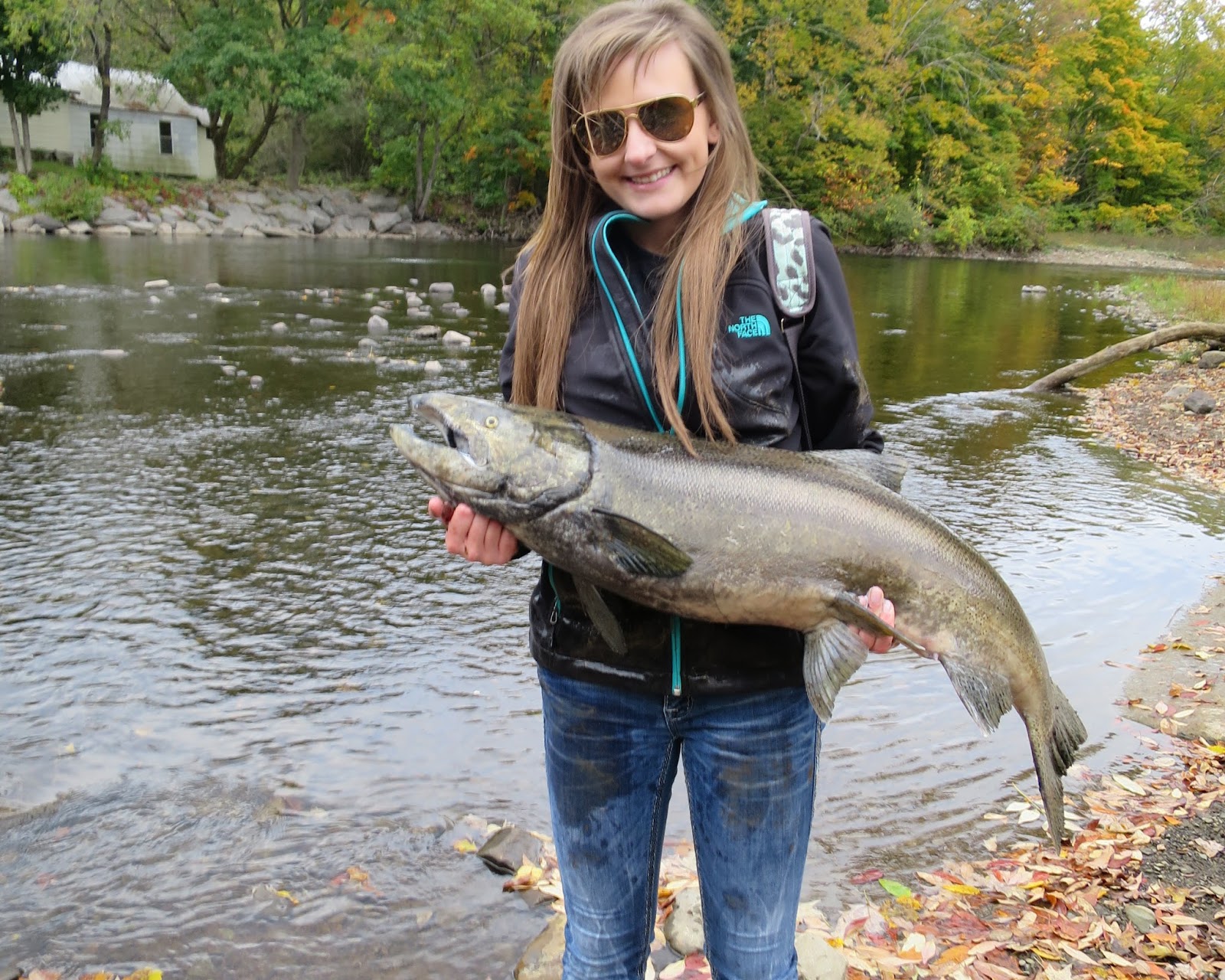
Typical Salmon River King
An old saying goes: The only things that are certain are death and taxes.

Well, that adage is due for revision; around these parts, anyway.

It should claim: The only things that are certain are death, taxes and Pulaski’s salmon run.

Indeed, the river running through this Oswego County village has been on the radar of the world’s most enthusiastic anglers for a couple centuries, now.

Back in the old days the Salmon River was the best stream in the state for trophy landlocked Atlantic salmon--it was named after them, in fact.

It’s still the best spot; only now the fishing is much better.

Atlantics are the first salmon to spawn. Entering the river in summer, they do their thing and beat it back to the lake. Oh sure, late bloomers hold off running until this month, some even wait until November, but their numbers are so few, they don’t draw much attention from anglers. If they’re caught at all, it’s usually incidentally.

Kings and cohoes to the rescue. Pacific salmon don’t start running in significant quantities until mid-September, and when they do, they storm the river in such numbers you could cross it on their backs…If they weren’t so slippery, of course.

While it’s well known Pacific salmon stop feeding when they return to the river to spawn, they will hit a streamer or lure.

Talking heads believe that’s because they’re used to being the biggest kids on the block. Extremely aggressive to begin with, they naturally get meaner in route to the spawning beds, striking out at anything that gets in their way.

The main salmon run stretches through this month, with stragglers showing up into November…even later.

This month the salmon will be joined by trophy brown trout and steelhead.

Decisions... Decisions...

Wednesday, March 26, 2014

Last Chance for Skinny Creek Steelies


By
Spider Rybaak

Little Sandy Creek is starting to emerge from winter's blanket.

Oswego County is steelhead country. Fast water anglers from around the world come up for the rich veins of ironheads running the Salmon and Oswego Rivers autumn through spring. As exciting as tackling a spawn-minded steelie in big rapids is, however, anyone worth his weight in glo-bugs can tell you taking one out of a skinny creek is even more fun and challenging.

Problem is, this winter has been so severe, most slim waters have been entombed in impenetrable ice caps since January. Steelhead ain’t complaining--they like the cover. On the other hand, die-hard creek fans are a little sore. But we’ll have our day… real soon.

You see, all that snow we had this year has gotta melt. When it does, run-off will swell the streams, sending their plumes deep into the lake, their ice caps into next winter. Steelhead cruising the open water cross these warm paths and follow them upstream, into the embrace of ideal spawning habitats.

All this promises to happen from now until mid-April. If the current weather patterns hold, the thaw will be slow and gradual, keeping the creeks at the optimal 40 to 44 degrees Fahrenheit for much of next month.

Some experts feel that this winter is a lot like the ones we had in the 1960s and 70s, and make predictions based on past experience. Fran Verdoliva, the New York State Department of Environmental Conservation’s Special Assistant for the Salmon River, says no matter what the weather does, the near term is going to be a win-win situation.

“If we get a burst of unseasonably warm weather, the thaw will be rapid and the water levels high and muddy, drawing a lot of fish all at once. If the thaw stays moderate like it’s been, the steelhead will run steadily, most likely extending the season for a week or two,” says Verdoliva.

 Regardless of what the weather does, spawn-minded steelhead face a now-or-never situation—they gotta mate soon. Each of Oswego County’s Lake Ontario tributaries will see runs of regular strain steelies for the next few weeks; Salmon River tributaries Trout and Orwell Brooks will likely have them all of April; and the Salmon River itself will boast  ironheads into May, followed by runs of Skamania and Atlantic salmon all summer long.

The Salmon River is still in winter's grip.


Thursday, November 14, 2013

Steelheading without the Leaves


By Spider Rybaak

Nice hen steelie taken on a wooly bugger.

One of the most frustrating things about early steelhead fishing is putting up with fallen leaves; they’re floating on the surface, suspended in the water, carpeting the floor. Come November, they can be so thick, it’s like fishing in a kaleidoscope.

To the uninitiated, that doesn’t sound so bad. After all, kaleidoscopes are entertaining, giving idle hands something to turn, bored eyes symmetrical patterns to feast on.

But fishing is serious business, and the Salmon River ain’t a romper room. If you have to spend half your time clearing leaves off the hook, the other half dodging leaves while trying to present a bait naturally, especially when you’re watching fish shooting the rapids, it can amount to an exercise in frustration, and that can make you grumpy.

So I went up to the Salmon River on Veterans Day to swing some streamers through the rapids with my Spey-casting equipment, conditions permitting.

Much to my delight, the conditions are super. Oh, a few leaves are still blowing into the water. But they’re so few, I only hooked a couple in the hour I fished.

Best of all, I hooked a steelhead weighing about 5 pounds, too, on a chartreuse wooly bugger I swung through the rapids behind a 10-foot Rio Spey VersiLeader, with a sink rate of 2.6 inches per second.

And I wasn’t the only lucky one on the river. A couple guys hooked steelies on beads they were float-fishing with centerpins in the Long Bridge Hole. Another took one in the rapids on an estaz egg he was chuck-n-ducking in the bottleneck, at the curve, about 100 yards upstream.

I was Spey-casting in the pool between the Long Bridge pool and Village pool, a relatively shallow spot with heavy rapids; two features that discourage normal anglers--which normally means there’s fish and room.

You see, most guys fishing the Salmon River think like humans, and concentrate on deep, slow moving pools.

I like to think like a fish. Right now, the water temperature is in the high 40s, and trout are still very active. Since they’re as lazy as I am, they hang out in fast water (they’re streamlined, the current goes effortlessly around them) where eggs float down to them and all they gotta do is open their mouths and suck ‘em in. And if a streamer swims by…well, that’s icing on the cake.

Steelhead are running the river right now in search of easy pickings; which means they can be anywhere…and they’re hungry.

Thursday, May 23, 2013

May Bites


By Spider Rybaak


Scott showing his walleyes as friends Anthony Sokolowski (left, Phoenix) and
Austin Pollmanteer (center, Central Square) cheer.


May sees some dramatic changes in Oswego County’s world class fisheries.  Most notably, steelhead move out of the tributaries-- out of the minds of most anglers-- and are replaced by walleyes: the other fish everyone wants to catch.

Walleyes prefer to spawn in rapids, too. In average situations, they procreate in creeks and peel out for deep water soon afterwards. Not in Oswego County.

You see, our walleyes are spoiled. They have major river systems to court in. Feeling safe in the relatively vast and deep rapids of the Oswego and Oneida Rivers, they aren’t under  any real pressure to beat fins back to the lake immediately afterwards, and stick around in the warm, caressing currents to pig out on all the minnows playing in the whitewater. 

Normally, the action is best the first week or two of the season. This year, however, for reasons varying from late bursts of unseasonably cold weather keeping the streams cool,  to the heavy rains we’ve had recently, the walleyes are extending their stay in the bubbly. 

Three hot spots of note:

Caughdenoy: The plunge pool below the dam has enough walleyes to draw lines of anglers on both sides of the river around dusk. Crankbaits like Smithwick Rogues account for most of the fish.

Phoenix : After years of so-so opportunities, this place is coming back…in spades. By 9 p.m. last Saturday evening (May 18), native son Scott Davie caught two fish about 20 inches long in the rapids on the west bank on a Thunderstick. 

Oswego: Larry Muroski says: “On a scale of 1 to 10, the walleye bite is at 7. The action stretches from the railroad bridge downtown, north to the former Coleman’s Restaurant. Shad Raps and Challenger Minnows are catching most of the fish,” continues the colorful owner of the Oswego Salmon Shop, (315-342-2778). 
But that ain’t all. 

“The dam in Oswego offers an unbelievable smorgasbord right now,” reports Muroski.  “Massive quantities of bluegills, yellow perch, monster rock bass, 15-pound sheepshead , and huge smallmouths are up there.”

[Smallmouth season is closed until June 15, but catch-and-release fishing with artificial lures is permitted: editor]

“Huge channel cats are in the tailrace below the powerhouse,” Muroski adds, suggesting: “still-fish half a shiner on bottom .”

If catfish are the apple in your eye, “The placid water above the dam in Caughdenoy holds trophies,” says Rob Goffredo, owner of Bartel Road Bait and Tackle (315-676-2144), Brewerton’s newest tackle shop. “Fish cutbait on bottom,” he advises.

Bear in mind, the rapids below the dam in Caughdenoy are the Oneida River’s only fast water and draw loads of catfish, too. While trophies are always possible in the plunge pool, most of these guys are spawning age, generally running from 16 to 22 inches, perfect eating size. They’ll take worms and shrimp.

2013’s Free kids Fishing Classes

May’s one of the best times to go fishing—and to teach kids how to fish.

This lesson was brought home last Saturday. Mike McGrath and I conducted our first kids fishing class of the year at Fulton’s Lake Neahtahwanta. 

Owner of McGrath & Associates Carp Angling services, Mike is the East Coast’s foremost expert on these freshwater behemoths. He proved it by landing 20 of the beasts ranging in size from 7 to 20 pounds, raising the eyebrows of all the youngsters and adults at the event.

Back at the gazebo, I was instructing the kids on how to fish with worms and lures, and showing them how to keep the bait out of the reeds and bushes. Roughly 15 showed up, and everyone caught a sunfish or white perch. 

Two more kids fishing classes are scheduled for this summer on Lake Neahtahwanta:

June 8 

July 13

And three are scheduled for the Veterans Memorial, on the west bank, in Oswego :

August 10

September 21

October 19

Sponsored by Berkley, Alvey, Shakespeare, Sampo, Mustad and Marukyu Baits of Japan, the classes are held from 10 a.m. to 1 p.m.
Tackle and bait are provided; or bring you own.

Kids 16 and over must possess a fishing license.
For more information, contact McGrath at 
mmcgrath2@twcny.rr.com ; 315-882-1549; or Spider at srybaak@yahoo.com.
Rob Goffredo, owner of Bartell Rd. Bait & Tackle, Brewerton's newest tackle shop,
fishing with a friend for cats above the Caughdenoy dam.


Fishing for walleyes in Caughdenoy.


Scott Davie unhooking one of his walleyes.
Marshall Kise, McGrath's main man, holding a carp caught by his student Dominick Evans of Weedsport.

Oswego's Carp Master, Mike McGrath, explaining the mysteries of his favorite fish.

Allie Waldron, Hannibal, holding her sunnie.

Ma Holden of Hannibal holdin' one of three pumpkinseeds caught by her daughter.

Wednesday, October 31, 2012

Hot Steelie Action on the Salmon River


By Spider Rybaak

Typical October-run steelie.


Anglers have been catching steelhead in the Salmon River for most of October. Like the stream’s flow, however, they only ran in trickles. 

Until last week’s rains changed everything. As water levels rose, massive quantities of steelhead poured upstream. They were still coming Sunday night, and the whole river is loaded with ‘em.

And they’re huge. Fish weighing in excess of six pounds are more common than smaller ones.

And fight…? I watched three fish get hooked at once in the rapids at the head of a popular hole in downtown Pulaski. After spending the first few seconds stubbornly struggling against the flow, they all jetted back into the pool. Guys standing along their path had to hop, bend--including backwards--duck, dodge and jump in a surrealistic dance to get out of the way. Back in the hole, the fish started leaping, porpoising, tail-walking, making the water look like it was boiling over with molten silver.

These fish are fresh, boasting olive backs fading into speckled, chrome-plated sides that’ll temporarily blind you if the sun reflects off them and strikes you in the face.

And careless…they act like they’re still in the safe, open waters of the lake. I watched several slide effortlessly upstream along the edge of the river, in water that barely covered their backs. I don’t know if their gutsy strategy was evolution or just plain luck, but-- to my amusement and surprise--they snuck past the gauntlet of anglers focused on the middle of the stream.

As the week progresses, things should only get better. You see, Hurricane Sandy’s heavy rains will raise water levels further. As Oswego County’s rivers rise, they’ll penetrate deeper into Lake Ontario, drawing even more fish upstream—and that includes skinny creeks like Grindstone and Little Sandy, maybe even Deer Creek, and brooks like Orwell and Trout.

One man’s perfect storm is another’s opportunity for a wall-hanger. So don’t be a victim, go fishing instead. The time is ripe for the fish you’ve been dreaming about to come into your life.
The steelies just kept on comin'.
This steelie hit a tiny glo-bug the size of a trout egg

Thursday, April 26, 2012

Last Chance Dropbacks

By Spider Rybaak

A nice domestic male rainbow caught in Downtown Pulaski.
Unseasonably warm weather turned March into the balmiest month of the year – so far. A  lot of steelheaders who came up to the Salmon River last month expecting to be blasted by winter’s last snow and cold ended up fishing in short sleeves. One Fort Drum angler I met complained, in a distinctly Southern drawl, “ Y'all, I expected to get snow-blinded , not sun burnt!”

Just then, he set the hook on a steelie and admitted, “But I ain’t complainin’…Fish On!”

While the bite, and weather, remained great the first week of this month, the second and third weeks saw cold temperatures riding high pressure systems. The weather had a curious effect on the fish. As often as not, they’d hit in the early morning but as the sun swept over the water, they’d shut right off. Hot bite one day… off the next… it was enough to make a quiet man mumble to himself in public.

This week the weather has been closer to normal; and the fish and anglers are acting like they’re supposed to. Most of the steelhead have spawned and they’re heading back to the lake, feeding like there’s no tomorrow.

While a few stragglers and late spawners – punctuated by domestic rainbows and early running landlocked Atlantic salmon – can be found throughout the stream, the main body of chromers is in the lower river, from the village of Pulaski down to the Douglaston Salmon Run.

In the middle of the week I decided to try my luck and fish in downtown Pulaski, within earshot of US 11.

On Tuesday, I used my JW Young centerpin outfit to float-fish a bubblegum-colored Berkley floating Trout Worm through the current at the foot of the Village Pool. In less than an hour, I landed a brilliantly colored, five-pound domestic rainbow, and lost two.

On Wednesday, I switched to my Spey-casting outfit and threw a stylized olive wooly bugger I got at Malinda’s Fly & Tackle Shop & Lodge (315-298-2993), over in Altmar. Using a Rio SpeyVersiLeader (got that at Malinda’s, too) with a 3.9-inch per second sink rate, I was able to swing the fly through the rapids right into the sights of a famished, three-pound steelie hen. She slammed it with the ferocity of a killer whale, almost throwing me off balance.

The fishing’s real good over at the Douglaston Salmon Run, according to river keeper Garrett Brancy. He offered, “Several of our guides (private guides who fish the DSR regularly) report everyone’s catching fish; a mixture of drop-backs and domestic rainbows, and a few smallmouths.”

“The Douglaston Salmon Run closes on the last of April,” he adds.

Which is only right; the smart money is betting this weekend will see the last of this spring’s run of steelies melt out of the river. If the typical spring weather of the last couple of days holds up, the bite’ll be a good one, adding a wonderful taste of normalcy to a spring seasoned with uncertainty.


A female steelie caught in the same area as the male above.

Tuesday, March 6, 2012

Early Spring on the Oswego River

Fulton's John Guzelak with a couple nice browns he took off the east bank, aka Hotel Row, in Oswego.

You can’t blame ice fishermen for feeling they got stiffed this winter. Oneida Lake didn’t even see a skim of ice until the first week of January and it took until the middle of the month for it to grow thick enough to walk on. And while the fishing was hot for a few weeks, the weather quickly  turned against the ice with warm spells and heavy winds, weakening it to the point where most guys wouldn’t go on it. Those who did walked slow, carefully; and even then some went through and had to be rescued…In mid-February!

But an ice fishermen’s lament is an Oswego River bank angler’s song.  And last weekend there was a lot of silent singing going on up and down the river.

In Phoenix, guys fishing minnows on bottom in the canal below the locks landed bucket loads of yellow perch for their efforts. Ranging from 6 to 10 inches, the fish weren’t as big as their Oneida Lake kin, but the smiles they produced were every bit as bright.

Upriver, in the city of Oswego, the east bank coughed up mixed bags of rainbows, steelies and browns. Most were taken on lures worked slowly a couple feet below the surface.  Blue and silver spoons,  silver in-line spinners and minnow-imitating crankbaits like Challengers all produced.

The shallow rapids above the power plant proved disappointing to most who waded up there. Those in the know say there isn’t enough snow in the hills to generate the run-off needed to swell the river to levels needed to entice steelies into the pockets and plunge pools just below the dam.

However, the deeper rapids along the middle wall and in the Power Plant’s tailrace contain enough chromers to make a trip worthwhile. You gotta work for ‘em, but they’re there.

About the best way to fish the whitewater right now is from a motorized drift boat. You see, the only place to put in is at the launch below the east side of the Bridge Street bridge. Then you run the fast water to the middle wall. You could always row your way over, I guess, but you’ll be limiting your options to the east side and north end of the wall.

With a motorized drift boat, you’ll be able to run the deep rapids and fish at the end of the power company’s retaining wall, as well as some of the deeper pockets in the whitewater.

The Oswego is a massive river, Lake Ontario’s second largest tributary. If you’re unfamiliar with big rapids, please consider hiring a seasoned  professional to show you the ropes. Local legends, captains Andy Bliss (Chasin Tail Adventures, 315-591-4578; www.chasintailadventures.com) and Kevin Davis (315-342-4861; www.catchthedrift.com), are intimately familiar with this mighty stream, and can lead you to the pockets preferred by its largest visiting steelies.
Guys perchin' below the lock in Phoenix.

Friday, December 30, 2011

Browns in Oswego for the Holidays

by
Spider Rybaak

Oswego native and professional fly tier David Gagnon (dgagnon5489@gmail.com) with a couple nice browns he took on a custom jig he designed and tied.

A couple days before Christmas--work squared away, Holiday gift giving on my mind--I set out to go shopping at Great Northern Mall in Clay, about 20 miles away. In the wrong lane at NY 31’s eastern entrance to the place, I look over my shoulder to see if I can slip into the right lane.  The center-pin rod stretched out on the floor in the center of my van catches my eye…

And I’m hooked.  The next thing you know, I’m past the mall’s entrance, turning onto I-481 north on a heading for Oswego--to check out the stores, I suppose?

Never happened.

When the river finally came into view on the south end of the city, its flow was perfect, more than I could resist. Run-off from the heavy rains that soaked the Finger Lakes Region a few days earlier still swelled the stream but all the sediments had dropped to the bottom by now, leaving the water high and clean, ideal for sight feeders. Intuition played with my imagination, creating thoughts of massive runs of steelies down there; and the store of human weakness in my heart drew me to the rapids like the sight of ripe road-kill draws a crow to the curb.

Crossing the river on the Utica Street Bridge, I turned left at the light, parked in the fishing access site next to the Post Office, hiked down to the river and headed upstream to fish the north corner of the west dam.

I never made it that far. As I walked the fenced-in concrete retaining wall stretching from the powerhouse to the falls, I see a guy fighting a fish in the rapids below the first gate (two gated staircases allow easy access to the river).

A minute later he lands a gold-bellied male brown of about eight pounds and tosses it on shore, in the direction of another, slightly smaller brown already wedged between the rocks.

One huge male brown decked out in autumn splendor has a way of stopping me in my tracks. A pair is enough to sweep away my inhibitions, provoking me to beg, politely and sternly: “You mind if I fish that seam between the fast water and the emergency platform upstream of you?”

“Go ahead,” the guy replies. “That’s where I got these two. Right now I’m gonna fish above the spillway, to see if there’s a steelie in there.

My first eight to 10 attempts are complete failures. Center-pinning equipment takes some getting used to. I hadn’t used it since early spring and lost my touch.

Eventually my cast hits the targeted seam. I watched the float bob downstream in perfect time with the current, carrying my bubblegum colored Berkley Power Floating Trout Worm through the strike zone. A couple seconds later it disappears.  I set the hook solidly into a feisty fish.

Before long, I’m leading a six-pound female brown to shore. Dave Gagnon, the guy who gave me his spot, works his way slowly upstream, offering to help me land my trophy. By the time he reaches me, I’ve already photographed the girl, and was preparing to release her.

“Want me to photograph you holding her?” he offered.

“Sure do. Thanks man.”

A couple high-fives later, and some serious whooping and hollering by me, Dave slowly heads back downstream; and I resume fishing.

A couple casts later, I’m into a steelie. The thing was right out’a SU mens basketball’s playbook; jumping and fast-breaking like Fab Melo in the paint. Gently coaxing the 18-inch female to shore, I remove her from the water long enough to take her picture, and release her.

Before I could wade out the five or so steps to my casting position, Dave’s into a fish. I head down to offer him assistance but he doesn’t need it. The brown is only about 14 inches, relatively easy to handle.

Releasing it, he casts out again and immediately gets another one, much bigger. After landing it, he calls it quits and heads for the fishing access site, three beautiful browns in tow; all caught on tiny jigs he designed and tied.

Another angler shows up as the sun touches the horizon and catches a brown on his third cast. He  catches another in the half hour left to fish.

Rain and snow in Central New York over the Holidays continues feeding the Oswego River and its growing fat with browns and steelhead. These conditions should remain into the second week of the New Year.
Me and my brown.
A small steelie for the Holidays.
Dave's last brown for the day.

Wednesday, November 30, 2011

Salmon River Steel: Shimmering beneath the Surface

By Spider Rybaak
Raritan, NJ, native Seth Correa with his 12-pounder taken at Altmar.

In terms of temperature, the past few weeks have been pretty much like any other November on the Salmon River. The one notable meteorological difference is that rainfall has been lower than average. And that makes arm-chair anglers worry the stream isn’t high enough to spur self-respecting chromers to storm in to feast on all the salmon eggs laying around.

But steelies aren’t bothered by such petty human anxiety. Indeed, even though the power company has reduced discharges from the reservoirs a couple notches because of low water, the lake’s chromers still have enough wiggle room to run the stream.  

Busy surf-fishing for walleyes on Oneida Lake the past few days, I’ve been hearing all kinds of negative reports from guys standing next to me. One even claimed “the Salmon River is just a trickle of its former self, not fit for fallfish.”

Say what???!!!

 So I went up last week to see for myself.

Boy, was he full of it. The water was running at about 335 CFS, lower  than most gung-ho steelheaders would like, but still enough for the fish; and they were all over the place.

In Altmar, anglers stood shoulder-to-shoulder in both the fly-fishing only section and the regular regulations area. While the fish weren’t exactly tumbling over one another to hit the baits, the steady chorus of “fish on” echoing over the river indicated the bite was decent.

In Pineville, the action was even better. I watched several anglers land nice steelies.

Fish were hitting everything but the kitchen sink (one fella’ fished a large, white streamer he called the kitchen sink without catching anything). Tiny glo bugs and egg sacs, “chuck-and-ducked” in pockets, the heads of pools and along the edges of the current were effective.

Recent rains over the past couple days will raise the Salmon River and its tributaries enough to draw massive quantities of fresh steelies.

The stream’s floor is very slippery. Wear traction devices, a flotation device, polarized sunglasses and a wading staff for safety. 

In addition, the water’s getting very cold. Falling in can result in immediate shock. Protect your upper half by wearing fabrics next to your skin that’ll keep you warm even when wet: polyester, wool or silk. Wear Wrangler’s Fleece lined jeans under your waders to keep your legs toasty.

Autumn Steel

Mike Vitalone does brother Matt one better with this impressive nine-pounder.

Matt Vitalone, Rome, NY, holding a five-pounder he took in Pineville.


Wednesday, November 16, 2011

Indian Summer on the Oswego River

Syracusan Dave Bentley with a six-lb. brown. 


Frosty nights riding the cold snap that blew through the Northeast the first week on November knocked most of the leaves off Oswego County’s trees. The majority floated gently to the ground, carpeting the woods in crackling bursts of brilliant autumn colors. Massive quantities, however, ended up in run-off, turning the Oswego River’s rapids into a raging kaleidoscope, creating headaches for anglers trying to keep the fallen foliage off their lines while fishing the high waters.

Fortunately, fall has many moods. Along with the smirk of biting rains and cold snaps comes a smiley face: Indian summer. Wednesday morning, November 9, saw one of these happy moments.

Beaming brightly when I got up, hanging in a bright blue sky washed in 50-something degrees, the sun convinced me to head up to Oswego to check out the fishing. To my delight, the river was down to summer levels. Varick Dam, which spewed a frightening torrent of foam and froth just a couple weeks ago, looked like a teenager squirting water between his front teeth. Indeed, the flow below was so low, I crossed the river in hip boots.

Not in a straight path, mind you. The ancient river bed is pretty flat, punctuated with crevices and pools. I started out at the first set of stairs just south of the power plant and zigzagged my way across, ending up at the foot of the falls on the east side.

Still, there was enough water to accommodate a steady flow of spawn heavy brown trout, late running kings—which were in pretty decent shape for this late—and caviar-minded steelhead. Just about every seam, pocket and slick in the rapids had fish.

Downstream of the powerhouse, guys were casting into the channel right at the end of the no fishing zone and walking their baits down, past the stairs to the small group that was still-fishing on bottom at the end of the wall.

Fish were evenly distributed throughout the rapids stretching from the dam to the Utica Street Bridge.

This month can be iffy but we can reasonably expect a couple more unseasonably pleasant days. It all adds up to being your best time of year to get close and personal with a whitewater, trophy brown trout; your last chance to get a spawning king juiced-up with raging hormones; and your first shot at a fall-run steelhead. And if it’s in your cards, you can even have a banner day and get all three.


While a bunch of fish are available from the safety of the fenced wall lining the river downstream of the powerhouse, wading the rapids offers a more personal sense of excitement and adventure. If you’re gonna walk the fast lane, wear traction devices on your boots, carry a wading staff to help  keep your balance, wear polaroid sunglasses so you can see bottom through the water’s glare and a personal flotation device just in case the unthinkable happens and you get swept off your feet. Always pay attention to the falls and if more water is coming over than when you started, or if you hear the siren go off followed by announcements directing you to exit the river, head for shore immediately.

After all, there’s a lot of trout and salmon in the river in autumn and we want you back to help us catch ‘em again next week, next year...


 Bob Sedorovitz of Scranton, PA, with a 13-lb brown.


  Fishing at the northwestern corner of the Varick Dam


View of the dam: like a teen-ager squirting water between his teeth.


 Larry Paccione, owner of Extinction's Custom Rods (607-588-7077), Conesville, NY, holding a late-run king.


 Clay Winter, Conesville, NY, with a nice steelie he took below the dam.


 A happy angler, who posed on condition of anonymity, holding a nice steelie and brown he took from the rapids below Varick Dam.


Gerorge White and Jackie Stocum, Corning, NY, with the four monster kings they took below Varick Dam on November 9, 2011.
Monday, January 24, 2011

Spey Casting Magician


Every body of water has its living fishing legends. One of the Salmon River’s most famous is Pat Miura.


With good reason: Pat’s specialty is fly-fishing. And while this world famous coldwater fishery is loaded with guides who are experts at beating the wind with long rods, and bringing home trophies for their clients, most switch techniques—center-pinning beads, for instance, or back trolling plugs--in an attempt to optimize their client’s chances at catching vast quantities of game.


Pat changes techniques, too, when it’s called for, but he stays true to fly-fishing, switching from glow bugs to nymphs, for instance, traditional streamers to Spey flies. And he’s mastered them all.


What’s more, he doesn’t make glowing promises of numerous hook ups to fill his schedule. Indeed, he doesn’t make any fishy promises at all. His only guarantee is to take you on a quality fly-fishing adventure; and he’s so good at providing dream trips that his name is a legend on the river; the retired US Army master sergeant stays as busy as he wants.


I’ve known Pat for several years and enjoy watching him whenever I get the chance. His style is flawless, and he’s always catching fish. I had to find out how he does it and asked if I could tag along when he gets a break in his schedule.


Next thing you know we’re on the Salmon River and he’s trying to teach me to Spey cast. Developed in the Spey River region of Scotland, this highly stylized technique uses rods anywhere from 12-something to over 13 feet long and heavy lines to cast large flies great distances, using three simple moves. In fact, a good caster can easily whip a fly 50 feet with trees, bushes, cliffs, fjords, you name it, right behind ‘em.


It took about an hour to show me the ropes. I learned how to establish an anchor (at the end of the drift, hold the rod in both hands and cross your arms, forcing the line high into the air upstream while keeping the fly in the water downstream, a rod’s distance from you), the importance of the D loop (swinging the rod in front of you, then behind you, it forms a D loop off to your side), and the forward motion (keeping the rod tip high, you whip it forward, launching the fly to its target). Done properly, the fly slices through the air upstream, back into the loop next to you, and forward, never coming close to what’s behind you.


It takes a little practice to get everything flowing in a rhythmic motion. In fact, I’ve been out twice, about three hours each time, and still haven’t mastered it. But I can cast greater distances under the tightest conditions than I ever imagined possible. What’s more, I can do it with the line staying straight, (mostly, anyway) instead of tangling mid-air into a rooster nest and dropping like a coiled, stone serpent.


After theory, Pat showed me how it works. Waving his Spey rod fluidly and rhythmically, he went through the motions like a conductor leading a symphony. The line responded flawlessly, flowing silently through air and water, landing in front of him, about 40 feet away, with hardly a ripple.


Watching him perform his magic, I ended up forgetting my lessons. Things got ugly quick. I snagged bottom a few times; wrapped the line around the rod tip twice, hooked some submerged branches downstream, ended up under a huge boulder…


Just then something tells me to look up. I watch Pat effortlessly make another perfect cast. Holding the rod in his right hand, parallel to the water, he pinched the line between his index finger and thumb. Suddenly, the line stretches, ripping through the water, a steelhead on the surface at the other end.


Pat doesn’t set the hook; his fingers hold the line tight, allowing the fish to hook itself. Afterwards he releases the tension, raises the rod and the fight is on.


A few minutes later, he lands a nice eight-pound steelie.


“Spider,” he says, eyes beaming, “the drug is in the tug,” and laughs confidently like a master after demonstrating his stuff, and knowing he performed well.


I was so excited I forgot my manners and ran right to where he hooked it.


Ten minutes later, still no hits, I get snagged and lose the fly.


He offers to tie on another for me but it was getting late, and I was getting cold, and I already had my story.


Besides, I knew I was hooked to Spey casting and would get back out there soon to craft more memories.


Pat can be contacted at 315-788-9571, 315-777-3570, or pmiura@aol.com.


Pat working his Spey casting magic on a snowy riverscape.


Miura holding a stylized wooly bugger pattern he uses very successfully in snowtime.

Getting to the river in Pineville can be very challenging this time of year; but often well worth it.

Tuesday, December 28, 2010

The Oswego River: Down... for Now

A friend helps Richard Hyde Jr. land his steelie as another friend looks on.

The Oswego River is finally down to size. Two factors – the sky clamming up and the Artic temperatures sweeping over the Northeast around Christmas – slowed the run-off pouring over the 5,000-something square miles of countryside that the stream drains.

Come Christmas, I was itching to wet a line in the rapids running through the Port City. I called a couple buddies and asked what they thought about the possibilities. They were enthusiastic and we agreed to meet on the water in the morning.

At 4:45 a.m., the temperature gage outside my window read 14 degrees. I was ready to cancel but figured I’d check the water level first. USGS.com measured it at 8636 cfs; very manageable for a guy with strong legs, average balance, a wading staff and Korkers. Figuring the fish would be cooperative because high water kept anglers at bay recently, I decided to give it a shot, come sub-zero weather or ice water

Two cups of coffee later, I bundled up in layers of Gore-Tex, polyester, silk and Morino wool and hit the road heading north. I got to the river at 7:30 a.m. Buddy-one, Frank Squadrito, a native of Pennelville, was already in the public lot at Lock 7, raring to go. By the time I worked into my Simms waders and Korkers, Buddy-two, Scott VanDerWater of Baldwinsville, pulled into the lot.

Everyone rigged up centerpins (I was dying to try out my new JW Young rod and reel combo) and we set out. Frank mentioned “temperature’s up a couple degrees, to a balmy 18.”

When we got to the river where the canal’s retaining wall ended, several guys were already stretched out in the spots we wanted to fish. One was even battling a steelie. Frank and Scott went upstream about 100 feet; I stayed to watch the guy land the fish.

It got off.

“Too, bad; that was a nice fish,” I remarked.

That’s the fourth one I’ve lost this morning,” he claimed.

The sun ain’t been up an hour and he’s already lost four; it promises to be a good day, I thought.

Before I could join my friends, another guy in the group, Richard Hyde, hooks a chromer. Before he can land it, his buddy Joseph Tullo nails one. Hailing from Oswego County, both these guys knew something I didn’t because they caught the last two fish I saw that day.

The Oswego River is huge and the fish move around. They swam in and out of our range before me and my buddies had a chance to get serious.

None of us was really disappointed because we knew the severe cold limited our chances of scoring. What drew us there on such a cold morning was the knowledge that if we were lucky and the sun came out, it could raise temperatures enough to trigger some furious action.

Never happened.

This weekend the bite promises to be a good one. The water will remain at fishable levels, and the weather forecast calls for temperatures reaching into the mid-40s. And if construction on the power plant’s intake channel is completed, and the stream is diverted to generate power, the water flowing over the entire ancient riverbed – from the dam to the canal wall – will be down a notch, creating an ideal steelie habitat, possibly igniting one of the most frenzied feeding binges of 2011.

Joseph Tullo gently unhooking a steelie he released.

Scott VanDerWater fishing against the Oswego River's icy backdrop.

Comparison: My JW Young centerpin combo, an example of human craftsmanship at its finest, surrounded by an icy waterscape, an example of nature at her finest.