Wednesday, October 5, 2011

Skinny Creek Salmon

A couple dudes who requested anonymity--and their cohos weren't talking, either.

Eastern Lake Ontario witnessed the beginning of the largest salmon run of the season--thus far, anyway--on the night of September 28th. By the following morning, reliable sources on the Salmon River reported fish where plentiful throughout the river.

And Pulaski wasn’t the only spot hosting spawn-happy salmon.

Oswego got massive quantities of fish, too. On cue, their run was spurred by heavy rains that drenched Central New York, especially the Finger Lakes and Oneida Lake regions, last week, raising water levels in the Oswego River by almost a foot. So many fish charged the River in the city, folks driving south on NY 48 Thursday evening could see salmon trying to jump the Varick dam. Fortunately, the water was so high at the foot of the structure, the effervescence so thick, it cushioned the blows and the fish didn’t get seriously hurt slamming into the barrier, only a little humiliated and a bit frustrated; but they tried and tried again until exhausted.

This writer’s favorite form of fishing is for large fish on skinny creeks. Summer smallmouths in the Salmon River, steelhead in Little Sandy Creek, big native browns in Scriba Creek, and, most of all, huge salmon in Oswego County’s creeks and brooks.

So I went and tried my luck on Thursday  afternoon. I stopped at Trout Brook, at the New York State Department of Environmental Conservation Fishing Access Site on the shoulder of cty. Rte. 48. I was a bit disappointed to see the water was at normal levels. Once I got in, however, I was excited by all the fish. I counted at least 15 fish, a mix of kings and cohos, in about ½ mile, and caught a coho.

I never made it all the way to the mouth but a couple guys  who passed me heading back to the road, two limits of kings in tow , said the whole creek was loaded. “The further you go downstream, the more fish you’ll see,” one added with great excitement.

After about an hour, I split for the mouth of Grindstone Creek, at Selkirk Shore’s State Park. When I pulled into the parking lot, a line of guys stood atop the concrete wall at creek’s end--its mouth wanders and without the wall it would have sliced through the parking lot long ago.

Before I could wet a line, three guys had fish on at the same time. All three landed them.

I wasn’t so lucky. I hooked a couple but they split back to the lake and the last I knew, they were heading for Nine Mile Point, probably on their way to the Oswego River.

The skinny creeks are loaded with fish right now and will remain so for as long as the rain keeps coming. Other Oswego County thin streams worth trying are Little Sandy Creek and Orwell Brook.

So, if you’ve never experienced the thrill of hooking a monster salmon high on hormones, in a creek so small you can walk across it on most days, now is your best chance of the season.


Peter Barnes, a native of Dingman's Ferry, PA, straining over a king he took in Grindstone Creek.

Mike Isabella, Rotterdam, NY, takes a king from Grindstone Creek.

Schenectady, NY's, Larry Millen with his Grindstone Creek king.

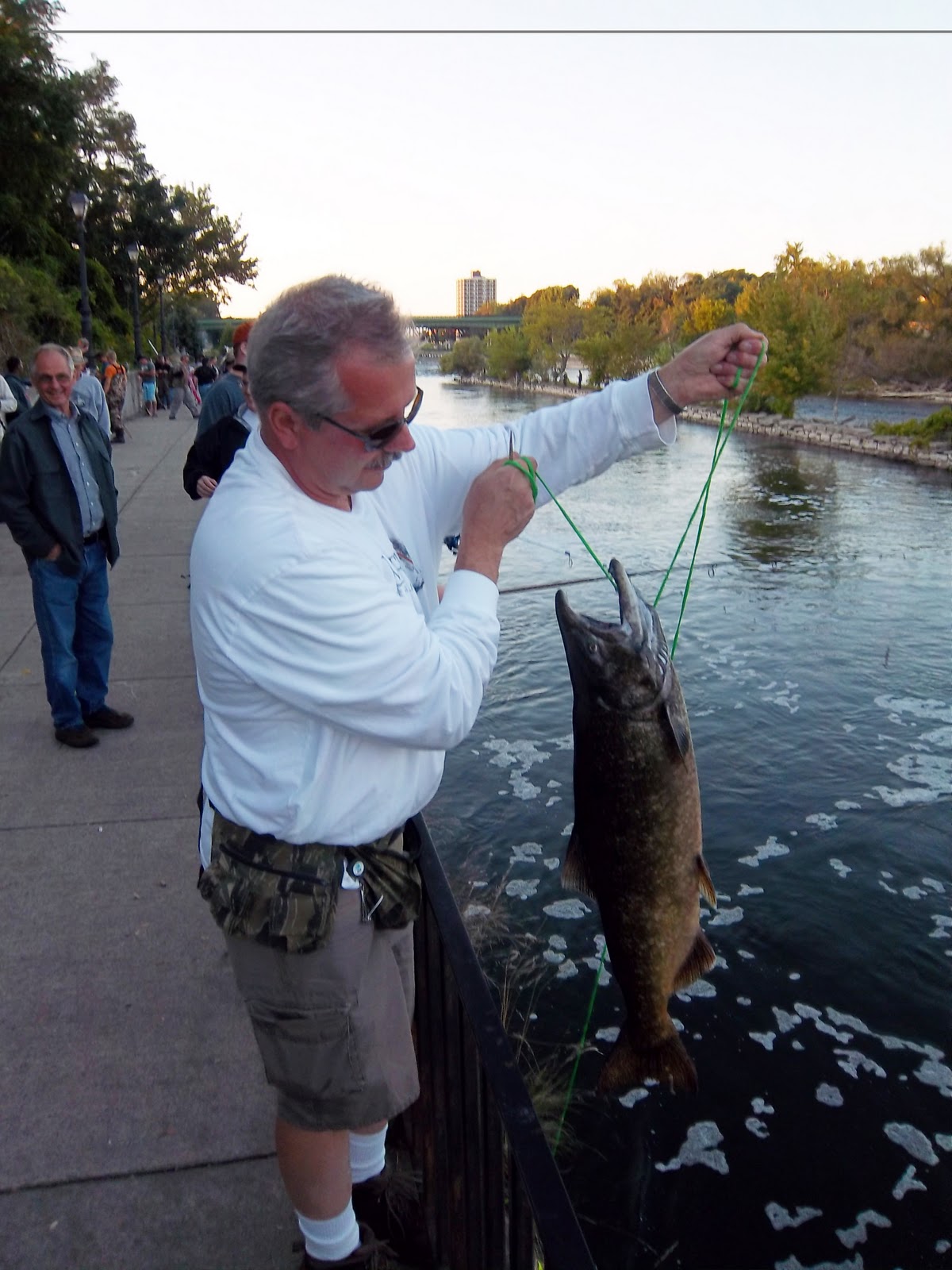
Oswego Swollen with Kings

Glen Lystash, Hardwick, NJ, shows off his hard-won trophy.

Nothing spurs ripe kings and cohos to charge into Lake “O’s” tributaries like an autumn moon washed by heavy rains.

True, Oswego County escaped the brunt of the inclement weather that shrouded much of Central New York last week (September 18-24). However, her largest river, the Oswego, drains thousands of square miles, including the Finger Lakes and Oneida Lake.  And it takes a while for all that water to finally reach the city at its mouth. When it does, it signals the salmon waiting out in the lake to start revving their fins because it’s party time!

So, Saturday morning I called Larry Muroski, over at Larry’s Oswego Salmon Shop (315-342-2778), to see if any new fish were coming in.

“Yup,” he replied. “The river’s full of ‘em.”

Larry’s a man of few words but great on enthusiasm. When I heard his tone, I knew the fish were on the move.

The lake launched this season’s most significant run on Friday. The following morning, anglers who were expecting “just decent” action by the steady numbers trickling in all week were surprised by all the fish that were present, prompting one,who was retying after a king broke off, his fifth loss in less than two hours, to complain  “These fish are so big and so fresh I can’t hold onto them.”

“I’m a 20-year veteran of the Oswego River’s salmon runs and I’ve never seen so many fish in September,” he added.

And it’s only just begun. If the past is any guide, this run will continue for the next few days, until the water drops.

But even then, fish will enter this large stream regularly for the next four weeks, at least. A good way to gauge your chances of success is to follow weather and temperature patterns: cold nights generally send new fish upstream, and so does rain.

Some browns are present, too, but I didn’t see any steelhead. Browns will bearound in great quantities all of October. Good numbers of steelhead should start appearing the second week of the month and continue pouring in through December.

For Safety’s Sake

With all this water feeding it, the Oswego River is probably the most run-of-sensitive stream in the state. Combined with the extreme fluctuations caused by ebbs and flows in hydroelectric power generation, the river can rise a foot or more in seconds…and I’m not exaggerating. Make a mental note of water levels on rocks, walls and depth gauges, how much is coming over the dam, before stepping in. If you see, or feel, the water rising, get out immediately. If you hear sirens, followed by warnings, head for shore. Finally, wear a personal flotation device—it can be a life saver.

While nowhere near as slippery as the Salmon River, the Oswego has its slick spots. Wear Korkers or similar traction devices to help you keep your footing. A pair of Polarized sunglasses helps penetrate the surface glare so you can see where you’re stepping—and easily spot fish, too.

Fulton Carp Action

On September 17, carp, another of the river’s popular leviathans, were the object of the Wild Carp Club of Central New York’s attention. Seventeen members of the group reportedly caught and released over a ton of the beaststhat day in Fulton, New York.

For more on the club, including this season’s last three events, call Jason Bernhardt at 315-427-7109; Jason@wildcarpcompanies.com.


Bobby Fuller and Jeff Proctor with an average-size king.

Donata Taylor, Redding PA, uses some fancy rod handling techniques on an uncooperative king.

Auburn, NY's, Lee Rusin with his day's catch.

Friday, September 30, 2011

The Returns are Here Again


Salmon Update: This season's largest run of kings entered the Salmon River Wednesday night, September 28. They're still entering the river as of this update, 11:30 a.m., Thursday morning. With rain predicted straight through the weekend, they should continue pouring in until the beginning of next week.

Owen Baxter, and his dad Don, of Boonville, N.Y. show off a Salmon River king

All the rain we’ve been having lately has spurred salmon into running Lake “O’s” tributaries a little early this year. In fact, enough fish entered the Salmon and Oswego Rivers in the first week of September to raise angler excitement to peak-run levels. And while a lot of guys got early thrills, these initial fish haven’t put a dent in the regular runs. Which, are just getting started.


Within the last few weeks, major numbers stormed the Salmon River (the Oswego always turns on a little later and should pick up this week). Anglers have reported tackling with near record numbers of kings and cohos.

Fortunately, for fish and fishermen alike, decent rain at regular intervals coupled with forecasts for more, means river conditions should remain almost perfect and stream banks and bottoms should be full of both for the next several weeks.

While Mother Nature is doing her part to make the angling experience more enjoyable, we are also realizing better conditions as the NYS DEC has been diligent in their efforts to eliminate lifters and snaggers from the environment.

“Now that lifting, lining, whatever…aren’t fashionable anymore, the chances of catching a clean fish are better than ever,” says Sean Rae, a Syracusan who fishes the river. “I’ve caught two today; neither one had wounds or hooks in its body.”

All the usual offerings are producing. Plastic eggs still seem to be the bait of choice but a lot of anglers are tossing flies, egg sacs and sponge to good effect, too.

What’s more, folks targeting early steelhead with everything from beads and Berkley Floating Trout Worms to yarn flies are finding their offerings are luring a lot of salmon.

Good numbers of fish are available throughout the river. Indeed, they’re stacked like cordwood below the bridge in Altmar.

The stream’s population of salmon should remain relatively consistent throughout the day for the next month or so as Brookfield Power continues to help balance the ebb and flow of natural precipitation. You see, the power company has agreed to release a steady stream high enough to draw and hold the beasts throughout the spawning season, a partnership that almost guarantees your trophy will be there waiting for several weeks to come.

For Safety’s Sake

The Salmon River is one of the slipperiest in NY. Wear clean Korkers or similar traction devices to help you keep your footing. A pair of Polarized sunglasses should be worn to help penetrate the glare so you can see where you’re stepping—and easily spot your prey.

Spawned in the Tug Hill Plateau, the Salmon is very sensitive to run-off and can rise quickly. Make a mental note of water levels before stepping in. In other words, note its location on a large object like a rock, bridge abutment, root ball or windfall. If you see, or feel, the water rising, get out immediately. Experts advise wearing a flotation device—it can be a life saver.


A hen coho taken by the author on September 21. 

Triple Deuce Charter's Matt Rubley, a Pulaski native, admiring a large male coho he took on September 21. 

Fishing at Ellis Cove on the Salmon River 

Watching the fish from the bridge in Altmar 

Stanley Cole of Snowcamp, N.C. fly-fishing for kings in the catch-and-release section of the river in Altmar.

Ron Haney of Altmar, who lost his right arm in an accident, shows how he fishes for kings

Tuesday, September 27, 2011

Pond Hawgs

 Pat with an average-size Sandy Pond bucketmouth.


Sandy Pond is mostly known as a splendid sandy beach bordered by majestic sand dunes where sunbathers toast themselves to a symphony of high winds, roaring waves and the cries of water birds of every feather.

On the other side of the dune sits the real Sandy Pond. Covering roughly 2,400 acres, it’s the largest embayment in the Eastern Lake Ontario Dune and Wetland Area, a 17-mile long natural barrier system containing the tallest sand dunes between Cape Cod and Lake Michigan.

The beauty of the place makes it extremely popular. Much of its shoreline is developed with camps, homes, and campgrounds. The place gets so crowded in summer, I never gave its warm weather fishery any thought.

However, I always knew “the Pond” was a well for northern pike and perch in winter, and crappies after ice-out. Some guys I normally consider reliable sources of information claimed it was a bass hot-spot in summer, but when I went with them, we got skunked every time. So I ignored it from then on.

That was, until I went fishing on Oneida Lake with Pat Miura last July (see blog post of Aug. 2, 2011). One of the most popular fly-fishing guides on the Salmon River (315-777-3570; pmiura@aol.com ), Pat spends his summers pursuing bass.

As often happens, our conversation drifted around our fishing experiences. I mentioned my lousy luck on Sandy Pond.

“Really!” he said, incredulously, “There’s a lot of bass in Sandy Pond…Some really big ones, too.”

“Oh yeah,” I countered, “Prove it.”

“OK,” he replied.

Late last month we fished the place and I’ve been eating humble pie ever since.

Only averaging 8 feet deep, it’s loaded with bass habitat: docks, creek mouths, windfalls, sprawling weed beds, boating channels leading to campgrounds and summer camps, reed fields, you name it. The problem is, you gotta look for the stuff.

You see, Sandy Pond has…lots of sand; sandbars stretching for hundreds of acres, in fact. And you wanna avoid fishing over these barren spots.

Once we located a fishy looking area, all the usual suspects worked: floating lures like Zara Spooks and buzzbaits in calm areas, Berkley Powerbaits, especially Texas-rigged  4-inch Finesse Worms and Carolina-rigged 6-inch Finesse Worms in and along weed edges, Smithwick Rogues jerked in deep water and Berkley’s Heavy Weight fat Sink Worms fished wacky style.

During the heat of the day, I found finesse presentations extremely gratifying. A good braided line like Nanofil on my spinning reels and Spider Wire Fluorobraid on my Abu Garcia Revo and Toro Winch allowed me to feel even the slightest take.

This time of year the pond prepares to hibernate.  Most of the boating crowd has gone back home. With hunting and salmon seasons just around the corner, a lot of local pressure is removed from the waves, making it possible to find some peace on the pond.

Pat says autumn is one of the best times to fish Sandy Pond. The bass are big, fat and cooperative, the scenery is colorful, and the days are brisk, making for the kind of trips you’ll be telling your grandkids about.


 Casting to some heavy brush.

 Bassin' in the reeds.

My biggest of the day came out of some heavy cover clinging to a sand dune.

Tuesday, September 6, 2011

Curtiss Gale Wildlife Management Area: Fulton’s Primordial Woods

Trees so tall you can't see where the canopy begins.


About a mile south of Fulton, a New York State Department of Environmental Conservation sign hangs on the west shoulder of Cty. Rte. 57, its golden letters announcing the Curtiss Gale Wildlife Management Area.

You search in vain, left and right, up and down the road, for a parking site or access point (the road on its north end is a private driveway).The only way in is from the shoulder of the highway or from the WMA’s 1,000 or so feet of Oswego River waterfront.

And if you decide to hike in, don’t expect to find even the barest amenity like a trail.

No, this lack of human intervention isn’t a sign of our tough economic times and things to come; it’s the result of DEC honoring an agreement it made with the pair of gentlemen who gave this magnificent patch of woods to the state to insure its rare, primordial beauty is never blemished by human kindness and remains a refuge for wildlife.

You see, H. Salem Curtiss and Thomas K. Gale donated the area to the DEC with the stipulation that hunting and trapping are prohibited.

That’s one of the things that make the spot unusual: hunting is a management tool used on all the other WMAs in the state.

Seems the donors’ kind restriction was contagious, spawning a rare moment of cooperation among all concerned.

Normally when a pristine piece of property this close to a metropolitan area is acquired, selfish interests band together to develop it, usually destroying its natural makeup with bathrooms, fences, and groomed trails, making it look like a franchise of the state park system.

Instead, they left the place to nature’s devices; and wow, what a job she’s done!

The forest has never seen mechanized equipment. Its rolling complexion doesn’t have one rut. Instead, the ground is carpeted in a uniform patchwork of plants and forest litter.

And the floor is old; older than the old growth trees reaching so high you need binoculars to recognize the leaves.
I know…I got a stiff neck trying.

I had to identify several by their bark.  A black cherry boggled my mind; how it managed to grow so straight and tall is nothing short of miraculous. Tulip poplars, maples, oaks, hickories, beechnuts, you name it, tower to heights I never knew the species could reach. They’re so far up there, in fact, it’s surprising the Federal Aviation Administration doesn’t make them wear blinking lights. 

These behemoths aren’t the exception; the forest’s full of majestic old growth. Adam Perry, a wildlife biologist with the state Department of Environmental Conservation puts it in a nutshell: “There’s a lot of really old, big trees there. If you’re into big trees, it’s the best place in Oswego County to see a bunch in a small area.”

Covering only 45 acres, Curtiss Gale WMA is one of the smallest in the system. Straddled by the highway and river on the east and west, and posted  signs to the north and south, it’s virtually impossible to get lost--or even disoriented--in the place.

And that’s great for family groups and others who fear wandering off the beaten path. The moment you step in, the trees start to dwarf you but never so much you have to worry about losing your way out.

To learn more about WMAs, including their locations, go to www.dec.ny.gov/outdoor/7768.html.

 One of countless giant tulip poplars.


No trails through Curtiss Gale WMA's magic forest.

Oswego River’s Master Chef

McGrath with a carp... they kept coming all night long.

On the water, Mike McGrath II looks like your average angler. But look close enough and you’ll see the guy’s fishing habits are anything but common. You see, the man’s favorite game is carp, and he owes his extraordinary success to his knowledge of carp cuisine.

Not cooking the brutes, mind you--hell, seafood chefs are a dime a dozen. But preparing meals that carp find so irresistible, they pack so thick into holes he chums, their wakes swamp the shoreline.

OK, that might be exaggerating things a bit. But the fact is the man knows more about the tastes of rough fish than anyone I’ve ever met. In fact, he’s so savvy about their dining habits, his firm, McGrath & Associates Carp Angling Services (315-882-1549; mmgrath2@twcny.rr.com), is famed for providing fishing adventures dreams are made of.

While most anglers fantasize about fishing action so fast and furious their arms ache for weeks afterwards, few ever have their dreams come true. A trip with McGrath, on the other hand, leads to so many carp, you’re immediately inducted into an exclusive group of smiling anglers incapable of ever wearing a straight face again.

Now, I’ve known about the river’s fantastic rough fish populations since early childhood. Back in the 60s, me and the boys would chip in to buy a can of kernel corn, go to our favorite fishin’ hole, throw three-quarters of the can into the drink to draw the fish, sit down and wait. We caught a lot of carp…but we had to wait. And we waited a lot between hits.

Not master carp chef McGrath. He reduces the waiting time to anywhere from a few seconds to a couple minutes by chumming the area with a fragrant recipe he calls a “tending pac” or “12 pac.”

In a big bowl, he mixes crushed popcorn, crème corn, quick oats, puffed wheat, corn pops, Panko bread flakes (Japanese breadcrumbs) and millet. Adding Marukyu carp sauce or R&W Carp juice for added scent, and reconstituted calve’s milk replacement as a binder, he mashes the ingredients into a ball and squeezes it 12 times; hence the name 12 pac.

“One youngster I know spits in his bait to bind it,” says McGrath. “We call him animal.”

After lobbing several baseball-sized chunks of the stuff into the spot he wishes to fish, and scattering several handfuls of boiled feed corn around the site to whet their appetites further, he gears up.

“This fishing is so brutal, I have to re-spool at least twice a month,” he says, while winding 14-lb Stren mono onto his Alvey reel, an Australian contraption which allows the spool to be moved so it’ll cast from the front like a spinning reel, or the side like a center-pin.

Terminal tackle consists of a slip sinker on the main line, a barrel swivel and a couple snelled hooks. The hooks are tied side-by-side onto the swivel’s bottom ring.

Baiting each of the hooks with a corn pop, he encases them in an egg-sized 12 pac and casts.

A carp is usually munching on the offering before the water can dissolve the 12 pac.

I reduced the time between hits even more by fishing a single corn puff dipped in Marukyu carp sauce, enticing numerous catfish to hit before the bait could reach bottom.

Mike, being a carp purist, wasn’t as thrilled as I, a catfish enthusiast.

“We’re fishing for carp, he reminded me. “When I start getting too many catfish, I cast to a different spot.”

I spent the next hour or so catching and releasing so many fish I broke out in a sweat. It was as heavenly a fishing experience as a mortal angler could ever hope to find down here.

All made possible by a guy who looked beyond prejudice, recognized the value of the Oswego River’s incredible carp population and founded McGrath & Associates Carp Angling Associates, an affordable guide service to fishing excitement that’ll take you beyond your wildest dreams.

McGrath mixing his secret tending pac (carpspeak for chum).


Terminal rig showing hooks holding line bait (carpspeak for bait).


Baited hooks wrapped in tending pac.


McGrath with the prize.


McGrath Associate's Darryl Storie holding a bonus catfish.

Tuesday, August 2, 2011

Oneida Lake: Hawgmouth Capital of Central New York

Pat Miura holding a fat, five-pounder. 


Perceptions have a life of their own.

For instance, a couple of weeks ago, I would have argued that when it comes to bass, Oneida Lake is bronzeback territory. Today I’d have to say it’s a hawgmouth hotspot.

That’s what I said,  hawgmouth. The largemouths in the lake are so big, you might as well put hawg right in their name!

I learned that the most pleasant way possible. Pat Miura, the only Salmon River guide I know of who specializes exclusively in fly-fishing, (315-777-3570; pmiura@aol.com), showed me while proving he knew how to catch bass, too, on Redfield Reservoir earlier this summer (click here to read that blog).

“Oneida Lake’s my favorite largemouth bass spot in the state,” claimed Miura, matter-of-factly, while removing the hook from his 10th bass of the day.

“Really?” I responded.

“The place is loaded with daggone largemouths. You wanna go sometime?”

“You’re on,” I replied; “how about the end of July?”

We went in the middle of the third week, the hottest day of the year—so far. Temperatures hovered just below 100. The sun’s rays made us sweat so profusely you could boil eggs on our foreheads.

Still, the fish were active. Right when we launched, we saw what appeared to be bass attacking minnows on the surface over deep weeds.

Pat starts out tossing a hard jerkbait. Before his 10th jerk, he reports “Fish on” and immediately lands a 20-inch walleye.

Next cast he’s got another…then another…and so on.

By his fifth walleye, I figure I better switch to a jerkbait. Before I could tighten the knot on my Bomber, Pat lands his sixth, the last one to cooperate in that spot.

Stubborn cuss that I am, I cast a couple dozen times anyway. Fortunately, I got a northern, one of my favorite fish.

Next we hit the weeds around the big islands. Once again, Pat shows me how good he is by landing about six largemouths averaging 1 ½ pounds and a bronzeback of about three pounds—in less than an hour.

All I got was a pickerel. It’s hard fishing behind a guy like him, I thought, jealousy welling in my heart.

“Now we’re gonna get serious,” Pat announces. We take off for the northwestern corner.

Big Bay, Three Mile Bay, bays with no name, even no bays (we fished the open lake, too) it didn’t matter, the guy hooks largemouths. All the while, I’m casting my heart out coming up with nothing but weeds.

So I switch to a 4-inch Berkley Power Worm rigged Texas Style. I drop the offering at the edge of a clump of weeds and get the slightest series of taps imaginable. Setting the hook gently (thinking it was a small rock bass, I didn’t want to rip too big a hole in its jaw), I wasn’t prepared for the intensity and duration of the struggle that ensued.

Pat knew it was a big bucketmouth and warned me to be cautious.

“This can’t be a largemouth,” I shot back. “I never caught one that fought this hard.” It’s gotta be a 20 pound sheepshead, or carp, maybe even a sturgeon…

My Abu Garcia Vendetta Rod and Revo SX reel combo proved their mettle and a few minutes later, the fish shows: a bucketmouth so big, it barely fit into my field of vision..

“Now that’s a hawgmouth,” I squealed like a Cub Scout holding his first sunny. “You see the size of this thing?”

And that was my last of the day.

But Pat kept right at it. He even caught one as big as mine, plus a couple only a few ounces smaller. In fact, he caught and released about 20 largemouths whose total weight would have been at least 50 pounds; on the hottest day of the year, no less.

We didn’t keep anything. Pat never does. Just fishes…and releases…and fishes some more.

“The fish will remain active all of August,” says Miura.

And as summer’s greens bleed into the reds and golds of autumn, the bite will only get better, he adds.


Pat and a chunky smallmouth he took on the east end of Dunham Island. 


My five-pounder; taken in Big Bay. 


Pat releasing two of his six walleyes.