Showing posts with label salmon. Show all posts

Thursday, September 22, 2016

Fishing the Rapids during the Run

Coho taken in the rapids at the bottom of the Long Bridge Hole in Pulaski, N.Y.

This week marks the time to get excited about Oswego County’s salmon runs.

Oh sure, a few precocious kings and cohoes have been teasing gung-ho, big-game anglers since the end of August; but you ain’t seen nothin’ yet!
Thousands of kings and cohoes will rip through the rapids from now until late next month. So many, in fact, cousin Staash claims “they’ll raise the water level a couple notches.”

You can bet the fish are gon’na draw legions of anglers from all over the Northeast, too.
Inexperienced in the ways of salmon in the fast water, most of these guys will think like humans and surround the big, deep  holes,  thinking they’re  the best spots to catch the trophies swimming around in their imaginations.

The fish are sure to be there, and fishing the rapids is one of the surest ways to find them.
You see, out in the big pond salmon are accustomed to being the biggest kids on the block. They bring that attitude with them when they enter the river, aggressively striking anything that gets in their way. Their confidence quickly fades after tasting the sting of a hook, or encountering excited anglers chasing after them.

That sends most of them heading for cover in the deep pools…where they encounter more hooks and more fish. So what’s a salmon to do?
Run!

And into the rapids it goes.
An exciting way to catch one is to swing a streamer through the current. Good patterns are wooly buggers in trout colors (brown or chartreuse) and Mickey fins.

Good spots to try on the Salmon River include Pineville Pool, Long Hole, Trooper Hole, Ball Park Run and Staircase.
Don’t be aggressive. Simply cast the streamer across the river and let the current swing it back to your side…and hold on.

After all, any fly-fisher can tell you: The drug is the tug!


Monday, April 14, 2014

Chuck Parker: Sportsman Activist


By
Spider Rybaak

Tucked into the northeastern corner of Lake Ontario, claiming the entire western half of Oneida Lake, etched by the Oswego and Salmon Rivers, the finest salmonid streams in the Lower 48, and watered by numerous productive streams and brooks, Oswego County offers some of the best fishing in the Western Hemisphere. 

 Small wonder, then, that it spawns some of the finest conservationists in the country.

Take Chuck Parker, for instance. An avid hunter and angler, the Texas, NY resident believes political activism is every sportsman’s responsibility, and practices what he preaches.

Parker traces the roots of his activism to the Mad River Club, which he joined in 1989. Ever since, he’s served in numerous conservation-minded sportsmen groups in every capacity from secretary to president, and reached the top when he was elected to the presidency of the New York State Conservation Council (NYSCC) a couple years ago, an office he still holds.

Parker describes the NYSCC as an advocacy group dedicated to promoting sportsman’s issues.

“One of our greatest concerns is legislation out of Albany,” says Parker. “We have advisors on the New York State Conservation Fund Advisory Board and the New York State Fish and Wildlife management Board,” he adds.

True conservationists, the NYSCC’s membership knows man is an integral part of the natural order, and graciously accepts responsibility as steward of the environment.

The NYSCC’s website states: “For over 80 years, the NYSCC Inc. has been a leader in advocating the wise use and management of NY’s valuable natural resources to ensure that they are protected for our children’s children.”

In this vein, NYSCC member clubs offer a wide variety of outdoor activities designed to acquaint kids with the great outdoors, including 4 H Youth Shooting Sports Programs, Youth Fly-fishing, the Oswego County Envirothon, Oswego County Soil and Water’s Annual Conservation Field Days (open to 5th graders) and the Plant a Tree program.

Parker has been a Hunter Safety Instructor since 1993, and states, unabashedly, “We stand opposed to the New York Safe Act. We would like to see it overturned.”

And that’s to be expected, considering the group’s respect for the natural order, and its acceptance that man is on the top rung of the food chain.

Parker feels the greatest threat facing hunting and fishing is the lack of activism among outdoorsmen. “I’m involved with a lot of good sportsmen but the problem is 7 out of 10 don’t belong to a sportsmen’s club, so they don’t advocate for our right to hunt and fish.”

His solution:  “Get your friends to join a sportsman’s club and teach your children the importance respecting our natural environment as well as how to safely enjoy all that is has to offer.”

Chuck Parker was named as one of The Syracuse Post-Standard's "Heroes of Conservation" in 2011.  

Monday, March 10, 2014

Dipping for Smelt


By Spider Rybaak

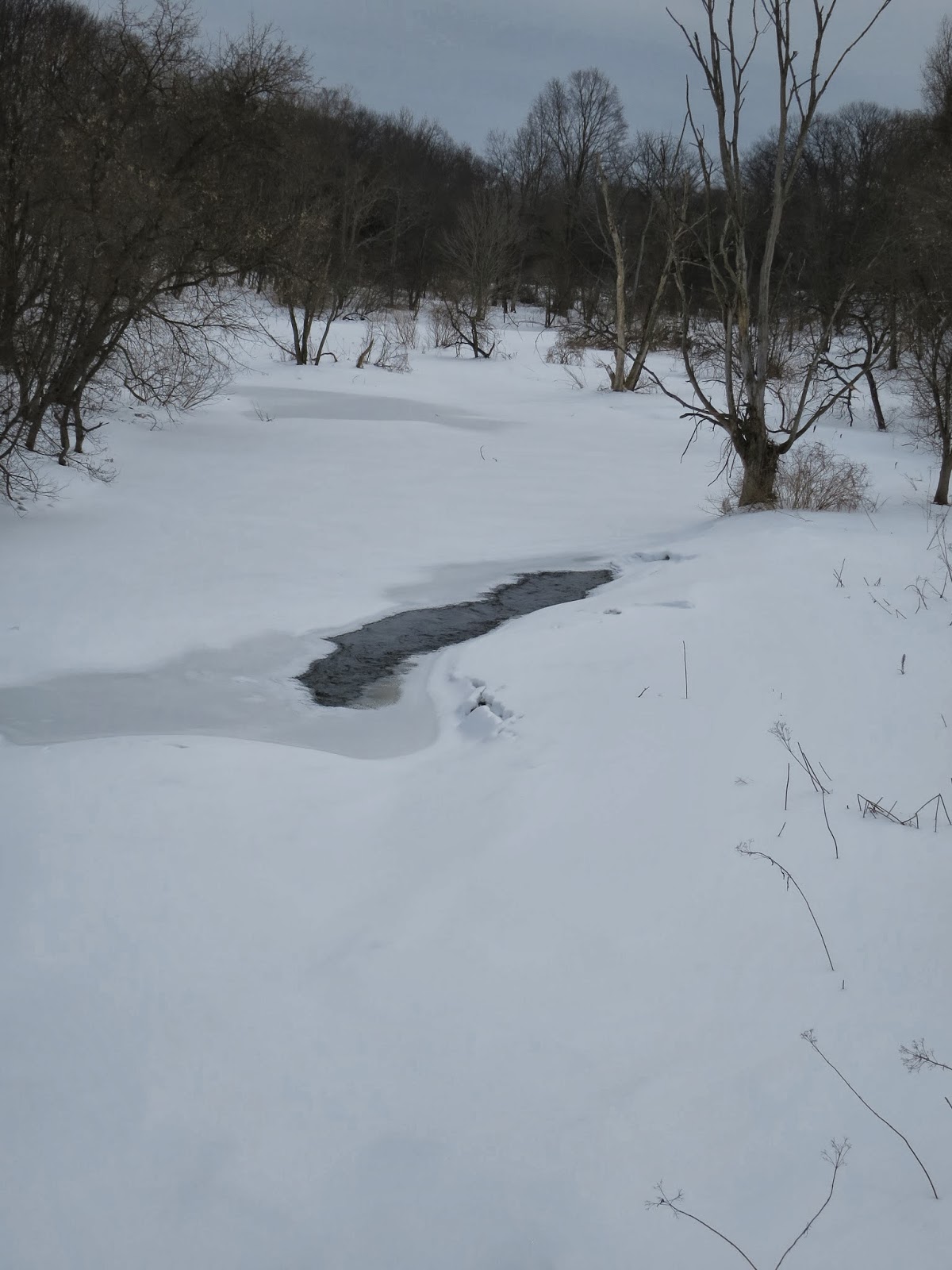
 Grindstone Creek from the NYS Rte. 3 bridge, March 5; gotta wait until ice-out to dip.

Back in the early 1960s, environmental pollution was rampant. Lake Erie was so dirty, authorities began drafting a death certificate. Lake Ontario was much deeper so it could swallow more stuff, but it was limping along on its last leg, too; fish populations were down to a fraction of what they used to be.

But there was hope.

By the middle of the decade, strict environmental laws were passed and enforced. Nature responded quickly, improving the water in the Lower Great Lakes to such a degree that fish numbers took off. Since it takes a while for game fish to grow to legal size, they were slow in coming around; but bait fish populations exploded.

That was good…and bad.

First the good: smelt reached such incredible numbers, guys dipping for them in the mouth of the Salmon River could fill 5-gallon buckets with their eyes closed. On skinny creeks like Deer and Little Sandy, conscientious anglers dipped gently, carefully to avoid crushing the smelt below the net’s rim or hurting those off to the sides.

The bad: alewives thrived, too. Boney and tasting like swamp mud, they were avoided by man. Unsightly winter kill lined beaches around the lake and the authorities decided to bring the lake back into balance by stocking voracious lake trout, king and coho salmon.

It worked. The salmonids swam around with mouths wide open, growing huge. Smelt numbers dropped incredibly. Dave Wood, owner of Woody’s Tackle on NYS Rte. 3, says dipping for them got so bad by the late 70s, he stopped going.

Fran Daher, over at North Syracuse’s Mickey’s Live Bait and Tackle concurs. “We used to sell dozens of dipping nets annually in the 70s, now we’re lucky if we sell a couple- three a year. Smelting has become a dead art,” he adds.

But it shouldn’t be. Word coming out of the western part of the lake has it that smelt numbers are rebounding. Fran Daher’s admission that he’s only selling a few nets a year suggests someone’s getting smelt around here. After all, argues cousin Staash, “these guys ain’t buying dip nets to catch butterflies; they’re getting smelt but they ain’t talking about it.”

Brian Weidel, of the USGS, Great Lakes Science Center, says” “From what I hear, spring 2011 was a good year for smelting, at least in the western NY tributaries. This MAY have been associated with slightly higher smelt abundance in the lake in 2010. Since then the population has dropped, which is usual for the species. Their abundance tends to naturally cycle.”

However, Weidel isn’t so quick to blame the drop in smelt populations on predators: “One thing that is important for anglers and the public to recognize is the overall productivity of the lake has decreased (which is a good thing) because of the Clean Water Act and other important legislation that reduced pollutants in the lake,” he claims.

Since smelt numbers are cyclical, there’s a good chance this year’s run will be a good one. The only way to find out if they’re running up Oswego County’s Lake Ontario tributaries again is to go for ‘em.

The mouth of any tributary will do. Here’s some with good public access:

- Little Salmon River, County Route 40 or Mexico Point Drive, Texas, NY.
- Grindstone Creek, Selkirk Shores State Park, NYS Rte. 3, a couple miles south of Port Ontario.
- Deer Creek, Deer Creek Marsh Wildlife Management Area, NYS Rte. 3, a couple miles north of Port Ontario     

Going for these guys isn’t rocket science; all you gotta do is stand on the bank, dip and scoop. Dip nets come with long handles so you don’t have to stretch too much.

Woody claims [global warming notwithstanding]“This winter is like the ones we used to have, so the smelt won’t be running until April.”

And that’s reassuring, suggesting the weather is like smelt…cyclical.

Dave Wood, owner of Woody's Tackle Shop in Port Ontario, holding a smelt dipping net.


Thursday, October 24, 2013

Best Downtown Fishing Around


By
Spider Rybaak

City mallards and anglers: Varick Dam.

The city of Oswego’s miracle mile boasts the greatest trophy fishing in the country.

Lake Ontario’s second largest tributary runs through the middle of town. Draining Oneida Lake and the Finger Lakes, the Oswego River is a magnet for bank anglers targeting warmwater species like catfish, walleyes and smallmouth bass in summer. But when October nights stir autumn’s chill into the rapids, massive quantities of the lake’s biggest salmonids move into downtown’s caressing currents to find mates under the neon.

Currently, king salmon are the rage. They hang out anywhere there’s fast-water, from Bridge Street all the way to the pools below Varick Dam.

The main stage for anglers trying their luck at landing one is the Linear Park lining the west bank. Running from the power house to just south of the silos looming over the harbor near the river’s mouth, a distance of almost a mile, the fence-lined, concrete wall offers a safe platform for battling these brutes.

Action is fast and furious along the northern half of the park, particularly from the power house to the end of the middle wall channeling the deep tailrace, roughly behind, and a little north, of Larry’s Oswego Salmon Shop (315-342-2778). Larry offers advice, a full line of tackle and a fish cleaning station.

This year, the most productive bait is skein and eggs cured with Pautzke Fire Brine. Most guys float-fish the stuff; suspending it anywhere from 3 inches to a foot off bottom on a slip bobber, and ensure their bait stays at the proper depth by walking the wall at the same pace as the current.

Fly-fishermen targeting steelhead in the rapids between the dam and the north end of Leto Island (access from Leto Island is closed, so you’ll have to wade to get to the east bank), are getting more kings than chromers on estaz flies and streamers, but the number of ironheads promises to increase dramatically from now through November. Some browns are also in the fast water.

Walleyes are still in the river, too, mostly in the deeper water downstream of Utica Street. They’ll hit floating crankbaits like Bass Pros XPS Minnows and Thundersticks, and worms rigged on Dixie Spinners and dragged slowly on bottom. Be prepared to tangle with incidental steelies and brown trout.

Anglers must wear personal flotation devices to fish the river upstream of the power house.

Below the signs announcing the power company's dress-code requiring personal flotation devises beyond this point.

Charter Captain Andy Bliss unhooking a nine-pound domestic rainbow taken below the power plant.

Mike Viggiano, Nanticoke, PA, carrying a steelie he took in the rapids a little downstream of the dam.

Father and son team from Long Island and their kings.

Josh Collette (left), president of the Oswego State Fishing Club, Phil Jenkins (center), interim treasurer, and club member Jordan Rabinowitz discussing fishy subjects at West Linear Park. Sanctioned by the Student Association, "the club is for recreational purposes and to further educate the student body on ethical and sustainable fisheries," explains Collette.

Tuesday, September 17, 2013

Salmon Everywhere: Oneida Lake, too.


By
Spider Rybaak


Gene Carey, founding member of the Fish Creek Atlantic Salmon Club, walking towards the FCASC's hatchery at the Harden Furniture Dam on the West Branch of Fish Creek, McConnellsville, NY.

Fishing on foot might not sound as glamorous as doing it from a souped-up Lund, but it has its benefits. For instance, it’s good exercise while moving around looking for hits; and a great way of gathering valuable intelligence. That’s how I heard the story of a guy who allegedly caught an Atlantic salmon below the dam in Caughdenoy last week. 

Now, I remember seeing one caught in Phoenix back in the 1960s.  And just about anyone who’s been fishing the Seneca and Oswego Rivers for any length of time can tell you a story or two about landlocks caught in the whitewater in Oswego, Minetto, Fulton, even Baldwinsville.  Experts surmise these fish were stocked by the New York State Department of Environmental Conservation in Lakes Ontario or Cayuga.

But how do you explain an Atlantic salmon in the Oneida River?

The Fish Creek Atlantic Salmon Club, that’s how. Formed in 1997, the group has been working to restore the species to its native waters ever since. 

While Fish Creek was never the primary residence of great numbers of Atlantic salmon, it served as an important nursery. In the old days, Lake Ontario claimed the greatest population of landlocked salmon in the world until dams and Industrialization’s rampant pollution all but wiped them out in the beginning of the 19th Century.  When it came time to spawn, they ascended its tributaries, including its second biggest, the Oswego River. Formed by the confluence of the Oneida and Seneca Rivers, the Oswego offered them access into Oneida Lake and the ideal spawning habitat of its largest tributary, Fish Creek.

The club’s program is funded through dues, raffles, the sweat of its members and donations.  Its fry are raised at a hatchery club members built on the creek’s west branch, at the spillway to Harden Furniture’s mill dam in McConnellsville. The company donated the site, as well as a $5,000 grant to build the thing. Spey Nation has been chipping in over the past three years with an annual $1,500 grant.

According to Eugene Carey, a founding member of the club (he’s on the cover of my first book “Fishing Eastern New York”), the facility is working out very well. The equipment is run by solar power so electrical outages aren’t a concern.  The creek’s fluctuating temperature prepares the fry for the conditions they’ll encounter in the wild, and the water’s natural nutrients, easily identifiable by the young, spur their appetite so they don’t have to be coaxed into feeding by club members.

Incoming reports bear him out. Oneida Lake’s ice fishermen have been treated to a smattering of landlocks each year this century. In the fall of 2011, three beauties ranging from 25 to 27 inches were caught in the canal at Sylvan beach. This summer, two were taken by open water anglers on the lake. 

The dream collectively envisioned by this small, dedicated group of romantic anglers in 1997 is materializing. If the trend continues, Oneida Lake tributaries will soon be giving Lake Ontario’s feeders stiff competition for NY’s native salmon.


Powered by the sun.

Water works: Inside the fish hatchery.

Wednesday, September 12, 2012

Low Water Salmon

By Spider Rybaak


The results of Captain Dick Stanton's outing last Saturday morning.


Nestled in an incredibly beautiful and productive web of waterways, Oswego County ranks high on the short list of the world’s greatest freshwater fishing destinations. And this summer we’re proving it in spades. While all the other self-proclaimed capitols of the fishing world are crying because the drought has drastically reduced water levels--and creel counts--our charter captains are smiling, pulling into port with coolers loaded with trophy salmon.

Take Capt. Richard G. Stanton (315-246-4767), for instance. The last two times he’s gone out, he’s led his highly satisfied clients to 16 keepers (see photos).

“We got these off Oswego, 50 to 70 feet deep, over 90 to 120 feet of water,” reveals Capt. Dick. “The vast majority was taken on Echip flasher/A-Tom-Mik fly combinations, and Moonshine spoons,” he adds.

Anyone who knows anything about Great Lakes salmon knows this is nothing new. Indeed, blessed with the Oswego (Lake Ontario’s second largest tributary) and Salmon (the most famous cold water stream in the Great Lakes) rivers, our corner of Lake Ontario is notorious for drawing the biggest concentration of mature salmon in the lower 48 states.

Unfortunately, the rivers aren’t faring so well...yet. Rain has been so scarce lately, that streams everywhere are running at about half of normal capacity. At this writing, the Salmon River is barely at 185 cubic feet per second (cfs); normal September flow is 300 cfs.

Still, a few salmon are in. Not in any great numbers, but enough to reward patient anglers with some of the most exciting fishing imaginable. You see, the fish are already staged off the Salmon River’s mouth and more are arriving every day. They feed like pigs while waiting for the signal (a drop in the stream’s temperature, rising water, nature’s clock running out, whatever) to collectively enter the flow. And while most wait to storm upriver in mass, there’s always a few that run early, on their own or in small groups, usually after dark.

These precocious critters rule the night. In the morning, they’re caught unaware and become easy prey to early-rising anglers. Veterans that survive daylight’s ambush head for the safety of pools and mill around all day avoiding hooks. 

But they’ll re-enter the rapids in daylight if fishing pressure subsides; and it often does the first couple weeks of September.

The key is to find a spot that isn’t crowded with excited anglers. Then you gotta hunt the beasts stealthily: wear camouflage (on sunny days, blue or white will do) and walk slowly, quietly. Swinging streamers through the rapids, or working egg sacs, gobs of skein or imitations like pieces of sponge in pockets and channels, often produce strikes.

As far as the Oswego River goes, Larry Muroski, owner of Larry’s Oswego Salmon Shop (315-342-2778), says, “The water’s in the low 70s right now [September 9] and it’ll take at least a week, probably a little longer for it to cool down enough for fish to start coming in.”

But come they will; and early indications are this is gonna be a banner year for big ones. 

A word of caution: Wear a personal flotation device whenever wading one of Lake Ontario’s major tributaries. Although the rivers are low and easy to wade right now, you have to remember they drain wide areas. For instance, the Oswego drains the entire Finger Lakes region and Oneida Lake. A storm upriver can send a mini-tsunami barreling downstream, raising the water to dangerous levels without warning. In addition, pay attention to the water level by mentally marking its location on a rock, wall, tree, even your boots; and if you see or feel it rising, get out as quickly as you can.

New Dress Code for the Oswego River: Personal flotation devices required to fish upstream of the power plant--Coast Guard approved, no less.

Capt. Stanton's results on Sunday morning.
Early birds on the Salmon River last Sunday.

Wednesday, August 8, 2012

Salmon River Summer Salmon


By Spider Rybaak

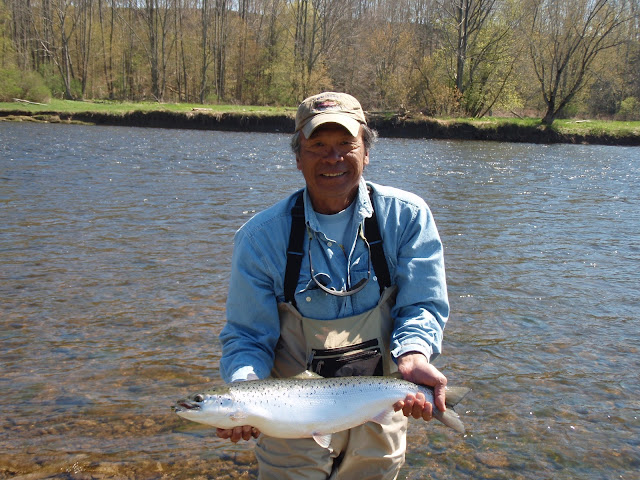
Local fly-fishing guide Pat Miura (315-777-3570) holding a trophy landlocked Atlantic salmon he took last spring from the Salmon River's Douglaston Salmon Run.

When you’re as pretty--and mildly wild-- as the Salmon River is, everyone wants a piece of your beauty and grace. And while the stream is lined with beaten paths for fishermen, hikers, bird watchers, yodelers, wildflower lovers, you name it, the only way to satisfaction for whitewater enthusiasts like kayakers and tubers is to get all wet. So in the spirit of making everyone happy, the power company conducts special releases each month during summer--two in July.

This year’s releases have mostly already taken place, and August was cancelled because of low water levels in the reservoir. So there’s only one more planned officially, the first weekend of September.


However, there’s always a chance we’ll get some heavy rains this month; and if we do, the river will come up all by itself. If that happens, grab a rubber tube, air mattress, kayak or anything that’ll float while you’re in it, and a buddy--you wanna have two cars so you can leave one at put-in and take-out—and launch on a whitewater thrill so mildly exciting, you’re guaranteed to get wet.

No craft?...Not into whitewater?...No sweat. There’s more to do during high water.

Take fishing for landlocked Atlantic salmon, for instance. Indeed, the Salmon River is the best fast lane in the U.S. for catching a keeper trophy landlocked Atlantic. Our Atlantic salmon are stocked by the NYS DEC.  (Natural strains of Atlantic salmon are ocean-running fish, and are on the endangered species list.)

Known as the king of fish in Europe because of its superb beauty, extraordinary leaping prowess, incredible power and stamina, and ability to survive the spawning ordeal and do it a second, even third time (it’s the only American salmon capable of spawning more than once), pursuing this fabulous critter is one of the most worthy challenges anglers face in freshwater.


Up until the 19th century, Lake Ontario boasted the world’s greatest population of these marvelous game fish. Pollution, over fishing, dams blocking migratory routes, and exotic species nailed their coffin shut before World War I.

The feds and NYS Conservation Department (precursor to today’s NYS Department of Environmental Conservation), spurred by the increased environmental awareness spawned during the hippie era (the 1960s), decided to restore the species into the tiniest Great Lake.

Late in the last century, the authorities stocked various Lake Ontario tributaries with baby Atlantics in various stages of development. But the lion’s share of their attention went to Little Sandy Creek, the northernmost skinny creek in Oswego County. It was stocked heavier than the rest, and was even placed off-limits to fishing during the salmon runs to protect the returns. The experiment failed.

Alewives, exotic forage that entered the Great Lakes system through the Erie Canal, were waging biological warfare on the Atlantics and winning. Rich in Thiaminaze, an enzyme that breaks down thiamine, a vitamin essential to salmon reproduction, the salmon were eating themselves to impotence. The condition was called the Cayuga Syndrome, after Cayuga Lake where it was first fingered. Oh, the fish still went through all the moves--run upstream, court, lay their eggs, fertilize them--but the offspring died before they could get beyond the sac-fry stage. Mortality was total.

Finally figuring out what was happening, the authorities lifted the ban on fishing the Little Sandy and got used to the idea that the only way to maintain a token presence of the species in Lake Ontario was by stocking, often with fry from eggs washed in thiamine.

Thousands of Atlantics have been stocked annually over the past 20-something years. While these numbers are tiny compared to the quantity of Pacific salmon stocked each year, the effort gives anglers a chance at catching this highly desirable and coveted native New Yorker.

The most warmwater tolerant salmon, a few Atlantics are in the river all summer long. Periods of high water, like after a rain or during whitewater releases draw fresh fish upstream. What’s more, the food rich higher water often spurs a feeding binge.

So if you’re into fishy challenges, the Salmon River offers one of the toughest in the fishing world.

But there’s more.

“For the past three years, 2009, 2010 and 2011, we’ve netted as many as 48 naturally reproduced fingerlings in the river in any given year,” claims Dr. James Johnson, ecologist and branch chief at the USGS’ Tunison Laboratory of Aquatic Science in Cortland, NY. He attributes this exciting development to “changes in lake conditions: fewer alewives--less Thiaminaze.”

There’s no shortage of theories. One even speculates the round goby, an exotic species indigenous to the Black Sea, is the hero in this wonderful mystery.  

I asked Dr. George Ketola, a research physiologist at Tunison Laboratory, if the gobies could be helping the salmon replenish the thiamine status in their eggs.

“That makes good sense,” the Dr. replies. “Gobies are high in thiamine and with the availability of that food source before spawning…if they have a month or so of exposure…it should make a difference. And I suspect it helps their spawning.”

A little over three years is a long spell in salmon time, long enough to reach trophyhood. The possibilities are the stuff of fantasy, and if you participate right now, you could be one of the pioneers in this developing fishery.

How do you tell a naturally spawned fish from a stocky? Scott Prindle, fisheries biologist at the Cortland office of the NYS Department of Environmental Conservation says about the only sure way is to look at the belly fins. If the leading edges are kind’a thick and wavy, there’s a good chance it’s a hatchery fish (they get calloused from bumping and rubbing their tank’s bottom). If the fins are straight and narrow, it’s probably the real thing.

By heading up to the Salmon River you’ll experience the thrill of a naturally warmed rushing river, and the chance of catching a naturally bred trophy landlocked Atlantic salmon, something that ain’t been seen around these parts for over 100 years.  

So c’mon up to the Salmon River; we'll keep the stream up for ya...for a little while, anyway.


Fran Verdoliva releasing a nice landlocked Atlantic salmon he took in the summer of 2010.

NY007  John Kendell showing a trophy he took from the Salmon River in the summer of 2010.

Friday, July 6, 2012

Oswego: The Fishing’s Hot Even When it’s Slow


By Spider Rybaak

Janet gets her brown.


The past few days have seen some awfully bright sunlight steeped in hot temperatures. Not exactly ideal fishing weather, especially if you’re getting a late-morning start. But there’s nothing average about the open waters off Oswego and when temperatures are sticky and the fishin’s lazy, you’ll still hear a lot of sizzling lines and screaming drags.

This was brought home to me for the hundredth time on Tuesday. A few days earlier, Capt. Richard Stanton (Stanton Charter Service, www.stantoncharters.com; 315-685-0651) dangled an offer to take me and Oswego County Tourism’s Janet Clerkin fishing so I could get photos and quotes for an upcoming book.  We bit. Little did we know it would turn out to be the best fishing day of the year…so far.

I ran into some construction and bad traffic getting to Wright’s Landing so we started late, 8:45 a.m., to be exact. On the way out of the harbor, boats were already coming in with their limits of kings, punctuated with browns, lakers, cohos and steelhead. One guy allegedly even nailed a trophy landlocked Atlantic salmon.

We trolled for a couple hours trying to figure out what the fish were hungering for. The sun was beating down on us like the upper heat element in a toaster oven. The lake was flat. I was having some serious doubts. Having run charters for 38 years, Capt. Dick has great intuition, for finding fish…and reading clients. “The fat lady ain’t sung, yet, Spider,” he says, “and we ain’t done until we’re done.” (Or something like that).

Suddenly, one of the rods goes off. “There’s a hit,” shouts Ron Marlett, one of the captain’s buddies who came along for the ride.

As he handed Janet the rod, Capt. Dick observes: “Look at that little guy jump!”

Bright as a mirror reflecting sunlight, it comes clear out of the water like a curved, silver rocket at least four times. A couple minutes later, it’s in the boat, getting unhooked and released.

Fifteen minutes later, another rod goes off. The fish is much bigger. Janet makes short work of it, though, and after a few minutes of battle, she brings a five-pound brown trout to the net.

We no sooner set the line again and another rod trips. A powerful fish, it tormented the drag—and Janet’s tiring arms—for a couple seconds before spitting the hook back at us with no respect at all.

But there’s no rest for the weary.

Before Janet could get comfortable, another rod tip pops up then dives for the drink. Janet beats everyone to the rod again and the fight is on. The fish tears off at least 20 yards of line before stopping. The poor lady on the other end is reeling for all it’s worth trying to catch up. But the beast isn’t in a playful mood and takes off for Toronto. Janet struggles for another 10 minutes, brings the beast to the side of the boat and just as the captain’s getting the net ready, the lure comes flying back at us.

Janet sits down, Capt. Dick sets the rod again, Ron’s in the cabin feeling bad for Janet…and I’m yapping my head off; nothing important, just talking to talk…irritating everyone on board.

And then the meanest salmon in our part of the lake takes one of our Michigan Stingers. This time I’m on top of things; growling, swinging elbows “it’s my turn!!!!!,” I demand.

The 18-pound chinook took me on a whirlwind lesson in kingly behavior. Fighting like the devil one minute, then jumping, diving, racing right at me. At that point I actually thought he got off but Ron ordered “He’s  running at you, reel like crazy.”

I’m glad I listened because right about then the slack tightens as the fish makes an abrupt about face and makes the fight honest again by storming for Niagara Falls. To make a long story short, it takes me another 10 minutes to land him.

By now the heat was getting to us and everyone except Capt. Dick—he wanted to keep fishing--agreed it was a good time to split.

Oswego’s territorial waters are so salmonid friendly, the fishin’s great even when it’s slow…And that’s hard to beat.

Deadly Trio: (top to bottom) Gobey, Honey Bee and Modified Stinger.
The face of battle: Janet Clerkin.
Capt. Dick and Janet holding an average king


Wednesday, October 5, 2011

Skinny Creek Salmon

A couple dudes who requested anonymity--and their cohos weren't talking, either.

Eastern Lake Ontario witnessed the beginning of the largest salmon run of the season--thus far, anyway--on the night of September 28th. By the following morning, reliable sources on the Salmon River reported fish where plentiful throughout the river.

And Pulaski wasn’t the only spot hosting spawn-happy salmon.

Oswego got massive quantities of fish, too. On cue, their run was spurred by heavy rains that drenched Central New York, especially the Finger Lakes and Oneida Lake regions, last week, raising water levels in the Oswego River by almost a foot. So many fish charged the River in the city, folks driving south on NY 48 Thursday evening could see salmon trying to jump the Varick dam. Fortunately, the water was so high at the foot of the structure, the effervescence so thick, it cushioned the blows and the fish didn’t get seriously hurt slamming into the barrier, only a little humiliated and a bit frustrated; but they tried and tried again until exhausted.

This writer’s favorite form of fishing is for large fish on skinny creeks. Summer smallmouths in the Salmon River, steelhead in Little Sandy Creek, big native browns in Scriba Creek, and, most of all, huge salmon in Oswego County’s creeks and brooks.

So I went and tried my luck on Thursday  afternoon. I stopped at Trout Brook, at the New York State Department of Environmental Conservation Fishing Access Site on the shoulder of cty. Rte. 48. I was a bit disappointed to see the water was at normal levels. Once I got in, however, I was excited by all the fish. I counted at least 15 fish, a mix of kings and cohos, in about ½ mile, and caught a coho.

I never made it all the way to the mouth but a couple guys  who passed me heading back to the road, two limits of kings in tow , said the whole creek was loaded. “The further you go downstream, the more fish you’ll see,” one added with great excitement.

After about an hour, I split for the mouth of Grindstone Creek, at Selkirk Shore’s State Park. When I pulled into the parking lot, a line of guys stood atop the concrete wall at creek’s end--its mouth wanders and without the wall it would have sliced through the parking lot long ago.

Before I could wet a line, three guys had fish on at the same time. All three landed them.

I wasn’t so lucky. I hooked a couple but they split back to the lake and the last I knew, they were heading for Nine Mile Point, probably on their way to the Oswego River.

The skinny creeks are loaded with fish right now and will remain so for as long as the rain keeps coming. Other Oswego County thin streams worth trying are Little Sandy Creek and Orwell Brook.

So, if you’ve never experienced the thrill of hooking a monster salmon high on hormones, in a creek so small you can walk across it on most days, now is your best chance of the season.


Peter Barnes, a native of Dingman's Ferry, PA, straining over a king he took in Grindstone Creek.

Mike Isabella, Rotterdam, NY, takes a king from Grindstone Creek.

Schenectady, NY's, Larry Millen with his Grindstone Creek king.

Friday, October 8, 2010

After the Storm

Fishing in the public access parking lot, Altmar, October 1.

Last week’s hurricane generated rains swelled Lake Ontario’s tributaries to the bursting point. By Friday afternoon, the Salmon River peaked, but not until it ran over the north end of the CR 52 Bridge in Altmar.

“That don’t happen often,” said a village resident. “When it did this time,” he continued, “a few guys fished on the bridge, in the ripples running over the pavement. One nailed a 20-pound king and another took a nice 10-pound male.”

I’ve heard of pounding the pavement, painting the pavement, laying pavement…but fishing the pavement???

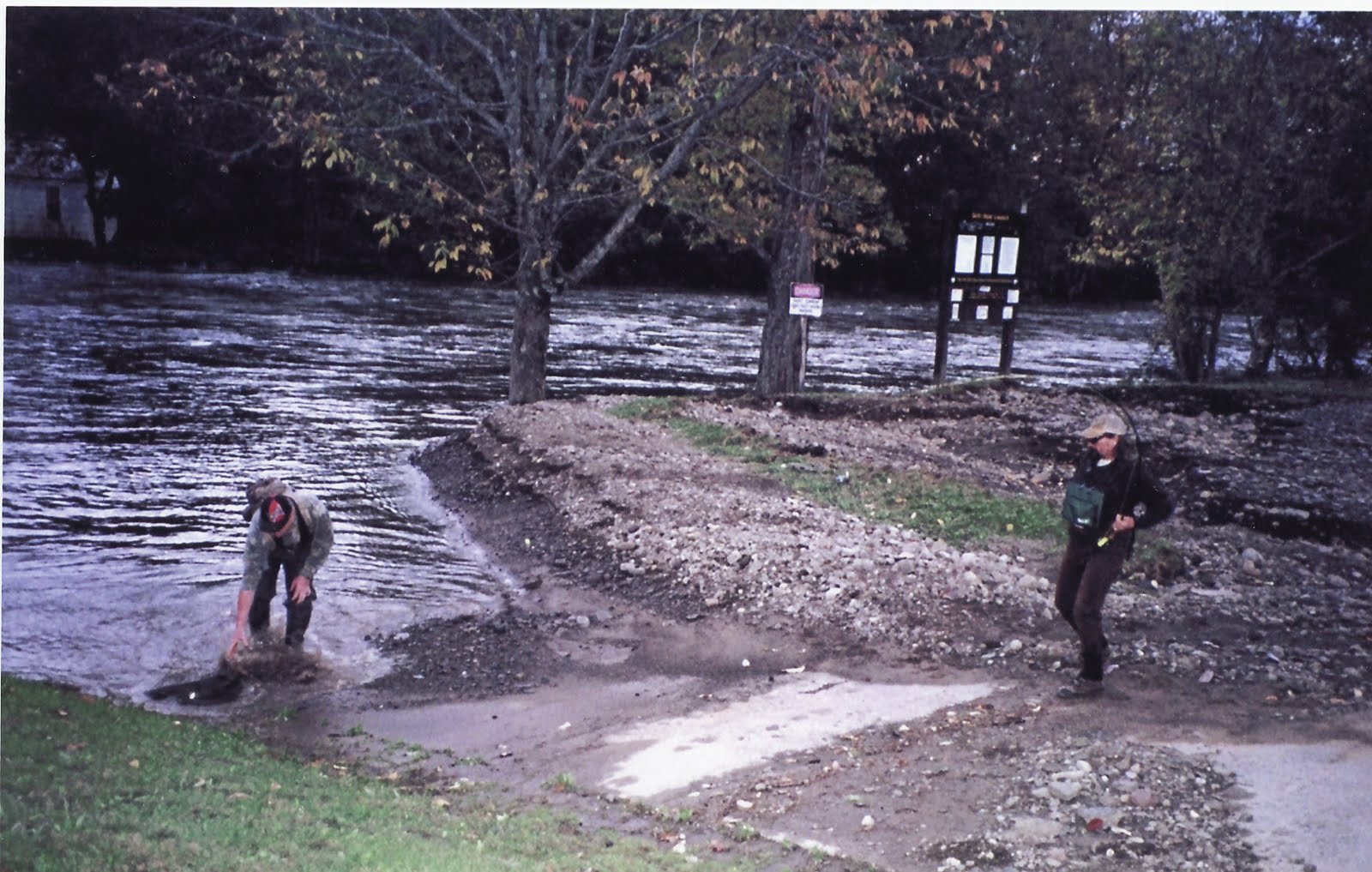
By the time I arrived on the scene at 5:30 p.m., the water was on its way down. But it was still way up there, higher than during your average spring thaw. A side channel with a good current plowed through the fishing access site on the northwestern corner of the bridge. I watched two kings get hooked in the parking lot. They were huge, at least 35 pounds each, and when they decided to head back to the main river, the anglers couldn’t stop them and they broke off.

An eddy developed at the drift boat launch on the other end of the bridge. I saw a guy holding a bowed rod high over his head. It danced in time with the thrusts made by the mighty king on the other end of the line.

Now, a sight like that normally doesn’t warrant a second glance. But this time, the guy was Ron Haney, an Altmar resident who only has one arm. You gotta see this guy fighting a fish to believe it. He holds his rod high while the fish has the upper hand, letting the drag, current and bent rod do all the work. When the fish tires and starts giving a little, Ron hangs the reel over his thigh and reels in the line.

He actually got the fish to shore, but it was a stubborn critter full of hope. Right when everyone watching thought the game was over, the fish waved its tail good-bye and snapped the line.

“That was a nice fish. But the conditions are tough,” Haney stoically remarked, staring out over the raging river.


Ron Haney holding on while an angler tries tailing his king. It got away at the last minute.

High water is good for salmon and they were everywhere. Unfortunately for “sports,” the water was too much to chase after the beasts and few were landed. Sunday saw the water down enough for anglers to have a fighting chance. I saw fish get taken in every pool I visited on the Salmon River. Kings mostly, with a few browns and steelies mixed in.

Water in the River Park's walkway, downtown Oswego, October 3.

South of the plant, more than two feet of water surged along the concrete wall lining the riverbank, forcing folks to fish from the sidewalk. Some brave anglers entered the water at the trail’s end but heavy current wouldn’t let them get more than 15 to 20 feet from the staircase.

Anglers fishing on the walkway upstream of the power plant, an area they usually fish from a dry bank.

Above the power plant, the stairway ended in water on Sunday.

Under normal conditions, salmon mill around in the lake waiting for high water before storming in. Usually, it comes after autumn showers that only raise the river a few inches to a foot per storm. As a result, the runs are staggered.

This year three months of rain fell in one day and the water rose to Global Warming proportions. It’s a good bet that a lot of salmon will take advantage, and come in groups to spawn, offering super fishing over the next several weeks.

So, there’ll still be plenty of salmon to catch, with late-running fish all month long.

In addition to kings with record-breaking potential, steelhead and brown trout runs should be off the charts. The high water will draw massive quantities of both species into the Salmon and Oswego Rivers; browns until the end of the month, chromers from now through spring.

The fish are huge, so’s the water. Put the two together and we stand to have the best fishing Oswego County--aka water of champions--has seen in 25 years.

When the water came down on Sunday, anglers began landing fish again.
.
.
A happy Sunday morning angler on the Salmon River

Friday, October 1, 2010

Salmon are In…and They’re Huge!

Notice: Given the recent weather conditions, the Salmon River and the Oswego River have become extremely dangerous. We urge anglers to consider fishing techniques other than standing directly in the water, such as fishing from streams, piers or driftboat, until the high water levels subside.

Normally, the last week of September sees waves of kings and cohos climbing the rapids of the Salmon River to spawn. This year the runs are on time but there’s one noticeable difference: the fish are the biggest they’ve been this century.

And that was expected. Fish that were taken from the tiniest Great Lake over the summer were huge compared to recent years. A lot of 35-something pounders were landed, including a 39 lb. 8 oz. fish that took America’s Fall LOC Derby. Better still, the Great Ontario Salmon Derby, a Canadian tournament sponsored by the Toronto Sun, was taken by a 40 lb. 2 oz. fish caught in July. The fish were so big, rumor had it charter boat captains were whistling “Happy Days are Here Again.”

I called some bait shops the last weekend of the month and they all reported the river was loaded with fish. One, under condition of anonymity, claimed so many fish were taken right in the heart of Pulaski, Main Street’s sidewalks were coated in a layer of fish slime.

I had to see that. But I couldn’t break away from other commitments until Monday night.

I got to Pulaski around 5 p.m. Parking on the shoulder on the side street heading to the ball park, right where US 11 banks west before crossing the Salmon River, I strapped my corkers to my sneakers (in case the sidewalks were slimy, you see) and headed for the bridge.


Salmon are everywhere in the river.


There was only about a dozen guys fishing on both sides of the crossing, but what the river lacked in anglers, it more than made up for in salmon. They were everywhere. I saw anglers fighting salmon, salmon frolicking on the surface in the Village Pool, and salmon climbing the rapids just upstream of the bridge.

I went to the Ball Park and the story was the same. Anglers were stretched out in comfortable distances from one another along the stream. Everywhere I went, someone was fighting a fish.

Kings ranging from 15 to 30 pounds made up the vast majority of fish I saw on stringers. But cohos ranging from 10 to 18 pounds were strung up with em in many cases…and that’s big for the species.

Again, that shouldn’t really surprise anyone, considering the world record coho, a fish indigenous to the Pacific Ocean, came out of the Salmon River several years ago.

All the salmon activity has spurred steelies into action. Several anglers I talked to, including PA resident Kurt Kmetz (see photo), have been catching steelhead ranging from 5 to 10 pounds on streamers like egg sucking leeches.

Thankfully, the unethical behavior spawned by snagging practices that were encouraged in the 1970s and early 1980s is a distant nightmare. There are fewer guys running up and down the river swinging hooks at everything with fins, and ethical anglers are reprimanding those who still try, so the fish have calmed down and are remarkably eager to hit a fly.

This world class salmon fishing is playing now through the middle of October. Get there early to claim the good seats.

PA resident, Kurt Kmetz, holding a 25-lb. king and a 15-lb. coho.


Village Hole

Wednesday, September 8, 2010

Stormin' Salmon

Most years, precocious salmon start trickling into Lake Ontario’s large tributaries in late August. But only a few lucky anglers, usually the earliest risers, ever get one until this month. You see, in August, water temperatures are generally way too hot by day to hold them, and the few fish that make reconnaissance runs at night seldom get too far before deciding the tight water isn’t for them and beat fins back for the lake.

And then there’s this year. August will probably go down as one of the most unusual in terms of numbers of early salmon running Oswego County’s large Lake Ontario tributaries. The heavy rains on the 21st and 22nd cooled the water and raised the streams enough to draw good numbers of kings from Aug. 25 through the 28th.

The Oswego River was still raging the last weekend of August. The Oswego Salmon Shop’s (315-342-2778) Larry Muroski claimed guys had been hooking up with fish off the high wall behind his shop for a few days, including several that morning.

I went down to take a look at the river and watched a couple guys fishing for about 15 minutes. No one hooked anything but I saw a fish porpoise.

Denise, a.k.a. "Mayor of the Salmon River," working her Spey casting magic;
a highly stylized form of fly-fishing developed in the Spey River region of Scotland.

A fly-fisherman starting his line up on the Salmon River in Altmar.

Next I headed for the Salmon River. I stopped at Woody’s Tackle and Gifts at the corner of NY 13/ NY 3 (315-298-2378). Karen was manning the register as usual and claimed that many customers reported catching fish over the past few days.

Outside, I watched a pick-up turn into the lot and park next to me. In the back, it had a large cooler splashed in red – and a huge spotted fish tail hanging out one end.

“Catch anything?” I asked the driver.

“Yeah, we landed three and lost one,” he replied. “Wanna see the biggest?”

“Sure do.”

“He weighs 35 pounds,” he gushed while lifting the dripping beast from the box.

As luck would have it, I ran out of film taking shots of the raging waters of the Oswego River. And after buying a new roll in Pulaski, I couldn’t find an angler with a fish.

So I returned the next day. It was hot and pleasant, not exactly a good day for salmon fishing in August. I didn’t get any hits but I saw a couple fish in the Staircase.

After giving my arm a good workout practicing Spey casting, I drove around and took photos of others fishing. No one had a salmon, but one guy said he saw one get landed that morning in the village’s ballpark area.

The title to the feature on page 34 of the current “New York Fresh Water Fishing Guide” proclaims “Fishing New York’s Great Lakes: The Good ‘Ol Days are Now.” From what I saw in the bed of the truck at Woody’s and from what I’ve been hearing, this year promises to see the biggest salmon in over a decade run the Salmon River.

Forty-pounder, anyone?