Showing posts with label pulaski. Show all posts

Friday, October 14, 2016

Salmon Are In

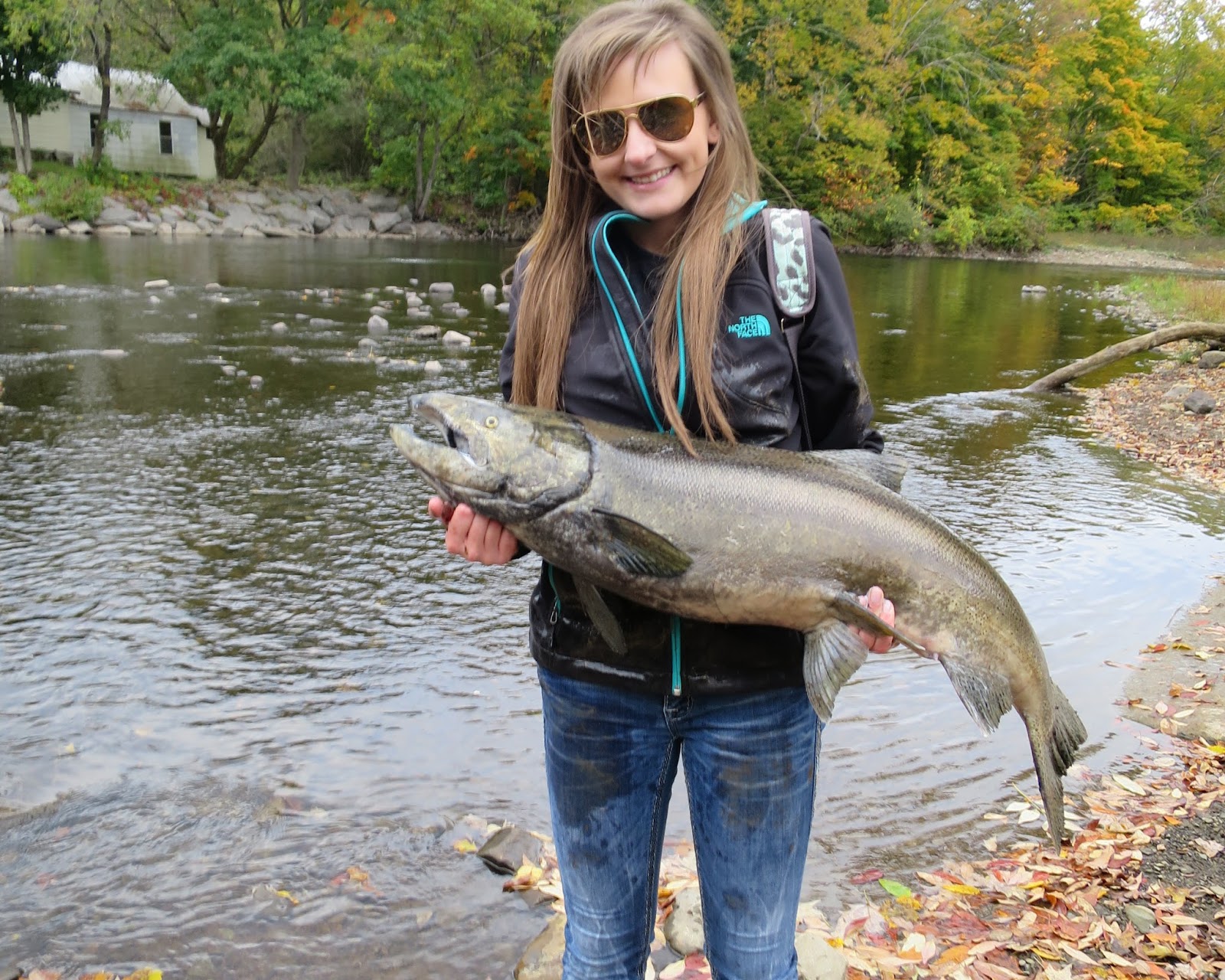
Typical Salmon River King
An old saying goes: The only things that are certain are death and taxes.

Well, that adage is due for revision; around these parts, anyway.

It should claim: The only things that are certain are death, taxes and Pulaski’s salmon run.

Indeed, the river running through this Oswego County village has been on the radar of the world’s most enthusiastic anglers for a couple centuries, now.

Back in the old days the Salmon River was the best stream in the state for trophy landlocked Atlantic salmon--it was named after them, in fact.

It’s still the best spot; only now the fishing is much better.

Atlantics are the first salmon to spawn. Entering the river in summer, they do their thing and beat it back to the lake. Oh sure, late bloomers hold off running until this month, some even wait until November, but their numbers are so few, they don’t draw much attention from anglers. If they’re caught at all, it’s usually incidentally.

Kings and cohoes to the rescue. Pacific salmon don’t start running in significant quantities until mid-September, and when they do, they storm the river in such numbers you could cross it on their backs…If they weren’t so slippery, of course.

While it’s well known Pacific salmon stop feeding when they return to the river to spawn, they will hit a streamer or lure.

Talking heads believe that’s because they’re used to being the biggest kids on the block. Extremely aggressive to begin with, they naturally get meaner in route to the spawning beds, striking out at anything that gets in their way.

The main salmon run stretches through this month, with stragglers showing up into November…even later.

This month the salmon will be joined by trophy brown trout and steelhead.

Decisions... Decisions...

Thursday, September 22, 2016

Fishing the Rapids during the Run

Coho taken in the rapids at the bottom of the Long Bridge Hole in Pulaski, N.Y.

This week marks the time to get excited about Oswego County’s salmon runs.

Oh sure, a few precocious kings and cohoes have been teasing gung-ho, big-game anglers since the end of August; but you ain’t seen nothin’ yet!
Thousands of kings and cohoes will rip through the rapids from now until late next month. So many, in fact, cousin Staash claims “they’ll raise the water level a couple notches.”

You can bet the fish are gon’na draw legions of anglers from all over the Northeast, too.
Inexperienced in the ways of salmon in the fast water, most of these guys will think like humans and surround the big, deep  holes,  thinking they’re  the best spots to catch the trophies swimming around in their imaginations.

The fish are sure to be there, and fishing the rapids is one of the surest ways to find them.
You see, out in the big pond salmon are accustomed to being the biggest kids on the block. They bring that attitude with them when they enter the river, aggressively striking anything that gets in their way. Their confidence quickly fades after tasting the sting of a hook, or encountering excited anglers chasing after them.

That sends most of them heading for cover in the deep pools…where they encounter more hooks and more fish. So what’s a salmon to do?
Run!

And into the rapids it goes.
An exciting way to catch one is to swing a streamer through the current. Good patterns are wooly buggers in trout colors (brown or chartreuse) and Mickey fins.

Good spots to try on the Salmon River include Pineville Pool, Long Hole, Trooper Hole, Ball Park Run and Staircase.
Don’t be aggressive. Simply cast the streamer across the river and let the current swing it back to your side…and hold on.

After all, any fly-fisher can tell you: The drug is the tug!


Wednesday, September 14, 2016

Estuary Perch

Stan Oulette of Deer Creek Motel; Pulaski, N.Y.


Back in the early 1960s, catching Pacific salmon and steelhead in Lake Ontario was just a dream entertained by fish and game officials and dreamy-eyed anglers, many of whom had fished out West.

To your average local angler, the targets of choice were warm-water species like smallmouth bass, northern pike and yellow perch. The estuary, the slow-moving, lower stretch of the Salmon River running from the last set of rapids to the mouth, was one of the best spots around to catch ‘em all, especially a bucket of yellow perch.

“Still is” boasts Stan Oulette of Deer Creek Motel, located on State Route 3, a couple miles north of Port Ontario. “In fact,” he claims, "it’s Oswego County’s best kept secret.”

Stan and his brother David are local experts on the lower river. With good reason: both, along with their families, love to eat fish, and perch are their favorite. 

“The estuary always holds fish,” claims Stan, “but they change with the seasons… northern pike are plentiful in the spring, bass are in all summer long, salmon and brown trout come through in the fall, steelhead in winter and spring, and perch…ahh, perch,” he goes on, dreamlike  “… they’re always around.”

The bait of choice for these tasty panfish is a minnow fished on bottom or suspended a few inches off the floor below a bobber. Squeamish anglers and those who prefer artificial lures will catch a batch by jigging a Berkley Atomic Teaser tipped with a Power Honey Worm.

An angler inexperienced in the ways of Lake Ontario tributaries would probably conclude the perch—indeed, all panfish—flee the estuary at the first sight of a salmon.

The exact opposite is true; panfish are drawn into the estuary and spurred into a feeding frenzy by all the salmon eggs and tiny life forms that feed on salmon cadavers.


Friday, February 21, 2014

Salmon River International Sport Fishing Museum


By
Spider Rybaak

Fred Betts with the cream of his collection.

Fishing museums are rare. Of the handful in existence, NY boasts two of the finest, both located on world famous trout streams. Oswego County has the most complete: The Salmon River International Sport Fishing Museum.

Truth be told, the Catskill Fly Fishing Center and Museum in Livingston Manor, on the banks of Willowemoc Creek, a tributary of the Beaverkill,  which flows into the East Branch of the Delaware River, is more famous. That’s mostly because it’s been around for about 20 years longer, is located in the Catskills, the cradle of American fly-fishing, and is only about 50 miles from New York City.

But the Salmon River is rapidly becoming the top salmonid stream in the world— it’s already the most famous in the Lower 48 states. Another, equally important factor that’ll propel the SRISFM into the front of the pack is its inclusiveness; it covers all aspects of fishing, everything from casting and spinning  reels, to trolling rods, eel spears, lures and trout creels.  

In fact, Fred Betts, a Central New Yorker who boasts one of the finest creel collections around, gave a lecture on their history last Sunday, February 16. He brought the cream of his collection to show the evolution of fishing baskets, and how each change benefited anglers.

Betts’ talk was part of the facility’s newest program, “Afternoon at the Museum.” An open house held every third Sunday of the month, the series will feature speakers on a litany of fishy subjects.
The next talk, given by Mike Riordan, is scheduled for 3:30 p.m. on March 15, and will cover the history of fishing line, from the braided horse hair lines of Ancient Rome to today’s super braids.

Riordan, president of the museum, says it’ll by open at 2 p.m., giving folks a little time to wander through the exciting displays before the speaker’s presentation, which will be given at 3:30 p.m.

But there’s more to the place than fishing equipment. The walls are plastered in fine art. Everything from fanciful Romantic era fishing scenes to realistic oils by greats like Maynard Reece is represented.

Run by volunteers, the hours of operation aren’t set in stone. However, the lobby contains loads of literature and is always open.

The museum is located at 3044 State Route 13, a few miles east of Pulaski. For more information, call 315-298-2213, visit www.salmonriverinternationalfishingmuseum.org. or www.facebook.com/pages/Salmon-River-International-Sport-Fishing-Museum/152643681444857. 

Old time fly wallet.

Fine art graces the museum's walls.

Ice fishing and eel spears.

Thursday, November 14, 2013

Steelheading without the Leaves


By Spider Rybaak

Nice hen steelie taken on a wooly bugger.

One of the most frustrating things about early steelhead fishing is putting up with fallen leaves; they’re floating on the surface, suspended in the water, carpeting the floor. Come November, they can be so thick, it’s like fishing in a kaleidoscope.

To the uninitiated, that doesn’t sound so bad. After all, kaleidoscopes are entertaining, giving idle hands something to turn, bored eyes symmetrical patterns to feast on.

But fishing is serious business, and the Salmon River ain’t a romper room. If you have to spend half your time clearing leaves off the hook, the other half dodging leaves while trying to present a bait naturally, especially when you’re watching fish shooting the rapids, it can amount to an exercise in frustration, and that can make you grumpy.

So I went up to the Salmon River on Veterans Day to swing some streamers through the rapids with my Spey-casting equipment, conditions permitting.

Much to my delight, the conditions are super. Oh, a few leaves are still blowing into the water. But they’re so few, I only hooked a couple in the hour I fished.

Best of all, I hooked a steelhead weighing about 5 pounds, too, on a chartreuse wooly bugger I swung through the rapids behind a 10-foot Rio Spey VersiLeader, with a sink rate of 2.6 inches per second.

And I wasn’t the only lucky one on the river. A couple guys hooked steelies on beads they were float-fishing with centerpins in the Long Bridge Hole. Another took one in the rapids on an estaz egg he was chuck-n-ducking in the bottleneck, at the curve, about 100 yards upstream.

I was Spey-casting in the pool between the Long Bridge pool and Village pool, a relatively shallow spot with heavy rapids; two features that discourage normal anglers--which normally means there’s fish and room.

You see, most guys fishing the Salmon River think like humans, and concentrate on deep, slow moving pools.

I like to think like a fish. Right now, the water temperature is in the high 40s, and trout are still very active. Since they’re as lazy as I am, they hang out in fast water (they’re streamlined, the current goes effortlessly around them) where eggs float down to them and all they gotta do is open their mouths and suck ‘em in. And if a streamer swims by…well, that’s icing on the cake.

Steelhead are running the river right now in search of easy pickings; which means they can be anywhere…and they’re hungry.

Wednesday, September 4, 2013

Salmon Everywhere


By Spider Rybaak


Sue with her biggest king.

Up until this summer, the term August kings referred to the legions of mature salmon that traditionally stage off the mouths of Lake Ontario’s tributaries in late summer to await the biological urge that shuts down their hypothalami and launches them upstream to spawn. This year changed that definition.

Oh, massive quantities of kings are still staging in Oswego County’s territorial waters. Indeed, the Oswego River draws an amount proportionate to what you’d expect the smallest Great Lake’s second largest tributary to attract. Its plume reaches out into the lake for miles, hooking the hormones of fish from here to Canada, drawing massive quantities of trophy Chinooks and cohos to the city of Oswego’s north bank.

It’s obvious from all the charter boats trolling within a mile of the Port City right now. In the past, they’d be out so far the first half of September, you’d need binoculars to see half of them.

And the fishing’s great. On the evening of August 29, Captain Richard “Big Dick” Stanton (Stanton Charter Service; 315-685-0651) took outdoor writer/online visibility expert Sue Bookhout fishing less than a mile due north of the city. It only took her about two hours to land (it was her first time out so she lost some) her limit of salmon: kings weighing 10 and 23 pounds, and a 12-pound coho; all of ‘em on a fly dragged behind an echip flasher.

Out in the lake, action like this is expected this time of year; and lots of guys plan their vacations accordingly. So this kind of excitement, within easy sight of the big city, is typical and loads of fun.

The Salmon River is a different story. Normally, only small groups of kings climb the stream in August;  usually on reconnaissance runs up to the Black Hole, sometimes a little further, with the majority falling back to regroup and join the major runs of mid- to late September.

This year kings began trickling in by the first of August, running the entire stream. The second week saw noteworthy runs.  And they haven’t stopped coming.

Fran Verdoliva, the state’s program coordinator for the Salmon River, says these are all wild fish, surmising that naturally bred kings run earlier than hatchery fish.

Captain Rick Miick concurs. “In the past, fish that ran this early would come in and out. This time they’re spawning and dying.”

September 1st saw lines of anglers at all the popular spots in Pulaski. Anglers interviewed for this blog claimed the fish upstream were all taken and a new run was shooting through town that morning.

The fish being hauled up the bank were all silvery, indicating they were fresh-run.

“These salmon are at their peak,” claimed an unidentified angler. “Unlike hatchery-bred fish, they’re super aggressive, avoid man…and fight!!!

 “With all these wild fish around, it’s like mother nature giving us another month of salmon in the river,” adds the New Jersey native.  “I can’t wait to see what she’s got in store for us when the browns and steelies start running.”

This season promises to be another for the record books; Oswego County’s getting good at doing that.
Captain Dick adjusting the drag during the fight.

Pay-off for two hours of trolling.

 Boats trolling for kings less than a mile off Nine-mile Point.

Stairway to Home.

Viewing platform on Maple Ave., Pulaski.

Discussing theory.

Hey buddy, give me a hand.


Friday, March 22, 2013

Flies and beads: Pathways to a steelie heart.


By Spider Rybaak
Rick Miick (L) and Stan Oullette with a 10-pound steelie taken on a orange bead in the corner Hole.


Global warming seems to have been put on hold again. At press time, March 22, more than half a foot  of snow clings to the banks of the Salmon River, and the weather forecast calls for more snow showers over the next few days.

But what’s bad for weather forecasters is great for Salmon River anglers. Currently, Brookfield Renewable Power is releasing about 900 cfs from the lower reservoir. Despite being more than twice the level it was just a week ago, the river is running at a pace steelies find easy and safe to negotiate; a flow anglers with average skills can ply productively.

Rob, one of the owners of Fat Nancy’s Tackle Shop on NY 13, just across from the Pulaski exit of I-81 (877-801-3474), says the water is still very cold but there’s a lot of fish in the river nonetheless.

All the usual suspects are producing: Egg sacs, 3-inch Berkley floating trout worms, beads, Streamers and Spey flies.

Trout worms and eggs sacs can be chuck- ‘n-ducked, but work best when float-fished. Spinning tackle will do, but centerpinning equipment is best.

If you’re still in the dark about centerpinning, it involves a single-action reel whose spool rides on a centerpin so it to spins effortlessly, allowing your float to keep in perfect time with the current. The rod can run anywhere from 10 to 15 feet. Its length allows you to keep the line off the water--and avoid drag--for great distances, a plus if you’re into “hero casts.”

“Beads are the most productive baits in the pinhead’s arsenal,” raves Capt Rick Miick (www.TrophyDreamcatcher.com , 315-387-5920). The man taught me how to centerpin, and has produced a popular DVD on the subject.  “When you float fish beads, 30-hit days are common,” adds Miick.

Spey casting flies is a little less productive but so much fun, if you try it once, chances are you’ll be hooked for life.

Migell Wedderburn, a native of Pennellville, says: “I don’t do regular fishing anymore. It has to be Spey and nothing else. I have learned Spey fishing is beautiful and you can fish a rocky bottom easily and not get hung up.”

He’s even developed his own nymph he calls the Death Ray.

 “Spey casting instructor and fly-fishing guide Pat Miura (315-777-3570; pmiura@aol.com), an angler respected by his peers and clients alike, says” the drug is the tug.”

And he’s right. Even a 6-inch Fallfish feels like a trophy trout when it strikes a fly swung across the current on Spey casting gear.

But you don’t need a double-handed rod to Spey cast. A regular 8-wt. reel loaded with floating fly line and a sinking leader, and a 9-foot fly rod will do in a pinch.  Simply roll cast a brown or olive wooly bugger across the current and let it swing downstream.  When  the bow in the line starts straightening out… hold on.

Migell Wedderburn's Death Ray

Migell Wedderburn, a nice steelie, and the Death Ray hanging from the roof of its mouth.


Wednesday, May 23, 2012

Kids Fishing Classes


By Spider Rybaak

Baldwinsville's Ethan Pruner with the first fish he's ever caught on a lure, and first smallmouth.
Mike Riordan’s dad planted countless memories by taking his boy fishing every chance he got. After his father died, Mike figured the best way to honor him was to pass on the many memorable lessons his dad blessed him with, and started day-long fishing seminars each spring at the Calvary Baptist Church in Brewerton. Over the years, his program has grown to attract thousands of kids and their parents, hooking them on this fabulous pastime.

I was honored to do a presentation on fishing from shore in Oswego County at the last event held on March 29. The enthusiasm shown by the children and their parents was unbelievable. Everyone had questions…so many questions; enough, in fact to make me walk away deeply troubled. After all, how can a parent teach a kid to fish if he doesn’t know how to tie a knot, bait a hook, the difference between a fly and crankbait...?

After giving the situation some thought, I contacted Mike McGrath, of McGrath & Associates Carp Angling Services (315)-882-1549); www.marukyu.com/eng  and invited him to join me in setting up a series of kids fishing clinics designed to help students from 5 to 75 to learn the ropes. 

We held our first class last weekend at the Clyde River fishing access site at Montezuma National Wildlife Refuge. To no one’s surprise, it was a resounding success. You see, Mike is the Pied Piper of carp. Instead of using a musical instrument, he hooks them with an astonishing menu of goodies, chumming an area with grains and vegetables soaked in juice and syrup, drawing them from miles around to his feasts.

And they come…by the hundreds. Everyone within eye shot--on both banks and in boats--had encounters with the beasts; our students, most of all.

Mike ended up drawing fish ranging from 10 to a whopping 25 pounds. Needless to say, the kids and their parents were hopelessly hooked. 

I conducted classes on lure fishing.  While everyone was mesmerized by McGrath’s magic, I went off by myself and started working a Berkley PowerBait Atomic Teaser tipped with a Chartreuse Power Wiggler. In about an hour, I landed everything from smallmouths and crappies to bluegills and rock bass. 

After catching his fill of huge carp, Ethan Pruner, like any youngster, started looking for other spots. I caught his eye and he came over to see what I was throwing. I showed him, gave him a pack of each to keep, tied the combination on his line, instructed him for a moment on the art of jigging and before you know it he’s battling his first smallmouth…and the first fish he’s ever caught on a lure.

Mike and I plan on doing several more clinics in Oswego County this summer. The first will be on June 2, at the municipal dock just off the northeastern corner of the US 11 bridge in Brewerton, 10 a.m. to 1 p.m. Bait and instructions will be provided free, and loaner Shakespeare rod and reel combos—spin-casting and fly-fishing--will be available for the duration of the class. Anglers 16 and older must have a NYS fishing license. Children under 14 must be accompanied by an adult.

For more information, call me at (315) 633-1245 or Mike at the above number.

See ya there.

Mike McGrath holding Ethan Pruner's first carp.

The Ultimate Fishing Town Contest: Vote for your Town!


World Fishing Nework.com, the only 24/7 TV network dedicated to all segments of fishing, recently announced its Ultimate Fishing Town Contest, and invites everyone to help in determining the location. Oswego, home to two of the most famous rivers in the Northeast, the Oswego and Salmon, has two communities vying for the honor: Oswego and Pulaski. The town that wins the title will receive a $25,000 community donation, and will be featured in a segment on WFN as the Ultimate Fishing Town.

“It’s clear to those who live here that Oswego County has the ultimate fishing spots and the perfect destination for outdoor enthusiasts,” says David Turner, Director, Community Development, Tourism and Planning. “It’s time to tell everyone outside the state: Oswego has the top two Ultimate Fishing Towns in the Country!”

Voting is allowed every 6 hours and closes on May 31, 2012.
Cast your vote:


For more information on Oswego County and fishing destinations in Oswego and Pulaski, visit www.visitoswegocounty.com.