Showing posts with label fishing. Show all posts

Friday, October 14, 2016

Salmon Are In

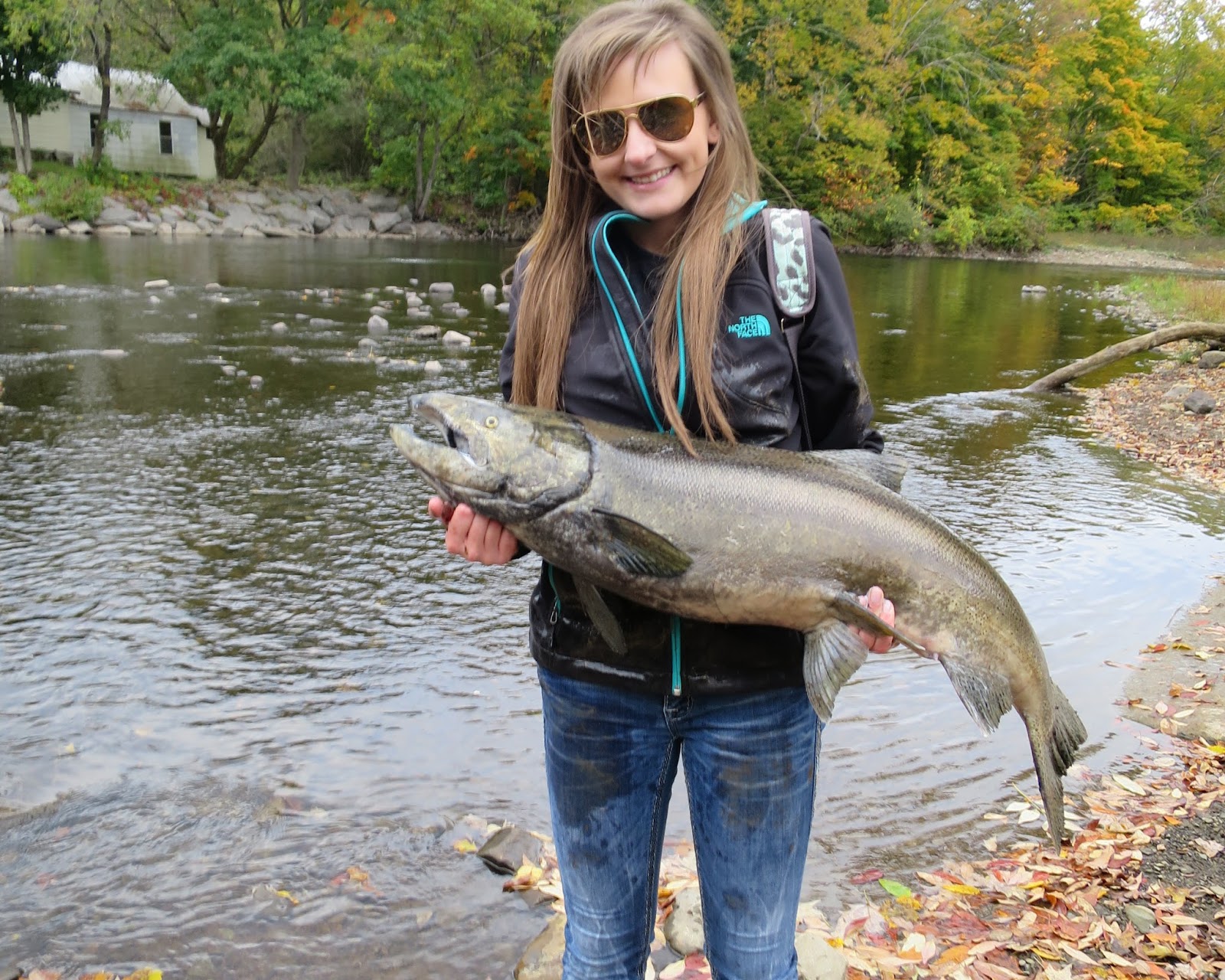
Typical Salmon River King
An old saying goes: The only things that are certain are death and taxes.

Well, that adage is due for revision; around these parts, anyway.

It should claim: The only things that are certain are death, taxes and Pulaski’s salmon run.

Indeed, the river running through this Oswego County village has been on the radar of the world’s most enthusiastic anglers for a couple centuries, now.

Back in the old days the Salmon River was the best stream in the state for trophy landlocked Atlantic salmon--it was named after them, in fact.

It’s still the best spot; only now the fishing is much better.

Atlantics are the first salmon to spawn. Entering the river in summer, they do their thing and beat it back to the lake. Oh sure, late bloomers hold off running until this month, some even wait until November, but their numbers are so few, they don’t draw much attention from anglers. If they’re caught at all, it’s usually incidentally.

Kings and cohoes to the rescue. Pacific salmon don’t start running in significant quantities until mid-September, and when they do, they storm the river in such numbers you could cross it on their backs…If they weren’t so slippery, of course.

While it’s well known Pacific salmon stop feeding when they return to the river to spawn, they will hit a streamer or lure.

Talking heads believe that’s because they’re used to being the biggest kids on the block. Extremely aggressive to begin with, they naturally get meaner in route to the spawning beds, striking out at anything that gets in their way.

The main salmon run stretches through this month, with stragglers showing up into November…even later.

This month the salmon will be joined by trophy brown trout and steelhead.

Decisions... Decisions...

Thursday, September 22, 2016

Fishing the Rapids during the Run

Coho taken in the rapids at the bottom of the Long Bridge Hole in Pulaski, N.Y.

This week marks the time to get excited about Oswego County’s salmon runs.

Oh sure, a few precocious kings and cohoes have been teasing gung-ho, big-game anglers since the end of August; but you ain’t seen nothin’ yet!
Thousands of kings and cohoes will rip through the rapids from now until late next month. So many, in fact, cousin Staash claims “they’ll raise the water level a couple notches.”

You can bet the fish are gon’na draw legions of anglers from all over the Northeast, too.
Inexperienced in the ways of salmon in the fast water, most of these guys will think like humans and surround the big, deep  holes,  thinking they’re  the best spots to catch the trophies swimming around in their imaginations.

The fish are sure to be there, and fishing the rapids is one of the surest ways to find them.
You see, out in the big pond salmon are accustomed to being the biggest kids on the block. They bring that attitude with them when they enter the river, aggressively striking anything that gets in their way. Their confidence quickly fades after tasting the sting of a hook, or encountering excited anglers chasing after them.

That sends most of them heading for cover in the deep pools…where they encounter more hooks and more fish. So what’s a salmon to do?
Run!

And into the rapids it goes.
An exciting way to catch one is to swing a streamer through the current. Good patterns are wooly buggers in trout colors (brown or chartreuse) and Mickey fins.

Good spots to try on the Salmon River include Pineville Pool, Long Hole, Trooper Hole, Ball Park Run and Staircase.
Don’t be aggressive. Simply cast the streamer across the river and let the current swing it back to your side…and hold on.

After all, any fly-fisher can tell you: The drug is the tug!


Wednesday, September 14, 2016

Estuary Perch

Stan Oulette of Deer Creek Motel; Pulaski, N.Y.


Back in the early 1960s, catching Pacific salmon and steelhead in Lake Ontario was just a dream entertained by fish and game officials and dreamy-eyed anglers, many of whom had fished out West.

To your average local angler, the targets of choice were warm-water species like smallmouth bass, northern pike and yellow perch. The estuary, the slow-moving, lower stretch of the Salmon River running from the last set of rapids to the mouth, was one of the best spots around to catch ‘em all, especially a bucket of yellow perch.

“Still is” boasts Stan Oulette of Deer Creek Motel, located on State Route 3, a couple miles north of Port Ontario. “In fact,” he claims, "it’s Oswego County’s best kept secret.”

Stan and his brother David are local experts on the lower river. With good reason: both, along with their families, love to eat fish, and perch are their favorite. 

“The estuary always holds fish,” claims Stan, “but they change with the seasons… northern pike are plentiful in the spring, bass are in all summer long, salmon and brown trout come through in the fall, steelhead in winter and spring, and perch…ahh, perch,” he goes on, dreamlike  “… they’re always around.”

The bait of choice for these tasty panfish is a minnow fished on bottom or suspended a few inches off the floor below a bobber. Squeamish anglers and those who prefer artificial lures will catch a batch by jigging a Berkley Atomic Teaser tipped with a Power Honey Worm.

An angler inexperienced in the ways of Lake Ontario tributaries would probably conclude the perch—indeed, all panfish—flee the estuary at the first sight of a salmon.

The exact opposite is true; panfish are drawn into the estuary and spurred into a feeding frenzy by all the salmon eggs and tiny life forms that feed on salmon cadavers.


Monday, November 9, 2015

Lake Neahtawanta: Best Kept Fishing Secret in Oswego County

By Spider Rybaak

The Pier at Lake Neatahwantha is a great place to teach kids to fish.
Covering roughly 750 acres on Fulton’s west side, skirted along its north bank by NY 3, Lake Neahtawanta affords easy access to the city’s 11,800-something residents.  Yet this huge pond on the edge of town doesn’t see many people at all.

You can blame its lack of fame on the Oswego River, the state’s second largest stream. Running through the heart of the city, boasting two sets of fish-rich rapids and a long stretch of canal, all lined with hundreds of yards of easy access, the river draws a lot of fishing pressure.

Natives don’t mind, however. Not because they’re altruistic and want to share their bounty; but because they have a plan B: Lake Neahtawanta.

Iroquois for “little lake near the big lake,” Lake Neahtawanta averages 6 feet deep and drops to a maximum depth of 12 feet. Roughly 75 percent of its shoreline is wooded, but its northeastern corner is wide open and public, offering loads of access on manicured lawns.

Savvy natives fish the place from the bank and boats. If you ask them how the fish are hitting, most remain calm, just shrug, and confess to catching some white perch, maybe a bullhead or carp. Not exactly something worth writing home to mom about.

That’s about all the attention most anglers give the place. And that’s a terrible shame.

Hailing from the south shore of Oneida Lake, I have all the dynamite fishing I want close to home and never found a good reason to fish this lake until 2010. That’s when Mike McGrath, my partner in a kids fishing program, suggested we do a couple sessions at Lake Neahtawanta. He took me up there and introduced me to the place.

The fishing was good. We added the spot to our list and have been staging a couple kids fishing classes there every year since.

Warm weather angling for white perch, bullhead and sunnies is popular from Bullhead Point Park. A pier stretches out for nearly 100 feet, and is favored by anglers who wish to fish in relatively deep water. The rough shoreline along the parking lot, and the manicured lawn that wraps around the northeastern corner for several hundred yards, are popular with folks who just want to kick back and relax while watching their rod tips for communications from the deep.

A few northerns and largemouth bass are also present, keeping things interesting. In fact, a local I know claims everything you find in the Oswego River, including unusual species like bowfin and gar, thrive in these waters.

Perhaps Neahtawanta’s greatest claim to fame is ice fishing.  In fact, its hard-water bite for crappies and panfish is legendary, drawing more anglers onto the ice than spring through fall.

While it’s possible to launch car-top craft from Bullhead Point, a more suitable spot is North Bay Campground. Located a couple hundred yards west of the point, at the end of Phillips Street, it offers a hard surface ramp. In addition, it has 36 seasonal sites and 42 day sites--each with easy access to the water--a camp store, a hard surface launch, a beach, bathhouse with showers, and a playground.

White perch are the lake's most cooperative fish.

Wednesday, May 6, 2015

Oneida Lake: still NY’s Walleye Hot Spot

By Spider Rybaak

A few of the winners line up.
Walleye season’s opening weekend proved once again what every pike enthusiast in Central New York knew all along: Oneida Lake is still your best bet when it comes to these toothy beasts.
From one end of the lake to the other, anglers netted pike, mostly walleyes, but a few northerns, too, including an 38-inch monster allegedly taken west of Frenchman Island.

Both sides of the Erie Canal at Sylvan Beach were lined with colorful anglers all weekend, from the opening minute straight through Sunday night.

Caughedenoy hosted loads of bank anglers throwing all the usual suspects, from Thundersticks and Rapalas to bucktail jigs and worms.

As expected, the crankbaits took the lions share in the plunge pool below the gates, primarily because they cover a lot of water and, most important, swim over most of the spot’s notorious snags.

Still, a couple old timers took their limits on bucktails. Not only by jigging them rapidly  to keep them above the rocks, but also by steadily swimming them, a technique locals claim was developed exclusively for the fast water on the Oneida River’s biggest oxbow.

Brewerton contributed some walleyes, too. The NYSDEC’s Fishing access sites on both ends of the I-81 Bridge coughed up a few for anglers jigging  Sonars in the deep water below the bridge, or running minnowbaits parallel to the canal’s drop-offs.

Out on the open lake, walleyes were hitting worms drifted on harnesses (spinner-rigged and plain), bucktail jigs, and Sonars.

The Cicero- Mattydale Lions Club held its 2015 Walleye Derby on Oneida Lake over the weekend, drawing 1,877 anglers to compete for more than $10,000.00 in cash and prizes.

Top honors went to Georgia native Jack Barber for a 27 3/8 inch walleye he took on a bucktail jig.
Herkimer native Mike Zucker won the drawing for a highly coveted  12-foot Low powered by an 8 horse. Merc.

Not surprisingly, jigs manufactured by Five-O Lure Co. and Voodoo Custom Tackle, a couple local firms, landed their users in the money.

The awards ceremony was held at Bartel Road Bait and Tackle, 5501 Bartel Road, Brewerton (315-676-2144). Bartel Road Bait and Tackle, a company specializing in all the popular Oneida Lake baits, announces its upcoming Pickerel Derby, May 26, 2015, from 6 a.m. to 1 p.m..

"The best 4-fish weight wins top prize,” says co-owner Kim Goffredo.

Tickets cost $10.00 and go on sale May 9.

“This derby is 100% payback,” says Goffredo, adding “ $8.00 goes into the general pot and $2.00 goes into the lunker pot.

“Last year we made 50 tickets and 151 anglers showed up,” claims Kim, suggesting anglers should sign up early.

For more info, call Bartel Road Bait and Tackle: (315) 676-2144.

At the weigh-in.


Thursday, May 8, 2014

Kids Fishing Classes


By Spider Rybaak

Marshall, an associate of McGrath's, holding a Lake Neatahwanta catfish as his student looks on.
New York is etched in a fabulous web of fishing hot spots. But even fantasies have highlights, and the most exciting fishing destination in the Empire State is Oswego County.

Not just for trophy seekers, either. Granted, catching a walleye or brown trout big enough to hang on the wall is a common goal; but it’s at the end of the line, one of the final tests of an angler’s skills. 

And expert anglers don’t just appear out of nowhere -- It takes years of patience and practice, even apprenticeship, to fully develop fishing skills. And although some learn the game as adults, most trace their interest back to when they were kids.

Mike McGrath is a good example. Packing almost two generations of angling expertise, the man is savvy in all things fishy: from tying flies and fly-fishing for trout, salmon, northern pike and black bass, to trolling for muskies, jigging for walleye and bottom fishing for monster catfish.

With all that knowledge under his cap, you’d expect to find him chiseling out a name for himself on the marble column of the world’s greatest anglers; or at least living high on the hog competing in the tournament circuit.

But that’ll probably never happen. You see, this mild mannered Central New Yorker is a husband and father.  And like the countless other unsung heroes throughout history, McGrath couldn’t live with himself without donating part of his life to giving back. He does it by instructing someone else’s kids in the secrets of carp fishing.

McGrath’s choice of the species is simple. He knows that youngsters have short attention spans. Although catching panfish is fun, the thrill is often fleeting. On the other hand, when children catch carp, the experience is so intense it’s burned into their fondest memories, often hopelessly hooking them for life to the character-building sport of angling.

Watching the master spin his magic, observers often ask: “But why carp?”

When you get to know him, the answer becomes clear: McGrath is a man of the times. An unabashed internationalist, he specializes in this fresh water behemoth because of its worldwide appeal; it’s the most popularly sought fish in the Old Country. (The fact that the Oswego River drainage boasts one of America’s greatest populations of huge carp doesn’t hurt, either.)

Having served apprenticeships under European and Asian masters, Mike knows his game. Like a turkey hunter, he draws his quarry in close. Instead of calling the fish vocally (he has trouble vocalizing the gurgles and grunts of carp speak), he lures them in with his “10 pack,” a gob of grain bound by sticky stuff like bismuth that he “packs” into clumps the size of softballs and heaves into the water. As the pack slowly dissolves, its flavors are released, drawing carp and catfish into the area.

He’s good enough at it to turn a profit running McGrath & Associates Carp Angling Services. But he always makes time to teach, and pairs up with this writer regularly to offer free classes on local waters.

To see how McGrath does it, or to learn how to fish with worms or lures in my section, you are invited to attend one of our classes. See the schedule below:

May 10:  Oneida Lake Hatchery, NYS Rte. 49, Constantia; 
11 a.m.-1 p.m.

May 17:  Lake Neatahwanta, NYS Rte. 3, Fulton; 11 a.m.-1 p.m.

June 14:  Lake Neatahwanta, NYS Rte. 3, Fulton; 11 a.m. – 1 p.m.

June 28:  Oneida Lake Hatchery, State Rte. 49, Constantia; 
11 a.m. – 1 p.m.

July 12:  Lake Neatahwanta, NYS Rte. 3, Fulton; 11 a.m. - 1 p.m.

July 19.   May’s Point Fishing Access Site, Montezuma National Wildlife Refuge, NYS Rte. 89;  11 a.m. -1 p.m.

August 9:  Lake Neatahwanta, NYS Rte. 3, Fulton; 
11 a.m. – 1 p.m.

August 16:  Great Swamp Conservancy, 8375 North Main Street, Canastota; 11 a.m. – 1 p.m.

September 6: Lake Neatahwanta, NYS Rte. 3, Fulton; 
11 a.m. – 1 p.m.

October 18:  Lake Neatahwanta, NYS Rte. 3, Fulton; 
11 a.m. – 1 p.m.

Mom and daughter admiring the child's first fish, caught during Spider's section of a kids fishing class on Lake Neatahwanta.


Mike McGrath unhooking an average-size Lake Neatahwanta carp.

Typical fishing class conducted by McGrath and Spider.


Monday, April 21, 2014

Salmon River Reservoir Thawing


By
Spider Rybaak

Kayaking the Salmon River in Redfield.

The nicest thing about severe winters like the one we just had is the pay back feels so good. Last weekend, Oswego County finally saw some global warming, with temperatures soaring into the high 70s, and folks stepped outdoors in droves to break their cabin fever. The Salmon River Reservoir saw loads of the weary gather on its banks to usher in spring by watching winter cry itself away.

While the Mad River, and both branches of the Salmon were too high and cold for average anglers to even think of fishing, their tributaries and the smaller creeks pouring into the reservoir were much more manageable. The water was so frigid, however, the fish weren’t into chasing after the bait, so you had to bump their noses with a garden worm to get them to hit. With all the run-off, that was kind’a hard and everyone interviewed for this story admitted to getting skunked.

Still, the mood was upbeat. “That leaves more for next month, when the brooks and rivers will not only be easier to get to, they’ll be easier to fish,” predicted Joe, a Pulaski native who wouldn’t divulge his last name.

A lot of bottom anglers tried their luck at the mouth of the Salmon River in Redfield. Fishing off the south bank, just below the County Route 17 bridge, they didn’t catch dinner, but were treated to spectacular natural scenes like glacier-sized floes sweeping downstream, the dalliance of bald eagles, and kayakers.

The channel below the public fishing access site’s platform at the northern County Rte. 17 bridge was mostly iced over and unfishable. However, several groups came to do everything from catch rays and play frisbie to relax in the fishing platform’s comfortable seats and take in the sounds and sights of the ice’s death throes.

A couple deer came around, too. They were just as surprised to see all the people as we were to see them, and bolted, jumping onto the spongy ice in their bid to reach the woods on the north shore. It held. But a couple spots of open water stood between them and the bank.

The lead deer jumped into the first opening, and the smaller one followed. Swimming over to the edge of the ice on the other side, the bigger doe struggled to get a toe-hold. Everyone feared the worst. A loud, collective sigh of despair swept over the reservoir.

Somehow, the struggling pair managed to climb onto the floe, slipped and slid their way across the porous ice, jumped into the second opening, and climbed out again.  Reaching the other side, they disappeared into the trees.

We hit County Rte 2.  The woods along the road were blanketed in snow.

Turning onto Dam Road, we headed for Salmon River Falls. Ice sculptures chiseled out of the snowbanks by the warm breeze lined the way. Susan decided to strike off for what would probably be her last jaunt through snowy woods this season. She thrilled in snowshoeing with just the shirt on her back.

The Salmon River Falls drew even larger crowds. The parking lot was full. But that didn’t matter because the trees were bare, and the awesome power of this magnificent cataract was easily visible from the road.

And there’s more. Although Monday’s warm weather whittled away at the ice and snow, the evening’s freezing temperatures, followed by Tuesday’s snow, sculpted the northeastern edge of Oswego County into a fresh winter wonderland.

It won’t last, however, probably not much past Easter, so get out there and enjoy while you can.
Susan Rybaak last-chance snowshoeing at the Dam Road. 


Deer heading for the Upper Reservoir's north shore.
Making it to the other side.

Monday, April 14, 2014

Chuck Parker: Sportsman Activist


By
Spider Rybaak

Tucked into the northeastern corner of Lake Ontario, claiming the entire western half of Oneida Lake, etched by the Oswego and Salmon Rivers, the finest salmonid streams in the Lower 48, and watered by numerous productive streams and brooks, Oswego County offers some of the best fishing in the Western Hemisphere. 

 Small wonder, then, that it spawns some of the finest conservationists in the country.

Take Chuck Parker, for instance. An avid hunter and angler, the Texas, NY resident believes political activism is every sportsman’s responsibility, and practices what he preaches.

Parker traces the roots of his activism to the Mad River Club, which he joined in 1989. Ever since, he’s served in numerous conservation-minded sportsmen groups in every capacity from secretary to president, and reached the top when he was elected to the presidency of the New York State Conservation Council (NYSCC) a couple years ago, an office he still holds.

Parker describes the NYSCC as an advocacy group dedicated to promoting sportsman’s issues.

“One of our greatest concerns is legislation out of Albany,” says Parker. “We have advisors on the New York State Conservation Fund Advisory Board and the New York State Fish and Wildlife management Board,” he adds.

True conservationists, the NYSCC’s membership knows man is an integral part of the natural order, and graciously accepts responsibility as steward of the environment.

The NYSCC’s website states: “For over 80 years, the NYSCC Inc. has been a leader in advocating the wise use and management of NY’s valuable natural resources to ensure that they are protected for our children’s children.”

In this vein, NYSCC member clubs offer a wide variety of outdoor activities designed to acquaint kids with the great outdoors, including 4 H Youth Shooting Sports Programs, Youth Fly-fishing, the Oswego County Envirothon, Oswego County Soil and Water’s Annual Conservation Field Days (open to 5th graders) and the Plant a Tree program.

Parker has been a Hunter Safety Instructor since 1993, and states, unabashedly, “We stand opposed to the New York Safe Act. We would like to see it overturned.”

And that’s to be expected, considering the group’s respect for the natural order, and its acceptance that man is on the top rung of the food chain.

Parker feels the greatest threat facing hunting and fishing is the lack of activism among outdoorsmen. “I’m involved with a lot of good sportsmen but the problem is 7 out of 10 don’t belong to a sportsmen’s club, so they don’t advocate for our right to hunt and fish.”

His solution:  “Get your friends to join a sportsman’s club and teach your children the importance respecting our natural environment as well as how to safely enjoy all that is has to offer.”

Chuck Parker was named as one of The Syracuse Post-Standard's "Heroes of Conservation" in 2011.  

Wednesday, March 26, 2014

Last Chance for Skinny Creek Steelies


By
Spider Rybaak

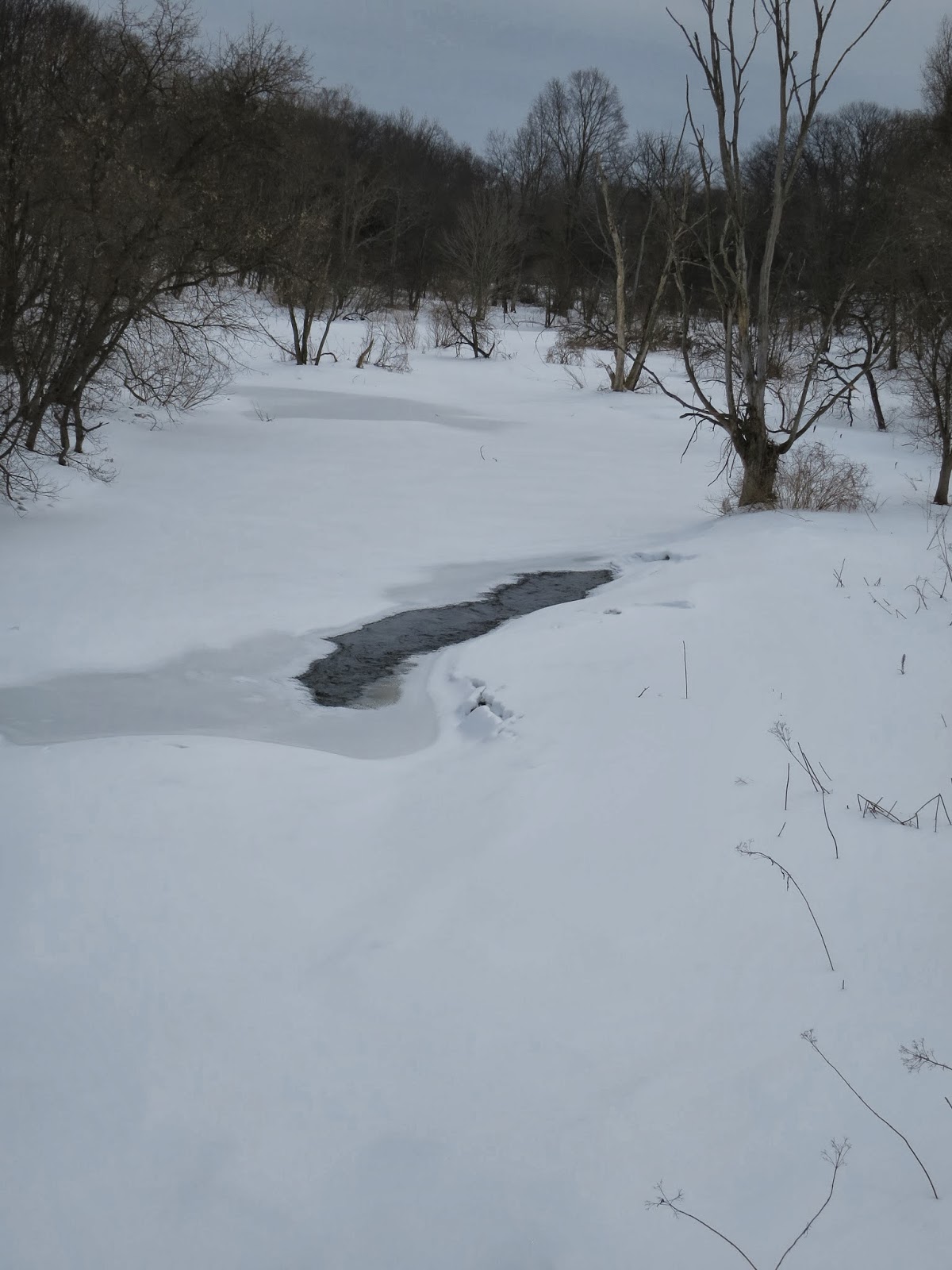
Little Sandy Creek is starting to emerge from winter's blanket.

Oswego County is steelhead country. Fast water anglers from around the world come up for the rich veins of ironheads running the Salmon and Oswego Rivers autumn through spring. As exciting as tackling a spawn-minded steelie in big rapids is, however, anyone worth his weight in glo-bugs can tell you taking one out of a skinny creek is even more fun and challenging.

Problem is, this winter has been so severe, most slim waters have been entombed in impenetrable ice caps since January. Steelhead ain’t complaining--they like the cover. On the other hand, die-hard creek fans are a little sore. But we’ll have our day… real soon.

You see, all that snow we had this year has gotta melt. When it does, run-off will swell the streams, sending their plumes deep into the lake, their ice caps into next winter. Steelhead cruising the open water cross these warm paths and follow them upstream, into the embrace of ideal spawning habitats.

All this promises to happen from now until mid-April. If the current weather patterns hold, the thaw will be slow and gradual, keeping the creeks at the optimal 40 to 44 degrees Fahrenheit for much of next month.

Some experts feel that this winter is a lot like the ones we had in the 1960s and 70s, and make predictions based on past experience. Fran Verdoliva, the New York State Department of Environmental Conservation’s Special Assistant for the Salmon River, says no matter what the weather does, the near term is going to be a win-win situation.

“If we get a burst of unseasonably warm weather, the thaw will be rapid and the water levels high and muddy, drawing a lot of fish all at once. If the thaw stays moderate like it’s been, the steelhead will run steadily, most likely extending the season for a week or two,” says Verdoliva.

 Regardless of what the weather does, spawn-minded steelhead face a now-or-never situation—they gotta mate soon. Each of Oswego County’s Lake Ontario tributaries will see runs of regular strain steelies for the next few weeks; Salmon River tributaries Trout and Orwell Brooks will likely have them all of April; and the Salmon River itself will boast  ironheads into May, followed by runs of Skamania and Atlantic salmon all summer long.

The Salmon River is still in winter's grip.


Monday, March 10, 2014

Dipping for Smelt


By Spider Rybaak

 Grindstone Creek from the NYS Rte. 3 bridge, March 5; gotta wait until ice-out to dip.

Back in the early 1960s, environmental pollution was rampant. Lake Erie was so dirty, authorities began drafting a death certificate. Lake Ontario was much deeper so it could swallow more stuff, but it was limping along on its last leg, too; fish populations were down to a fraction of what they used to be.

But there was hope.

By the middle of the decade, strict environmental laws were passed and enforced. Nature responded quickly, improving the water in the Lower Great Lakes to such a degree that fish numbers took off. Since it takes a while for game fish to grow to legal size, they were slow in coming around; but bait fish populations exploded.

That was good…and bad.

First the good: smelt reached such incredible numbers, guys dipping for them in the mouth of the Salmon River could fill 5-gallon buckets with their eyes closed. On skinny creeks like Deer and Little Sandy, conscientious anglers dipped gently, carefully to avoid crushing the smelt below the net’s rim or hurting those off to the sides.

The bad: alewives thrived, too. Boney and tasting like swamp mud, they were avoided by man. Unsightly winter kill lined beaches around the lake and the authorities decided to bring the lake back into balance by stocking voracious lake trout, king and coho salmon.

It worked. The salmonids swam around with mouths wide open, growing huge. Smelt numbers dropped incredibly. Dave Wood, owner of Woody’s Tackle on NYS Rte. 3, says dipping for them got so bad by the late 70s, he stopped going.

Fran Daher, over at North Syracuse’s Mickey’s Live Bait and Tackle concurs. “We used to sell dozens of dipping nets annually in the 70s, now we’re lucky if we sell a couple- three a year. Smelting has become a dead art,” he adds.

But it shouldn’t be. Word coming out of the western part of the lake has it that smelt numbers are rebounding. Fran Daher’s admission that he’s only selling a few nets a year suggests someone’s getting smelt around here. After all, argues cousin Staash, “these guys ain’t buying dip nets to catch butterflies; they’re getting smelt but they ain’t talking about it.”

Brian Weidel, of the USGS, Great Lakes Science Center, says” “From what I hear, spring 2011 was a good year for smelting, at least in the western NY tributaries. This MAY have been associated with slightly higher smelt abundance in the lake in 2010. Since then the population has dropped, which is usual for the species. Their abundance tends to naturally cycle.”

However, Weidel isn’t so quick to blame the drop in smelt populations on predators: “One thing that is important for anglers and the public to recognize is the overall productivity of the lake has decreased (which is a good thing) because of the Clean Water Act and other important legislation that reduced pollutants in the lake,” he claims.

Since smelt numbers are cyclical, there’s a good chance this year’s run will be a good one. The only way to find out if they’re running up Oswego County’s Lake Ontario tributaries again is to go for ‘em.

The mouth of any tributary will do. Here’s some with good public access:

- Little Salmon River, County Route 40 or Mexico Point Drive, Texas, NY.
- Grindstone Creek, Selkirk Shores State Park, NYS Rte. 3, a couple miles south of Port Ontario.
- Deer Creek, Deer Creek Marsh Wildlife Management Area, NYS Rte. 3, a couple miles north of Port Ontario     

Going for these guys isn’t rocket science; all you gotta do is stand on the bank, dip and scoop. Dip nets come with long handles so you don’t have to stretch too much.

Woody claims [global warming notwithstanding]“This winter is like the ones we used to have, so the smelt won’t be running until April.”

And that’s reassuring, suggesting the weather is like smelt…cyclical.

Dave Wood, owner of Woody's Tackle Shop in Port Ontario, holding a smelt dipping net.


Friday, February 21, 2014

Salmon River International Sport Fishing Museum


By
Spider Rybaak

Fred Betts with the cream of his collection.

Fishing museums are rare. Of the handful in existence, NY boasts two of the finest, both located on world famous trout streams. Oswego County has the most complete: The Salmon River International Sport Fishing Museum.

Truth be told, the Catskill Fly Fishing Center and Museum in Livingston Manor, on the banks of Willowemoc Creek, a tributary of the Beaverkill,  which flows into the East Branch of the Delaware River, is more famous. That’s mostly because it’s been around for about 20 years longer, is located in the Catskills, the cradle of American fly-fishing, and is only about 50 miles from New York City.

But the Salmon River is rapidly becoming the top salmonid stream in the world— it’s already the most famous in the Lower 48 states. Another, equally important factor that’ll propel the SRISFM into the front of the pack is its inclusiveness; it covers all aspects of fishing, everything from casting and spinning  reels, to trolling rods, eel spears, lures and trout creels.  

In fact, Fred Betts, a Central New Yorker who boasts one of the finest creel collections around, gave a lecture on their history last Sunday, February 16. He brought the cream of his collection to show the evolution of fishing baskets, and how each change benefited anglers.

Betts’ talk was part of the facility’s newest program, “Afternoon at the Museum.” An open house held every third Sunday of the month, the series will feature speakers on a litany of fishy subjects.
The next talk, given by Mike Riordan, is scheduled for 3:30 p.m. on March 15, and will cover the history of fishing line, from the braided horse hair lines of Ancient Rome to today’s super braids.

Riordan, president of the museum, says it’ll by open at 2 p.m., giving folks a little time to wander through the exciting displays before the speaker’s presentation, which will be given at 3:30 p.m.

But there’s more to the place than fishing equipment. The walls are plastered in fine art. Everything from fanciful Romantic era fishing scenes to realistic oils by greats like Maynard Reece is represented.

Run by volunteers, the hours of operation aren’t set in stone. However, the lobby contains loads of literature and is always open.

The museum is located at 3044 State Route 13, a few miles east of Pulaski. For more information, call 315-298-2213, visit www.salmonriverinternationalfishingmuseum.org. or www.facebook.com/pages/Salmon-River-International-Sport-Fishing-Museum/152643681444857

Old time fly wallet.

Fine art graces the museum's walls.

Ice fishing and eel spears.

Wednesday, January 15, 2014

Hit the North Shore’s Bars for a Grand Slam


By
Spider Rybaak

Dennis, Pittston, Pa, a guest of Anglers' Bay,
holding an  "eye" he took between Cleveland and Vienna Bars

Early last week, I was trolling along NY 49 for some juicy quotes and photos for my next book, “Fishing Oneida Lake” (Burford Books, Ithaca, NY, scheduled for release in autumn, 2014). A group of guys standing around in the parking lot of David C. Webb Memorial Park at Taft Bay caught my eye. They looked too burly, hairy and ugly to be trying out for the Olympic figure skating team. So I figured they must be ice fishermen.

I approached them slowly. When you look like me, you walk gently so’s not to scare anyone.

“How were they hittin’, fellas,” I asked.

All but the hairiest remained silent. 

“I got my limit of walleyes,” he answered “but came up a little short of a Grand Slam.”

“Say what?” 

“I was trying to hit an Oneida Lake Grand Slam,” he answered, looking at me askance, like I was really dumb. “You know, a limit of walleyes and a limit of perch,” he continued, with great patience and understanding.

“Of course I know what you mean,” I protested.

I mentioned what I was doing and Craig Storms immediately volunteered to take me ice-fishing, to show me “How to pick up walleyes and perch on the North Shore’s bars.”

Surprisingly, all the other guys started opening up, too. True to the tradition of camaraderie Oneida Lake ice-fishermen are known for, they all pitched in with stories of their day. Everyone agreed to having a ball, even though the day was the coldest so far this winter.

An aspiring guide, Craig volunteered to take me fishing to show me how it’s done. We agreed to meet 6:30 a.m., on January 8, at Apps Bait, tucked into the northeastern corner of the New York State Department of Environmental Conservation’s Cleveland Docks Public Fishing Access Site. 

We ended up heading out at Anglers Bay, just west of Vienna Bar, because we were “walkers” (the term mechanized icers use to describe their pedestrian counterparts), and that’s where the steep drop-off into the lake’s deepest area comes closest to shore. About a quarter-mile out, Craig pulls out his smart phone, goes to the Navionics App and starts looking for the 20-foot depth on the drop-off, more specifically, “a bend in the structure.”

Craig likes to fish the bends because they attract more fish. When he finds one, he digs a hole and lowers his MarCum LX5 sonar into it. 

“The bottom’s carpeted in fish,” he announces with the excitement of a man who just had the world’s most beautiful woman invite him over for a chat. 

He digs a couple more holes. Setting up his Otter Double--a two-man shelter--he pulls out a jigging rod loaded with a Slender Spoon, hooks on the top half of a pinched buckeye (he actually lets his left thumbnail grow all winter so he can pinch bait--and irritate his wife). Dropping it to bottom, he lifts it a couple inches and starts jigging pretty forcefully, in 4- to 6- inch sweeps, punctuated every 6th time or so by lifting it to arms-length.

I tie-on a Northland Buck-Shot Rattle Spoon, bait it, and follow his lead.

After about 30 minutes, our arms are twitching … Nothing.

We move about 10 yards north, into 28 feet of water. Craig drops his bait. A line separates from bottom and rises toward it (the lake floor, fish and the lure all appear as short horizontal lines on the graph).

“Seeing a separation head for your bait is very exciting. When it merges with the bait, the temptation to set the hook can be overwhelming. But don’t do it!” he says, with a look as serious as cancer. “Wait until you feel the hit before setting the hook,” he advises.

The fish hits. Barely legal, we agree it’s still a nice one. Breaking out in a smile, the master says “I can’t remember ever seeing a bad one, come to think of it.”

Dropping his lure back down, Craig gets another hit almost immediately, but loses it.

Things are starting to smoke, I think.

I get a hit without seeing a separation. The fish sped in out of the sonar’s range. It’s a shorty, too.

A couple minutes later, I watch a separation rise to my lure. Then it goes down again. Then it comes up. 

“Steady…steady,” Craig instructs.

After playing a mind game for a couple minutes, the fish hits. The fight is a good one. We’re using 4 lb. test line so it takes a couple minutes. But it appears, dodging maddeningly in and out of view. Finally, it goes vertical and Craig pulls it out of the hole.

After high-fiving, and taking hero shots, I decide to lay the thing down near the graph to get a photo of our set up.

Craig warns me not to…But no, I don’t listen. Somehow, that big, fat walleye managed to stick her head back into the hole. Craig grabbed her, but she slipped through his fingers like an exciting dream when you wake up. 

The Cleveland, Phillips and Vienna Bars boast drop-offs where walleyes and perch gather in winter, and slowly move west. Find the magic depth and you’ll stand a good chance of pulling fish dinners out of the hole until your arms hurt.

Still, Craig reminds everyone: “Grand slams don’t happen very often; only about 1 in 25 times out. But that’s what makes ‘em so worth it.”

You can access the best walleye spots from the Cleveland Docks Fishing Access site at the sharp bend on the hamlet’s east side, and at the little park at the end of Mill Street in the village of Constantia. 
Craig landing a good one.

One of our shorties

Craig on Ice