Showing posts with label Atlantic Salmon. Show all posts

Friday, October 14, 2016

Salmon Are In

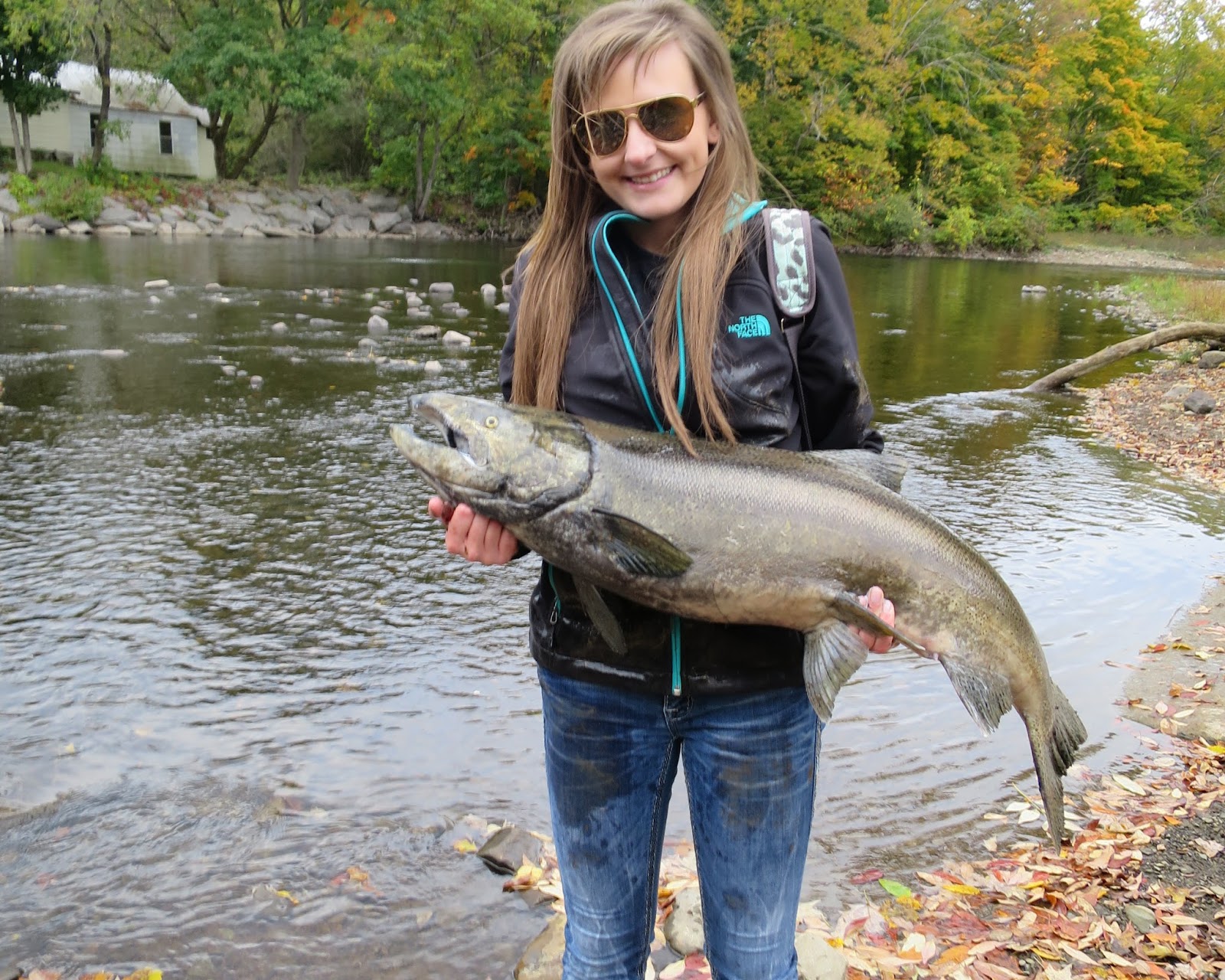
Typical Salmon River King
An old saying goes: The only things that are certain are death and taxes.

Well, that adage is due for revision; around these parts, anyway.

It should claim: The only things that are certain are death, taxes and Pulaski’s salmon run.

Indeed, the river running through this Oswego County village has been on the radar of the world’s most enthusiastic anglers for a couple centuries, now.

Back in the old days the Salmon River was the best stream in the state for trophy landlocked Atlantic salmon--it was named after them, in fact.

It’s still the best spot; only now the fishing is much better.

Atlantics are the first salmon to spawn. Entering the river in summer, they do their thing and beat it back to the lake. Oh sure, late bloomers hold off running until this month, some even wait until November, but their numbers are so few, they don’t draw much attention from anglers. If they’re caught at all, it’s usually incidentally.

Kings and cohoes to the rescue. Pacific salmon don’t start running in significant quantities until mid-September, and when they do, they storm the river in such numbers you could cross it on their backs…If they weren’t so slippery, of course.

While it’s well known Pacific salmon stop feeding when they return to the river to spawn, they will hit a streamer or lure.

Talking heads believe that’s because they’re used to being the biggest kids on the block. Extremely aggressive to begin with, they naturally get meaner in route to the spawning beds, striking out at anything that gets in their way.

The main salmon run stretches through this month, with stragglers showing up into November…even later.

This month the salmon will be joined by trophy brown trout and steelhead.

Decisions... Decisions...

Wednesday, March 26, 2014

Last Chance for Skinny Creek Steelies


By
Spider Rybaak

Little Sandy Creek is starting to emerge from winter's blanket.

Oswego County is steelhead country. Fast water anglers from around the world come up for the rich veins of ironheads running the Salmon and Oswego Rivers autumn through spring. As exciting as tackling a spawn-minded steelie in big rapids is, however, anyone worth his weight in glo-bugs can tell you taking one out of a skinny creek is even more fun and challenging.

Problem is, this winter has been so severe, most slim waters have been entombed in impenetrable ice caps since January. Steelhead ain’t complaining--they like the cover. On the other hand, die-hard creek fans are a little sore. But we’ll have our day… real soon.

You see, all that snow we had this year has gotta melt. When it does, run-off will swell the streams, sending their plumes deep into the lake, their ice caps into next winter. Steelhead cruising the open water cross these warm paths and follow them upstream, into the embrace of ideal spawning habitats.

All this promises to happen from now until mid-April. If the current weather patterns hold, the thaw will be slow and gradual, keeping the creeks at the optimal 40 to 44 degrees Fahrenheit for much of next month.

Some experts feel that this winter is a lot like the ones we had in the 1960s and 70s, and make predictions based on past experience. Fran Verdoliva, the New York State Department of Environmental Conservation’s Special Assistant for the Salmon River, says no matter what the weather does, the near term is going to be a win-win situation.

“If we get a burst of unseasonably warm weather, the thaw will be rapid and the water levels high and muddy, drawing a lot of fish all at once. If the thaw stays moderate like it’s been, the steelhead will run steadily, most likely extending the season for a week or two,” says Verdoliva.

 Regardless of what the weather does, spawn-minded steelhead face a now-or-never situation—they gotta mate soon. Each of Oswego County’s Lake Ontario tributaries will see runs of regular strain steelies for the next few weeks; Salmon River tributaries Trout and Orwell Brooks will likely have them all of April; and the Salmon River itself will boast  ironheads into May, followed by runs of Skamania and Atlantic salmon all summer long.

The Salmon River is still in winter's grip.


Tuesday, September 17, 2013

Salmon Everywhere: Oneida Lake, too.


By
Spider Rybaak


Gene Carey, founding member of the Fish Creek Atlantic Salmon Club, walking towards the FCASC's hatchery at the Harden Furniture Dam on the West Branch of Fish Creek, McConnellsville, NY.

Fishing on foot might not sound as glamorous as doing it from a souped-up Lund, but it has its benefits. For instance, it’s good exercise while moving around looking for hits; and a great way of gathering valuable intelligence. That’s how I heard the story of a guy who allegedly caught an Atlantic salmon below the dam in Caughdenoy last week. 

Now, I remember seeing one caught in Phoenix back in the 1960s.  And just about anyone who’s been fishing the Seneca and Oswego Rivers for any length of time can tell you a story or two about landlocks caught in the whitewater in Oswego, Minetto, Fulton, even Baldwinsville.  Experts surmise these fish were stocked by the New York State Department of Environmental Conservation in Lakes Ontario or Cayuga.

But how do you explain an Atlantic salmon in the Oneida River?

The Fish Creek Atlantic Salmon Club, that’s how. Formed in 1997, the group has been working to restore the species to its native waters ever since. 

While Fish Creek was never the primary residence of great numbers of Atlantic salmon, it served as an important nursery. In the old days, Lake Ontario claimed the greatest population of landlocked salmon in the world until dams and Industrialization’s rampant pollution all but wiped them out in the beginning of the 19th Century.  When it came time to spawn, they ascended its tributaries, including its second biggest, the Oswego River. Formed by the confluence of the Oneida and Seneca Rivers, the Oswego offered them access into Oneida Lake and the ideal spawning habitat of its largest tributary, Fish Creek.

The club’s program is funded through dues, raffles, the sweat of its members and donations.  Its fry are raised at a hatchery club members built on the creek’s west branch, at the spillway to Harden Furniture’s mill dam in McConnellsville. The company donated the site, as well as a $5,000 grant to build the thing. Spey Nation has been chipping in over the past three years with an annual $1,500 grant.

According to Eugene Carey, a founding member of the club (he’s on the cover of my first book “Fishing Eastern New York”), the facility is working out very well. The equipment is run by solar power so electrical outages aren’t a concern.  The creek’s fluctuating temperature prepares the fry for the conditions they’ll encounter in the wild, and the water’s natural nutrients, easily identifiable by the young, spur their appetite so they don’t have to be coaxed into feeding by club members.

Incoming reports bear him out. Oneida Lake’s ice fishermen have been treated to a smattering of landlocks each year this century. In the fall of 2011, three beauties ranging from 25 to 27 inches were caught in the canal at Sylvan beach. This summer, two were taken by open water anglers on the lake. 

The dream collectively envisioned by this small, dedicated group of romantic anglers in 1997 is materializing. If the trend continues, Oneida Lake tributaries will soon be giving Lake Ontario’s feeders stiff competition for NY’s native salmon.


Powered by the sun.

Water works: Inside the fish hatchery.

Thursday, July 18, 2013

Whitewater Summer


By  Spider Rybaak

Photos by Susan Rybaak

A family of tubers floating through the Trestle Pool.


A web of exciting whitewater slices through Central New York. Unfortunately, much of it is too dangerous (Black River), shallow (Scriba Creek) or short (the rapids at Caughdenoy) for most of us to play in. The Salmon River, on the other hand, is just right.

Running for roughly 13 miles, from the spillway at Lighthouse Hill Reservoir to its mouth, this world-famous trout and salmon stream’s base flow is kept at 185 cubic feet per second year-round. That’s the minimum required to keep its rapids at the right speed and level to maintain the sensitive habitats that mature salmon and trout need to spawn; and their offspring require to carry them through their first few months of life and their trek to Lake Ontario.

Serious whitewater enthusiasts rank the Salmon River as a pitiful Class II, about as exciting as spit in the bucket.  But for average folks, its pleasant, safe pace allows for leisurely floats in tubes, kayaks and canoes, down playful rapids lined in riverbanks teeming with colorful plants and wildlife, all under the graceful flight of bald eagles to ospreys.

Still, even the meekest among us harbor fantasies of risky adventures some of the time. Several years ago the authorities, after gentle coaxing by whitewater interests, decided it wouldn’t hurt to shift the  Salmon River ‘s thrill level higher periodically and decreed that the power company release additional water five weekends each summer for recreational purposes.

The second of this season’s flow increases took place 4th of July weekend and legions of folks took to the rapids in everything from tubes to over-sized rubber duckies to indulge in some bubbly. About the only complaint competing with the laughter wafting over the whitewater was that the water didn’t stay up a little longer.

Good news. This year ain’t typical, and when the screws were tightened on the water gates, the rapids didn’t slow down a bit. The above average rainfall pouring over the region since the beginning of summer hasn’t drained off the countryside yet; and at this writing the level is at 650 cfs, well above the normal for this time of the year. Considering the size of the river’s drainage, it’ll take all of a week, maybe longer, for the flow to resume its typical summer level.

While the thought of a stream flowing so high above average is enough to send the fear of rapids coursing through your veins, it’s really not that bad in a shallow stream like the Salmon River.

That doesn’t mean you can throw caution to the wind and jump in carelessly.

 What it does mean is you can enjoy a long, comfortable, relatively safe float down whitewater averaging 70 degrees. But you gotta play smart. Here’s some tips to keep you safe:

- Always wear a life jacket.
- If you go by tube or air mattress, make sure it’s big enough to float your body weight.
- If you get thrown into the fast water out in the middle, don’t try to stand; you might get your feet wedged between rocks and the force of the rapids can submerge you. Float on your back, feet first, until you come to a slow moving shallow area before trying to walk out.

If you go by canoe or kayak, bring along a fishing outfit. Atlantic salmon and Skamania—summer-running steelhead--are drawn into the stream by high water. They’re in top shape this time of year, guaranteeing you a run for the money.

If the water goes down before you can make it, no sweat: additional whitewater releases are scheduled for the weekends of July 20-21, August 4-5 and August 31-September 1.

Launches and take-outs with parking areas line the river. Some of the most popular include:

- CR 52 Bridge in Altmar
- Sheepskin Road, about 100 yards east of its intersection with CR 48, Pineville.
- Northeastern corner of the CR 2A Bridge, about a mile east of Pulaski.

Enjoy…and stay safe.

Spider casting  a streamer for Atlantic salmon as kayakers watch.

The river's at the perfect height, the weather's just right,
for a float trip.

Fishy encounter: Kayak angler and Spey-caster at the Trestle pool.