Showing posts with label salmon river. Show all posts

Friday, October 14, 2016

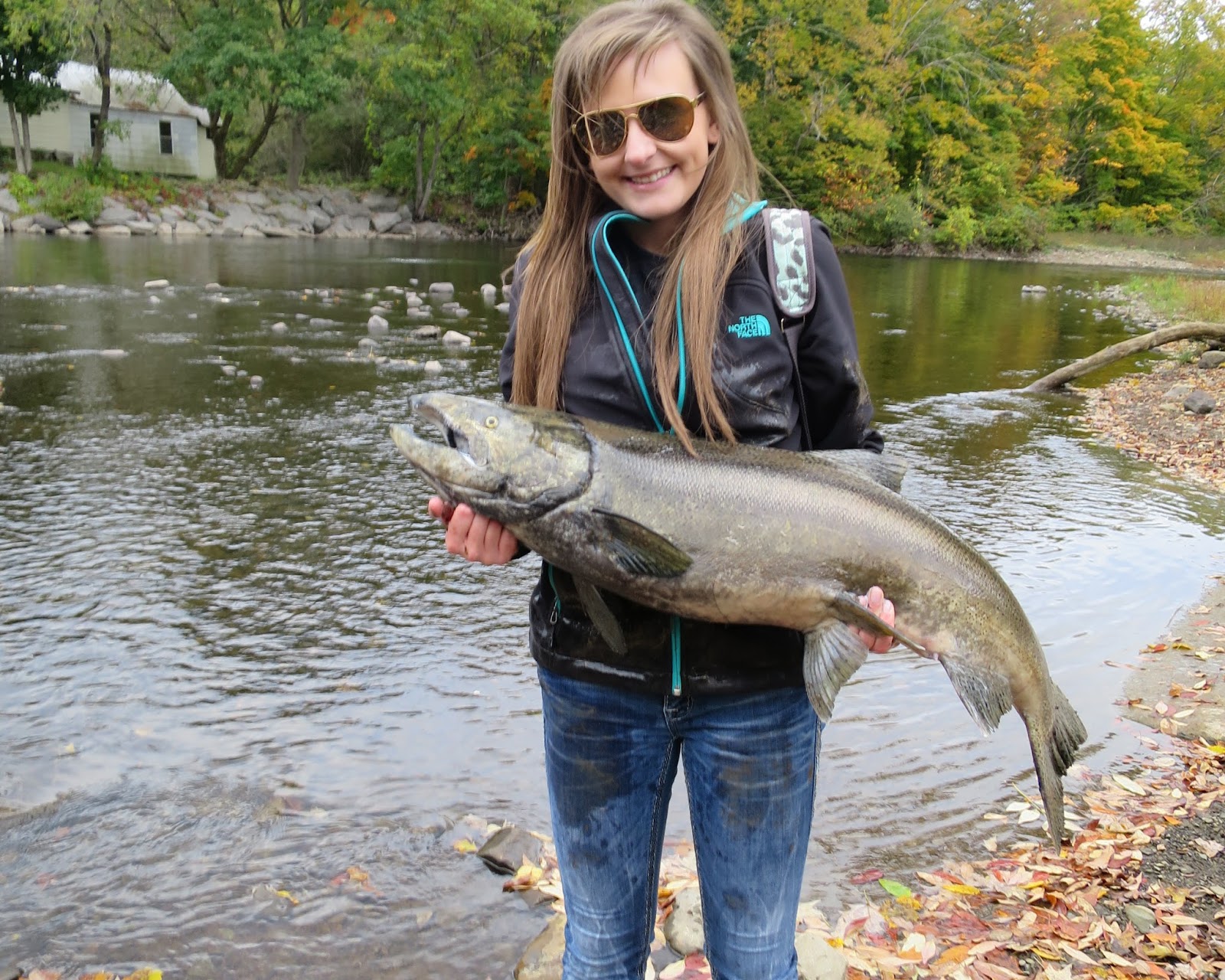
Salmon Are In

Typical Salmon River King
An old saying goes: The only things that are certain are death and taxes.

Well, that adage is due for revision; around these parts, anyway.

It should claim: The only things that are certain are death, taxes and Pulaski’s salmon run.

Indeed, the river running through this Oswego County village has been on the radar of the world’s most enthusiastic anglers for a couple centuries, now.

Back in the old days the Salmon River was the best stream in the state for trophy landlocked Atlantic salmon--it was named after them, in fact.

It’s still the best spot; only now the fishing is much better.

Atlantics are the first salmon to spawn. Entering the river in summer, they do their thing and beat it back to the lake. Oh sure, late bloomers hold off running until this month, some even wait until November, but their numbers are so few, they don’t draw much attention from anglers. If they’re caught at all, it’s usually incidentally.

Kings and cohoes to the rescue. Pacific salmon don’t start running in significant quantities until mid-September, and when they do, they storm the river in such numbers you could cross it on their backs…If they weren’t so slippery, of course.

While it’s well known Pacific salmon stop feeding when they return to the river to spawn, they will hit a streamer or lure.

Talking heads believe that’s because they’re used to being the biggest kids on the block. Extremely aggressive to begin with, they naturally get meaner in route to the spawning beds, striking out at anything that gets in their way.

The main salmon run stretches through this month, with stragglers showing up into November…even later.

This month the salmon will be joined by trophy brown trout and steelhead.

Decisions... Decisions...

Thursday, September 22, 2016

Fishing the Rapids during the Run

Coho taken in the rapids at the bottom of the Long Bridge Hole in Pulaski, N.Y.

This week marks the time to get excited about Oswego County’s salmon runs.

Oh sure, a few precocious kings and cohoes have been teasing gung-ho, big-game anglers since the end of August; but you ain’t seen nothin’ yet!
Thousands of kings and cohoes will rip through the rapids from now until late next month. So many, in fact, cousin Staash claims “they’ll raise the water level a couple notches.”

You can bet the fish are gon’na draw legions of anglers from all over the Northeast, too.
Inexperienced in the ways of salmon in the fast water, most of these guys will think like humans and surround the big, deep  holes,  thinking they’re  the best spots to catch the trophies swimming around in their imaginations.

The fish are sure to be there, and fishing the rapids is one of the surest ways to find them.
You see, out in the big pond salmon are accustomed to being the biggest kids on the block. They bring that attitude with them when they enter the river, aggressively striking anything that gets in their way. Their confidence quickly fades after tasting the sting of a hook, or encountering excited anglers chasing after them.

That sends most of them heading for cover in the deep pools…where they encounter more hooks and more fish. So what’s a salmon to do?
Run!

And into the rapids it goes.
An exciting way to catch one is to swing a streamer through the current. Good patterns are wooly buggers in trout colors (brown or chartreuse) and Mickey fins.

Good spots to try on the Salmon River include Pineville Pool, Long Hole, Trooper Hole, Ball Park Run and Staircase.
Don’t be aggressive. Simply cast the streamer across the river and let the current swing it back to your side…and hold on.

After all, any fly-fisher can tell you: The drug is the tug!


Monday, April 21, 2014

Salmon River Reservoir Thawing


By
Spider Rybaak

Kayaking the Salmon River in Redfield.

The nicest thing about severe winters like the one we just had is the pay back feels so good. Last weekend, Oswego County finally saw some global warming, with temperatures soaring into the high 70s, and folks stepped outdoors in droves to break their cabin fever. The Salmon River Reservoir saw loads of the weary gather on its banks to usher in spring by watching winter cry itself away.

While the Mad River, and both branches of the Salmon were too high and cold for average anglers to even think of fishing, their tributaries and the smaller creeks pouring into the reservoir were much more manageable. The water was so frigid, however, the fish weren’t into chasing after the bait, so you had to bump their noses with a garden worm to get them to hit. With all the run-off, that was kind’a hard and everyone interviewed for this story admitted to getting skunked.

Still, the mood was upbeat. “That leaves more for next month, when the brooks and rivers will not only be easier to get to, they’ll be easier to fish,” predicted Joe, a Pulaski native who wouldn’t divulge his last name.

A lot of bottom anglers tried their luck at the mouth of the Salmon River in Redfield. Fishing off the south bank, just below the County Route 17 bridge, they didn’t catch dinner, but were treated to spectacular natural scenes like glacier-sized floes sweeping downstream, the dalliance of bald eagles, and kayakers.

The channel below the public fishing access site’s platform at the northern County Rte. 17 bridge was mostly iced over and unfishable. However, several groups came to do everything from catch rays and play frisbie to relax in the fishing platform’s comfortable seats and take in the sounds and sights of the ice’s death throes.

A couple deer came around, too. They were just as surprised to see all the people as we were to see them, and bolted, jumping onto the spongy ice in their bid to reach the woods on the north shore. It held. But a couple spots of open water stood between them and the bank.

The lead deer jumped into the first opening, and the smaller one followed. Swimming over to the edge of the ice on the other side, the bigger doe struggled to get a toe-hold. Everyone feared the worst. A loud, collective sigh of despair swept over the reservoir.

Somehow, the struggling pair managed to climb onto the floe, slipped and slid their way across the porous ice, jumped into the second opening, and climbed out again.  Reaching the other side, they disappeared into the trees.

We hit County Rte 2.  The woods along the road were blanketed in snow.

Turning onto Dam Road, we headed for Salmon River Falls. Ice sculptures chiseled out of the snowbanks by the warm breeze lined the way. Susan decided to strike off for what would probably be her last jaunt through snowy woods this season. She thrilled in snowshoeing with just the shirt on her back.

The Salmon River Falls drew even larger crowds. The parking lot was full. But that didn’t matter because the trees were bare, and the awesome power of this magnificent cataract was easily visible from the road.

And there’s more. Although Monday’s warm weather whittled away at the ice and snow, the evening’s freezing temperatures, followed by Tuesday’s snow, sculpted the northeastern edge of Oswego County into a fresh winter wonderland.

It won’t last, however, probably not much past Easter, so get out there and enjoy while you can.
Susan Rybaak last-chance snowshoeing at the Dam Road. 


Deer heading for the Upper Reservoir's north shore.
Making it to the other side.

Monday, April 14, 2014

Chuck Parker: Sportsman Activist


By
Spider Rybaak

Tucked into the northeastern corner of Lake Ontario, claiming the entire western half of Oneida Lake, etched by the Oswego and Salmon Rivers, the finest salmonid streams in the Lower 48, and watered by numerous productive streams and brooks, Oswego County offers some of the best fishing in the Western Hemisphere. 

 Small wonder, then, that it spawns some of the finest conservationists in the country.

Take Chuck Parker, for instance. An avid hunter and angler, the Texas, NY resident believes political activism is every sportsman’s responsibility, and practices what he preaches.

Parker traces the roots of his activism to the Mad River Club, which he joined in 1989. Ever since, he’s served in numerous conservation-minded sportsmen groups in every capacity from secretary to president, and reached the top when he was elected to the presidency of the New York State Conservation Council (NYSCC) a couple years ago, an office he still holds.

Parker describes the NYSCC as an advocacy group dedicated to promoting sportsman’s issues.

“One of our greatest concerns is legislation out of Albany,” says Parker. “We have advisors on the New York State Conservation Fund Advisory Board and the New York State Fish and Wildlife management Board,” he adds.

True conservationists, the NYSCC’s membership knows man is an integral part of the natural order, and graciously accepts responsibility as steward of the environment.

The NYSCC’s website states: “For over 80 years, the NYSCC Inc. has been a leader in advocating the wise use and management of NY’s valuable natural resources to ensure that they are protected for our children’s children.”

In this vein, NYSCC member clubs offer a wide variety of outdoor activities designed to acquaint kids with the great outdoors, including 4 H Youth Shooting Sports Programs, Youth Fly-fishing, the Oswego County Envirothon, Oswego County Soil and Water’s Annual Conservation Field Days (open to 5th graders) and the Plant a Tree program.

Parker has been a Hunter Safety Instructor since 1993, and states, unabashedly, “We stand opposed to the New York Safe Act. We would like to see it overturned.”

And that’s to be expected, considering the group’s respect for the natural order, and its acceptance that man is on the top rung of the food chain.

Parker feels the greatest threat facing hunting and fishing is the lack of activism among outdoorsmen. “I’m involved with a lot of good sportsmen but the problem is 7 out of 10 don’t belong to a sportsmen’s club, so they don’t advocate for our right to hunt and fish.”

His solution:  “Get your friends to join a sportsman’s club and teach your children the importance respecting our natural environment as well as how to safely enjoy all that is has to offer.”

Chuck Parker was named as one of The Syracuse Post-Standard's "Heroes of Conservation" in 2011.  

Wednesday, March 26, 2014

Last Chance for Skinny Creek Steelies


By
Spider Rybaak

Little Sandy Creek is starting to emerge from winter's blanket.

Oswego County is steelhead country. Fast water anglers from around the world come up for the rich veins of ironheads running the Salmon and Oswego Rivers autumn through spring. As exciting as tackling a spawn-minded steelie in big rapids is, however, anyone worth his weight in glo-bugs can tell you taking one out of a skinny creek is even more fun and challenging.

Problem is, this winter has been so severe, most slim waters have been entombed in impenetrable ice caps since January. Steelhead ain’t complaining--they like the cover. On the other hand, die-hard creek fans are a little sore. But we’ll have our day… real soon.

You see, all that snow we had this year has gotta melt. When it does, run-off will swell the streams, sending their plumes deep into the lake, their ice caps into next winter. Steelhead cruising the open water cross these warm paths and follow them upstream, into the embrace of ideal spawning habitats.

All this promises to happen from now until mid-April. If the current weather patterns hold, the thaw will be slow and gradual, keeping the creeks at the optimal 40 to 44 degrees Fahrenheit for much of next month.

Some experts feel that this winter is a lot like the ones we had in the 1960s and 70s, and make predictions based on past experience. Fran Verdoliva, the New York State Department of Environmental Conservation’s Special Assistant for the Salmon River, says no matter what the weather does, the near term is going to be a win-win situation.

“If we get a burst of unseasonably warm weather, the thaw will be rapid and the water levels high and muddy, drawing a lot of fish all at once. If the thaw stays moderate like it’s been, the steelhead will run steadily, most likely extending the season for a week or two,” says Verdoliva.

 Regardless of what the weather does, spawn-minded steelhead face a now-or-never situation—they gotta mate soon. Each of Oswego County’s Lake Ontario tributaries will see runs of regular strain steelies for the next few weeks; Salmon River tributaries Trout and Orwell Brooks will likely have them all of April; and the Salmon River itself will boast  ironheads into May, followed by runs of Skamania and Atlantic salmon all summer long.

The Salmon River is still in winter's grip.


Monday, March 10, 2014

Dipping for Smelt


By Spider Rybaak

 Grindstone Creek from the NYS Rte. 3 bridge, March 5; gotta wait until ice-out to dip.

Back in the early 1960s, environmental pollution was rampant. Lake Erie was so dirty, authorities began drafting a death certificate. Lake Ontario was much deeper so it could swallow more stuff, but it was limping along on its last leg, too; fish populations were down to a fraction of what they used to be.

But there was hope.

By the middle of the decade, strict environmental laws were passed and enforced. Nature responded quickly, improving the water in the Lower Great Lakes to such a degree that fish numbers took off. Since it takes a while for game fish to grow to legal size, they were slow in coming around; but bait fish populations exploded.

That was good…and bad.

First the good: smelt reached such incredible numbers, guys dipping for them in the mouth of the Salmon River could fill 5-gallon buckets with their eyes closed. On skinny creeks like Deer and Little Sandy, conscientious anglers dipped gently, carefully to avoid crushing the smelt below the net’s rim or hurting those off to the sides.

The bad: alewives thrived, too. Boney and tasting like swamp mud, they were avoided by man. Unsightly winter kill lined beaches around the lake and the authorities decided to bring the lake back into balance by stocking voracious lake trout, king and coho salmon.

It worked. The salmonids swam around with mouths wide open, growing huge. Smelt numbers dropped incredibly. Dave Wood, owner of Woody’s Tackle on NYS Rte. 3, says dipping for them got so bad by the late 70s, he stopped going.

Fran Daher, over at North Syracuse’s Mickey’s Live Bait and Tackle concurs. “We used to sell dozens of dipping nets annually in the 70s, now we’re lucky if we sell a couple- three a year. Smelting has become a dead art,” he adds.

But it shouldn’t be. Word coming out of the western part of the lake has it that smelt numbers are rebounding. Fran Daher’s admission that he’s only selling a few nets a year suggests someone’s getting smelt around here. After all, argues cousin Staash, “these guys ain’t buying dip nets to catch butterflies; they’re getting smelt but they ain’t talking about it.”

Brian Weidel, of the USGS, Great Lakes Science Center, says” “From what I hear, spring 2011 was a good year for smelting, at least in the western NY tributaries. This MAY have been associated with slightly higher smelt abundance in the lake in 2010. Since then the population has dropped, which is usual for the species. Their abundance tends to naturally cycle.”

However, Weidel isn’t so quick to blame the drop in smelt populations on predators: “One thing that is important for anglers and the public to recognize is the overall productivity of the lake has decreased (which is a good thing) because of the Clean Water Act and other important legislation that reduced pollutants in the lake,” he claims.

Since smelt numbers are cyclical, there’s a good chance this year’s run will be a good one. The only way to find out if they’re running up Oswego County’s Lake Ontario tributaries again is to go for ‘em.

The mouth of any tributary will do. Here’s some with good public access:

- Little Salmon River, County Route 40 or Mexico Point Drive, Texas, NY.
- Grindstone Creek, Selkirk Shores State Park, NYS Rte. 3, a couple miles south of Port Ontario.
- Deer Creek, Deer Creek Marsh Wildlife Management Area, NYS Rte. 3, a couple miles north of Port Ontario     

Going for these guys isn’t rocket science; all you gotta do is stand on the bank, dip and scoop. Dip nets come with long handles so you don’t have to stretch too much.

Woody claims [global warming notwithstanding]“This winter is like the ones we used to have, so the smelt won’t be running until April.”

And that’s reassuring, suggesting the weather is like smelt…cyclical.

Dave Wood, owner of Woody's Tackle Shop in Port Ontario, holding a smelt dipping net.


Friday, February 21, 2014

Salmon River International Sport Fishing Museum


By
Spider Rybaak

Fred Betts with the cream of his collection.

Fishing museums are rare. Of the handful in existence, NY boasts two of the finest, both located on world famous trout streams. Oswego County has the most complete: The Salmon River International Sport Fishing Museum.

Truth be told, the Catskill Fly Fishing Center and Museum in Livingston Manor, on the banks of Willowemoc Creek, a tributary of the Beaverkill,  which flows into the East Branch of the Delaware River, is more famous. That’s mostly because it’s been around for about 20 years longer, is located in the Catskills, the cradle of American fly-fishing, and is only about 50 miles from New York City.

But the Salmon River is rapidly becoming the top salmonid stream in the world— it’s already the most famous in the Lower 48 states. Another, equally important factor that’ll propel the SRISFM into the front of the pack is its inclusiveness; it covers all aspects of fishing, everything from casting and spinning  reels, to trolling rods, eel spears, lures and trout creels.  

In fact, Fred Betts, a Central New Yorker who boasts one of the finest creel collections around, gave a lecture on their history last Sunday, February 16. He brought the cream of his collection to show the evolution of fishing baskets, and how each change benefited anglers.

Betts’ talk was part of the facility’s newest program, “Afternoon at the Museum.” An open house held every third Sunday of the month, the series will feature speakers on a litany of fishy subjects.
The next talk, given by Mike Riordan, is scheduled for 3:30 p.m. on March 15, and will cover the history of fishing line, from the braided horse hair lines of Ancient Rome to today’s super braids.

Riordan, president of the museum, says it’ll by open at 2 p.m., giving folks a little time to wander through the exciting displays before the speaker’s presentation, which will be given at 3:30 p.m.

But there’s more to the place than fishing equipment. The walls are plastered in fine art. Everything from fanciful Romantic era fishing scenes to realistic oils by greats like Maynard Reece is represented.

Run by volunteers, the hours of operation aren’t set in stone. However, the lobby contains loads of literature and is always open.

The museum is located at 3044 State Route 13, a few miles east of Pulaski. For more information, call 315-298-2213, visit www.salmonriverinternationalfishingmuseum.org. or www.facebook.com/pages/Salmon-River-International-Sport-Fishing-Museum/152643681444857. 

Old time fly wallet.

Fine art graces the museum's walls.

Ice fishing and eel spears.

Thursday, November 14, 2013

Steelheading without the Leaves


By Spider Rybaak

Nice hen steelie taken on a wooly bugger.

One of the most frustrating things about early steelhead fishing is putting up with fallen leaves; they’re floating on the surface, suspended in the water, carpeting the floor. Come November, they can be so thick, it’s like fishing in a kaleidoscope.

To the uninitiated, that doesn’t sound so bad. After all, kaleidoscopes are entertaining, giving idle hands something to turn, bored eyes symmetrical patterns to feast on.

But fishing is serious business, and the Salmon River ain’t a romper room. If you have to spend half your time clearing leaves off the hook, the other half dodging leaves while trying to present a bait naturally, especially when you’re watching fish shooting the rapids, it can amount to an exercise in frustration, and that can make you grumpy.

So I went up to the Salmon River on Veterans Day to swing some streamers through the rapids with my Spey-casting equipment, conditions permitting.

Much to my delight, the conditions are super. Oh, a few leaves are still blowing into the water. But they’re so few, I only hooked a couple in the hour I fished.

Best of all, I hooked a steelhead weighing about 5 pounds, too, on a chartreuse wooly bugger I swung through the rapids behind a 10-foot Rio Spey VersiLeader, with a sink rate of 2.6 inches per second.

And I wasn’t the only lucky one on the river. A couple guys hooked steelies on beads they were float-fishing with centerpins in the Long Bridge Hole. Another took one in the rapids on an estaz egg he was chuck-n-ducking in the bottleneck, at the curve, about 100 yards upstream.

I was Spey-casting in the pool between the Long Bridge pool and Village pool, a relatively shallow spot with heavy rapids; two features that discourage normal anglers--which normally means there’s fish and room.

You see, most guys fishing the Salmon River think like humans, and concentrate on deep, slow moving pools.

I like to think like a fish. Right now, the water temperature is in the high 40s, and trout are still very active. Since they’re as lazy as I am, they hang out in fast water (they’re streamlined, the current goes effortlessly around them) where eggs float down to them and all they gotta do is open their mouths and suck ‘em in. And if a streamer swims by…well, that’s icing on the cake.

Steelhead are running the river right now in search of easy pickings; which means they can be anywhere…and they’re hungry.

Wednesday, September 4, 2013

Salmon Everywhere


By Spider Rybaak


Sue with her biggest king.

Up until this summer, the term August kings referred to the legions of mature salmon that traditionally stage off the mouths of Lake Ontario’s tributaries in late summer to await the biological urge that shuts down their hypothalami and launches them upstream to spawn. This year changed that definition.

Oh, massive quantities of kings are still staging in Oswego County’s territorial waters. Indeed, the Oswego River draws an amount proportionate to what you’d expect the smallest Great Lake’s second largest tributary to attract. Its plume reaches out into the lake for miles, hooking the hormones of fish from here to Canada, drawing massive quantities of trophy Chinooks and cohos to the city of Oswego’s north bank.

It’s obvious from all the charter boats trolling within a mile of the Port City right now. In the past, they’d be out so far the first half of September, you’d need binoculars to see half of them.

And the fishing’s great. On the evening of August 29, Captain Richard “Big Dick” Stanton (Stanton Charter Service; 315-685-0651) took outdoor writer/online visibility expert Sue Bookhout fishing less than a mile due north of the city. It only took her about two hours to land (it was her first time out so she lost some) her limit of salmon: kings weighing 10 and 23 pounds, and a 12-pound coho; all of ‘em on a fly dragged behind an echip flasher.

Out in the lake, action like this is expected this time of year; and lots of guys plan their vacations accordingly. So this kind of excitement, within easy sight of the big city, is typical and loads of fun.

The Salmon River is a different story. Normally, only small groups of kings climb the stream in August;  usually on reconnaissance runs up to the Black Hole, sometimes a little further, with the majority falling back to regroup and join the major runs of mid- to late September.

This year kings began trickling in by the first of August, running the entire stream. The second week saw noteworthy runs.  And they haven’t stopped coming.

Fran Verdoliva, the state’s program coordinator for the Salmon River, says these are all wild fish, surmising that naturally bred kings run earlier than hatchery fish.

Captain Rick Miick concurs. “In the past, fish that ran this early would come in and out. This time they’re spawning and dying.”

September 1st saw lines of anglers at all the popular spots in Pulaski. Anglers interviewed for this blog claimed the fish upstream were all taken and a new run was shooting through town that morning.

The fish being hauled up the bank were all silvery, indicating they were fresh-run.

“These salmon are at their peak,” claimed an unidentified angler. “Unlike hatchery-bred fish, they’re super aggressive, avoid man…and fight!!!

 “With all these wild fish around, it’s like mother nature giving us another month of salmon in the river,” adds the New Jersey native.  “I can’t wait to see what she’s got in store for us when the browns and steelies start running.”

This season promises to be another for the record books; Oswego County’s getting good at doing that.
Captain Dick adjusting the drag during the fight.

Pay-off for two hours of trolling.

 Boats trolling for kings less than a mile off Nine-mile Point.

Stairway to Home.

Viewing platform on Maple Ave., Pulaski.

Discussing theory.

Hey buddy, give me a hand.


Thursday, July 18, 2013

Whitewater Summer


By  Spider Rybaak

Photos by Susan Rybaak

A family of tubers floating through the Trestle Pool.


A web of exciting whitewater slices through Central New York. Unfortunately, much of it is too dangerous (Black River), shallow (Scriba Creek) or short (the rapids at Caughdenoy) for most of us to play in. The Salmon River, on the other hand, is just right.

Running for roughly 13 miles, from the spillway at Lighthouse Hill Reservoir to its mouth, this world-famous trout and salmon stream’s base flow is kept at 185 cubic feet per second year-round. That’s the minimum required to keep its rapids at the right speed and level to maintain the sensitive habitats that mature salmon and trout need to spawn; and their offspring require to carry them through their first few months of life and their trek to Lake Ontario.

Serious whitewater enthusiasts rank the Salmon River as a pitiful Class II, about as exciting as spit in the bucket.  But for average folks, its pleasant, safe pace allows for leisurely floats in tubes, kayaks and canoes, down playful rapids lined in riverbanks teeming with colorful plants and wildlife, all under the graceful flight of bald eagles to ospreys.

Still, even the meekest among us harbor fantasies of risky adventures some of the time. Several years ago the authorities, after gentle coaxing by whitewater interests, decided it wouldn’t hurt to shift the  Salmon River ‘s thrill level higher periodically and decreed that the power company release additional water five weekends each summer for recreational purposes.

The second of this season’s flow increases took place 4th of July weekend and legions of folks took to the rapids in everything from tubes to over-sized rubber duckies to indulge in some bubbly. About the only complaint competing with the laughter wafting over the whitewater was that the water didn’t stay up a little longer.

Good news. This year ain’t typical, and when the screws were tightened on the water gates, the rapids didn’t slow down a bit. The above average rainfall pouring over the region since the beginning of summer hasn’t drained off the countryside yet; and at this writing the level is at 650 cfs, well above the normal for this time of the year. Considering the size of the river’s drainage, it’ll take all of a week, maybe longer, for the flow to resume its typical summer level.

While the thought of a stream flowing so high above average is enough to send the fear of rapids coursing through your veins, it’s really not that bad in a shallow stream like the Salmon River.

That doesn’t mean you can throw caution to the wind and jump in carelessly.

 What it does mean is you can enjoy a long, comfortable, relatively safe float down whitewater averaging 70 degrees. But you gotta play smart. Here’s some tips to keep you safe:

- Always wear a life jacket.
- If you go by tube or air mattress, make sure it’s big enough to float your body weight.
- If you get thrown into the fast water out in the middle, don’t try to stand; you might get your feet wedged between rocks and the force of the rapids can submerge you. Float on your back, feet first, until you come to a slow moving shallow area before trying to walk out.

If you go by canoe or kayak, bring along a fishing outfit. Atlantic salmon and Skamania—summer-running steelhead--are drawn into the stream by high water. They’re in top shape this time of year, guaranteeing you a run for the money.

If the water goes down before you can make it, no sweat: additional whitewater releases are scheduled for the weekends of July 20-21, August 4-5 and August 31-September 1.

Launches and take-outs with parking areas line the river. Some of the most popular include:

- CR 52 Bridge in Altmar
- Sheepskin Road, about 100 yards east of its intersection with CR 48, Pineville.
- Northeastern corner of the CR 2A Bridge, about a mile east of Pulaski.

Enjoy…and stay safe.

Spider casting  a streamer for Atlantic salmon as kayakers watch.

The river's at the perfect height, the weather's just right,
for a float trip.

Fishy encounter: Kayak angler and Spey-caster at the Trestle pool.

Wednesday, June 26, 2013

Deer Creek Marsh Wildlife Management Area

By
Spider Rybaak

Canoeing the pond, Deer Creek WMA.


Oswego County is blessed with some of the largest, most awesome wildlife management areas in New York.  None, however, comes close to offering the wide variety of recreational opportunities, steeped in natural beauty, Deer Creek WMA provides.

One of three WMAs punctuating the Eastern Lake Ontario Dune and Wetland Area, a 17-mile-long barrier system boasting the tallest sand dunes between Cape Cod and Lake Michigan, Deer Creek WMA sprawls over 1,771 acres. Tucked between the mouth of the Salmon River and Sandy Pond, two heavily developed areas famed for their splendid beaches and sunsets, it’s like a breath of wilderness among the cottages; and it’s all close to the road.

Its most popular feature this time of year is a mile-long cobblestone beach. It used to be sandy, but the jetty that keeps the mouth of the Salmon River from wandering blocks currents from sweeping sand off a submerged dune out in the lake and bringing it close to the beach where it's picked up by waves and deposited  on shore.  

Without this continuous supply of sand to replenish what the waves wash away during high water, all that’s left on the beach when the water goes down is cobbles.

Fortunately, the order of this natural masterpiece prevented man’s folly from turning its undulating habitats into a level wasteland. You see, a dune and wetland area is comprised of six zones stretching from the water to the upland forest marking the end of the barrier system: the beach, fore dune, trough, secondary dune, back dune and wetland. Like the front in a battle, the fore dune is the system’s first line of defense, protecting its interior from the worst Lake Ontario dishes out. Luckily, it did its job long enough for environmentalists to see the sand slipping through the stones  and take measures to prevent further erosion.

A saddle-like trough separates the fore dune from the back dune. A trail, cut over the years by hikers, slices through its patchwork of beach grass and poison ivy. 

Beyond the trough, the secondary dune begins its steep ascent, climbing up to 40 feet in spots. Clumps of beech grass cling to its sandy sides all the way to the crown cropped in mature cottonwood s. On the other side, the back dune descends into a pond created by Deer Creek on its last leg to its mouth. By this point it moves so slow, it seeps into the sand before reaching the lake.

The stream’s water temperature keeps the system cool enough to support thriving populations of fish, including largemouth bass (some over 6 pounds), northern pike (most are axe handles, but some go 30 inches) bullheads up to a foot long, and yellow perch and sunfish averaging 6 inches. It even harbors bowfin; a native species that’s been around since the Jurassic period and can breathe air.

Canada Geese, mallards, blue herons, kingfisher, osprey, and a variety of less common water fowl; and mammals like mink, muskrats and beaver find Deer Creek Marsh to their liking.  Pheasants and cottontail rabbits flourish in the WMA’s grasslands. Whitetail deer, raccoons and turkeys flourish in the woods tracing its edges.

Most argue the best way to see the marsh is by canoe.  “You can silently paddle up to everything from beavers to geese,” argues cousin Staash.

The access site on NY 3, 2 miles north of Port Ontario, offers parking for about 10 cars and a beach launch.

Others prefer to hike it’s two most prominent features, the beach and sand dune. Although climbing and walking on dunes is prohibited, the trough between the fore dune and secondary dune has a ½-mile long trail running through it, and a couple of boardwalks allowing folks to cross over the fore dune without hurting it or brushing the poison ivy that grows on it like a weed. The southern boardwalk ends in a fishing platform looming over the pond.

Get there by heading north on NY 3 from Port Ontario for a little over 2 miles. Turn left on Rainbow Shores Road, drive to the end, turn left on South Rainbow Shores Road (unmarked), bear left at the fork a few hundred feet later and continue to the parking lot.

WMAs are managed…you guessed it, for wildlife and related recreation: primarily hunting, fishing , bird watching, stuff like that. 

Off-road vehicles, camping, and camp fires are prohibited.

Boardwalk.

Walking the Trough.

Gateway to the beach.

Monday, April 29, 2013

Spring 2013: Back to Normal


By Spider Rybaak

Walleyes in the ripples at Scriba Creek.

Ice finally broke up on Oneida Lake on April 1. A heavy northwesterly wind on March’s last night grabbed the tattered corners of the cap on the north shore, ripping it open, piling it into a jagged ring along the south shore like the crust on a giant frozen pizza.

Within a week, the icy ridges clinging to the shoreline melted into sandy beaches punctuated by rocky points poking into the lake on all sides. The water stayed cold; the fishing slow.

Fortunately, heavy rains soaked Central New York recently, swelling creeks beyond their banks, shooting their currents into the lake like chocolatey fingers. They stirred the downpour into the inshore waters, warming the lake‘s edge and raising it to normal levels, spurring the natural cycles anglers expect each spring.

And the fish are responding. Walleyes stormed into Scriba Creek so thick they looked like a throbbing carpet. Every step I took along the streamside path from the Oswego County Recreation Trail to the hatchery dam sent walleyes sprinting for cover in the deep rapids in the middle of the creek. Their backs exposed, they ran upstream creating a surrealistic scene in which the whitewater crashed into their wakes, creating a Maytag effect of clashing currents. What’s more, they bumped the mass of walleyes in the whitewater, causing them to erupt through the surface like miniature autumn cohos in the fish ladder at the Salmon River hatchery.

At the New York State Toad Harbor Fishing Access Site, a colorful ring of anglers lined the bank. The water is still a little too cold for massive schools of crappies to pack in, but a few hardy ones are there. In addition, some yellow perch averaging 8 inches and bullheads around the same size are present.

But hey, the one thing fish and anglers have in common is: the early bird gets the worm. The water’s warming as you read this, so get out there when you’re done and maybe you’ll hit a major run.

If you go by the old saw: spring makes the rest of New York’s weather bearable, you understand that there’s more to fishing this time of year than just catching fish. Coming back from the THFAS last week, I decided to take a right on McCloud Road to see if wild flowers were blooming along the forested shoulder. A couple daffodils were up but that’s it...for now.

On the way to Phillips Point, an old guy was bottom fishing for bullheads in Toad Harbor, off to the right. Mergansers were about 100 yards in front of him, diving and water dancing, feeding and courting at the same time. I disturbed a large blue heron; it cackled as it took off in fright off to his right, startling him and me. The guy’d been there half the day, hadn’t caught anything, but he wasn’t complaining.

At Phillips Point, I watched Allen Handy of North Syracuse launch his kayak. He’d been there a couple times already this month and hadn’t caught anything…but he was optimistic.

Oneida Lake is alive after winter’s deep sleep; and the natural world is celebrating with a visual feast steeped in a cacophony of sound. But you better hurry, and get there before brush and trees shield nature’s miracles behind curtains of leaves--and before walleye season opens May 4, making you too busy to look for anything else.

Walleyes in the pockets.

Allan Handy, North Syracuse, kayak-fishing in Three Mile Bay.

Dave, a resident of Central Square, with a crappie taken at the THFAS.