Thursday, April 12, 2012

Browns Abound

By Spider Rybaak

Captain Lee holding Dave Rath's first fish of the day.

May’s warmth in late February, winter winds in mid-April, robins and daffodils in early March...It’s enough to make self-respecting anglers wanna hang up their rods until June. Fortunately, Lake “O” is a huge pond and its fish don’t pay much attention to today’s screwy weather patterns. And its bread-and-butter  fishery, brown trout, proves it.

This year, the pack ice that normally encircles the big pond all winter long like a pie crust was gone in February. The unseasonably warm temperatures lured anglers to the lake’s banks and piers like Northern nightcrawlers draw robins from the South. The first-of-March bite was great, with more guys catching huge browns from the bank earlier than anyone can remember.

Gutsy charter boat operations like Good Times Sportfishing of Lake Ontario , LLC (607) 768-9121; www.goodtimessportfishing. net ) embraced the propitious weather as a rare opportunity to extend their fishing season by a couple weeks and launched their boats early. Captains Nick Lee and George Haskins invited me to go with them on April 4, this year’s maiden voyage.

As luck would have it, the weather reverted to more normal patterns that morning and when I left the house at 5:30 a.m., stiff northwesterlies greeted me at the door. I went back inside to get my Spey casting gear, half expecting to be fishing the Salmon River at 6:30 a.m. instead.

The 40 years of collective fishing experience the captains packed under their belts, combined with their 30’ long Sportcraft Express with a 10 –foot beam, gave them all the confidence they needed to cast off. I was skeptical but when I came aboard and felt how solid the craft was, I figured: hey, this might work.

We spent the first half-hour or so trolling around the mouth of the Salmon River looking for water with a little color. Slightly muddy water came into view south of the “Sticks” (lights on the jetty at the mouth of the Salmon River).  We ran through it half-heartedly because this color was caused by waves stirring up the sand on the beach—productive, on occasion, but not what we were looking for.

“We didn’t get much run-off this year,” explained Capt. Lee, a local science teacher. “So the insects, worms and other delights normally pumped into the lake this time of year are in short supply. But the unseasonably warm weather has compensated by causing insects to hatch and plankton to bloom early. Bait converges on these events and the browns are sure to be there, too, “ he continued.

“Without the normal run-off, we don’t have the numerous schools of browns that hang out in the shallows most years,” added Captain Haskins.  “But the schools we do locate are bigger and we catch 90% of our fish in 10% of the water.”

We changed course to a northern heading, hoping to find some pea-green water (the color of plankton) in the Salmon River’s plume. Before we got to the “Crab Legs” (secret charter captain’s code for a local landmark) less than a mile north of the river, a nice brown hit one of the Michigan Stingers we were flatlining off planer boards.

Dave Rath, a former Oswego County legislator, and member of the County’s Tourism Advisory Council, was on board. He expected me to take the first fish. Well, I thought he should be first. We didn’t come to blows, but by the time we hashed it out and he lifted the rod, the fish was off.

And that was all right because it only took about five minutes for another fish to hit, a nice five-pounder; and five minutes later, another hits…then another. The bite was steady for the next ¼-mile or so.

When we turned the boat to run back down, all hell breaks loose. We had doubles a couple times; and three on once. While several were small, running one to two pounds, the vast majority (I stopped counting after 15) were five pounds and a couple tipped the scales at 10 or better.

The browns should stay in the shallows into next month when warm temperatures will force them deeper.

So get out there at you’re earliest chance and catch browns so close to shore, you can skip a stone from the boat to the sand dunes.


Dave Rath fighting a brown while Captain Nick Lee tries unhooking one just landed.

Captains George Haskins (left) and Nick Lee holding a couple 10-pounders, the day's best.

The good Captain's performs the day's final service.

Thursday, March 29, 2012

Football Browns from the Bank

By Spider Rybaak
Jamey Bond, caretaker of Mexico Point State Park, and son Jericho with a couple of browns they took off the west breakwall off the mouth of the Little Salmon River.

Oswego County offers world-class fishing opportunities for every temperament. Take bank fishing, for instance. No matter what time of year it is, something’s hanging out close enough to shore to reach by casting. In early spring, the game fish of choice for landlubbers is the brown trout.

We’re not talking your typical two-year-old stocky that the New York State Department of Environmental Conservation throws into “cricks” to sweeten a stream angler’s chances of catching something to write home to mother about. We’re taking about veterans of a couple years of running free in Lake Ontario, growing three to five pounds, so big they’re called football browns. They resemble America’s favorite pigskin so closely, cousin Staash (rhymes with gosh) claims “if your grip is good enough to hold one of the slimy things you can throw it into the end zone, making it spin like a bullet all the way.”

While just about any Lake Ontario pier, breakwall or beach makes a good casting platform, Oswego County’s waterfront is superior because of our tributaries. After all, the Oswego (the lake’s second largest feeder) Salmon and Little Salmon Rivers run through here; as do numerous skinny creeks like Grindstone, Catfish, Rice and Sage. Slightly stained by run-off, and a couple degrees warmer than the lake, their plumes reach deep, hooking the appetites of browns, dragging them inshore to bask in the comfortable temperatures--and indulge in a feeding frenzy on all the baitfish hanging out in the balmy zone.

One of the hottest spots is off the mouth of the Little Salmon River in the hamlet of Texas. Public breakwalls line both sides at stream’s end. The western structure, the longest, is on the grounds of the Mexico Point State Park (from NY 104B, head north on Mexico Point Drive), a facility run by the Town of Mexico. The east side’s belongs to NYS Park’s Mexico Point Boat Launch (from NY 104B, head north on Cty. Rte. 40.)

Equally popular among local anglers are the stained waters where Grindstone Creek pours into the lake at Selkirk Shores State Park (head south on NY 3 about three miles from the NY 3/NY 13 intersection). While the fishing is most consistent off the park pier just north of the stream, running a lure through the current just off the mouth gives you a good chance of catching a bonus steelhead heading upstream to spawn.

Beach fishing is good off the mouth of Deer Creek, which feeds the lake a few hundred feet north of the Salmon River’s mouth. Running through a wildlife management area of the same name, get there from the NY 13/ NY 3 intersection by heading north on NY 3 for about 3 ½ miles, turning left on Rainbow Shores Road, continuing to the end, turning left on the dirt road, bearing left at the fork ½ mile later, and continuing to the WMA’s parking lot. From there, walk south along the beach to the creek’s mouth.

If you’re into urban settings, the city of Oswego offers a couple popular beach sites: one at the end of 6thAvenue on the west side of town, and another at the end of East 10th1/2 Street.

Good baits to use are blue/silver and green/silver Little Cleos, and gold or silver/black back crankbaits like Smithwick Rogues, Thundersticks and Rapalas.

A brown trout taken at Selkirk Shores State Park last weekend by the author.

Fishing scene: Pier at Selkirk Shores State Park.

Pier view of the sunset: Selkirk Shores State Park.

Tuesday, March 20, 2012

Football Browns in the Shallows


By Spider Rybaak


Captain Tiny holding the day's best.


Last Wednesday saw me out in a drift boat. Nothing unusual about that, I suppose, people do it all the time. But this was different: I was out of my element…way out, a few hundred yards off Mexico Point Boat Launch, in fact.

Two- to three- foot rollers lifted and dropped the boat to an extremely irregular beat. A landlubber at heart, I was holding my own in the waves, which in my troubled mind seemed like swells tossing us around like a cork in a typhoon. But Captain Ryan Gilbert’s (315-529-6427; onemorefish@twcny.rr.com) wit and disarming optimism helped me control the suspicion in my heart that the big lake was intent on swallowing our little boat. In addition, his sidekick, Norm Hall’s steely calm plastered the holes the waves tore into my confidence.

When a couple four-something footers lifted the boat and let it slide into the trough at angles so steep my nose filled with water, “Rub-a-dub-dub…Three men in a tub” started playing in my mind over and over and over… I was ready to call it quits.

Just then, we reached the spot the captain was aiming for. He slowly turned the boat around so the lines wouldn’t tangle and we started back-trolling. “We’re going with the wind now, so it’s gonna be a lot smoother,” Tiny (the captain’s nickname) promised.

We were running anywhere from 1.9 to 2.5 mph. Suddenly, without warning he hollers: “Spider, There’s a fish hitting on that planer board off to your left.”

The nasty thoughts eating away at my composure stopped biting. I went into action.

“Norm, you handle it!” I ordered. “I’m going to the back of the boat to photograph the action.”

Before I could get back there, the violent rocking of the boat reminded me the rollers were out to get me. Tiny’s broad shoulders and the gunwales provided good support, however, and a minute later, I made it to the back, sat on the motor and prepared to shoot.

“Fish off,” Norm reported.

I struggled back to my seat. By the time I got there, Norm had another fish on. He landed it. This time I stayed put and photographed him where we were.

Five minutes later, Norm’s into another fish. It jumped several times, looking like a sunbeam bouncing off the waves.

“Another nice football brown,” Captain Ryan commented while sweeping it into the net.

I was busy photographing the action when my planer board starts acting spastic. Diving, turning sharply, it heads straight for the boat at ramming speed. I lift the rod out of its holder and the fight is on.

As Tiny slips the net under it, Norm informs us, in his usual calm manner: “I got one.”

No sooner has Tiny removed the hook from mine and put the net down, Norm’s prize is at the side of the boat.

“We’re not keeping any more, are we?” Tiny asks rhetorically, and releases the fish without removing it from the water.

In the span of just over an hour we landed eight browns running from three to five pounds each and lost several more. The action was so fast and furious we didn’t notice the lake lay down. On the way back we were gently rocked by what Tiny called “left over rollers.”

After ice-out, browns seek comfort and food in warm water just off shore. When we were there, the surface temperature was 44 degrees and the fish were cruising three feet deep over water ranging from 8 to 15 feet deep.

Captain Tiny says the fish will be hanging around close to shore for at least another month. After that, they’ll head out deeper and you’ll have to find them by trolling in temperatures ranging from the high 40s to low 50s.

Yours truly with a football brown.  
Norm with his first brown.
The good captain releasing a fish without even taking it out of the water.

Wednesday, March 14, 2012

Early Ice Out on the Oneida River

By Spider Rybaak

Pennelville's Jason Pope admiring a crappie just before releasing it.
One of the most reliable ice fisheries in New York, Oneida Lake normally freezes early and stays that way right to the close of walleye season.

Not this year. Open water ruled by the third week of February, and the first of March saw solid ice become as rare as whiskers on a perch.  Indeed, last weekend courageous souls set out in summer boats to troll off Cleveland, Constantia and Sylvan Beach.

Average anglers, on the other hand, left their rigs in cold storage for another week or two and hit the Oneida River instead to fish from the bank and in the rapids.

Nice perch were available at Caughdenoy last Monday. Syracusan Mike Higgens took a batch, including a few 12-inchers, below the northernmost flood gate on minnows dangled a couple feet below a bobber.

“It’s still early,” claims the bass pro. “The skeins are still tight on the females and the males haven’t started milting yet.  If today’s catch is any guide,” he predicts, “we’ll have some dynamite fishing for the next few weeks.”

Since my original plan was to surf-cast for browns on Lake Ontario, I was packing my favorite Abu Garcia Revo spinning reel and Fenwick rod. Putting on a spare spool loaded with eight-pound test Trilene, I tie on a Berkley PowerBait Atomic Teaser, tip it with a red Berkley PowerBait Honey Worm, attach a Rod-N-Bobb’s slip bobber, set it for two feet and take a position next to Mike.

Looking at my strange offering, and then at me in askance, “minnows are the best bait,” Mike advises.

“I know,” I confess, “but I wasn’t planning on fishing for perch. I always carry a supply of Atomic Teasers and Honey Worms, because they’re effective for everything from panfish and crappies to bass, pickerel, northerns and trout. You can’t find a more productive bait combination that ain’t slimy, doesn’t die, stink or spoil.”

I dropped my line into the eddy below us. Before he could respond, I’m into a perch of about nine inches. Not exactly a trophy like the ones in his bucket, but a very respectable jack.

Afterwards, I decide to follow the Oneida River into Phoenix to get on I-481 and continue north. Surprisingly, the bank at Big Bend was lined with anglers. Some were catching fish; others were watching bobbers as an excuse to soak in some sun; everyone was having a ball.

This year we’re being treated to the warmest late winter weather in a long time. Don’t question it. Just head out to the Oneida River at Brewerton, Caughdenoy or Big Bend (County Route 12, east of Phoenix) and relax, catch some early rays, and maybe a perch or two.

Crappie fishing at Big Bend.


Brave souls trolling off the ice pack on Oneida Lake last Sunday

Mike Higgens with a fat 12-inch jack.


Me with a smaller but equally respectible perch
Family fishing at Big Bend.

Tuesday, March 6, 2012

Early Spring on the Oswego River

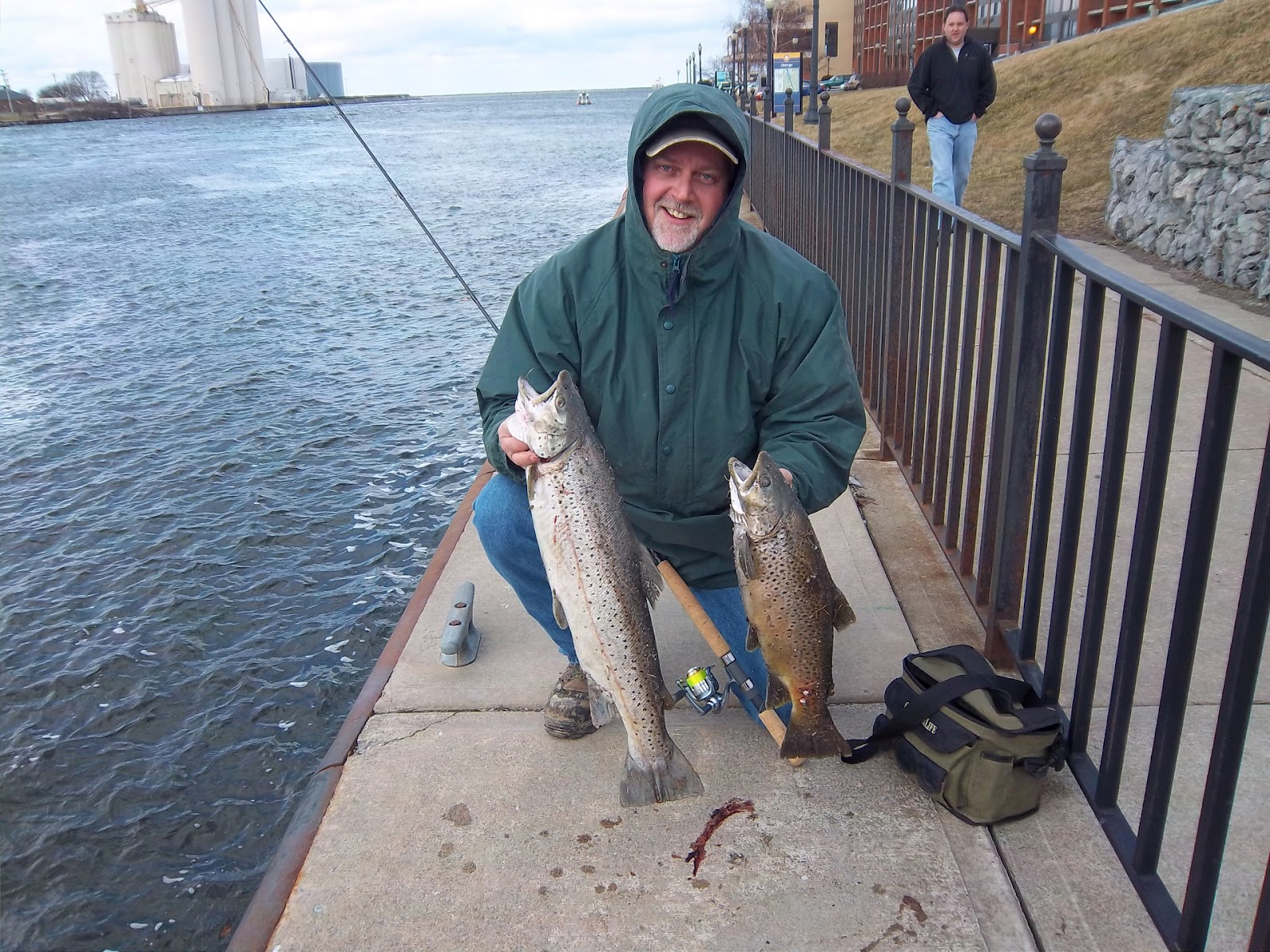
Fulton's John Guzelak with a couple nice browns he took off the east bank, aka Hotel Row, in Oswego.

You can’t blame ice fishermen for feeling they got stiffed this winter. Oneida Lake didn’t even see a skim of ice until the first week of January and it took until the middle of the month for it to grow thick enough to walk on. And while the fishing was hot for a few weeks, the weather quickly  turned against the ice with warm spells and heavy winds, weakening it to the point where most guys wouldn’t go on it. Those who did walked slow, carefully; and even then some went through and had to be rescued…In mid-February!

But an ice fishermen’s lament is an Oswego River bank angler’s song.  And last weekend there was a lot of silent singing going on up and down the river.

In Phoenix, guys fishing minnows on bottom in the canal below the locks landed bucket loads of yellow perch for their efforts. Ranging from 6 to 10 inches, the fish weren’t as big as their Oneida Lake kin, but the smiles they produced were every bit as bright.

Upriver, in the city of Oswego, the east bank coughed up mixed bags of rainbows, steelies and browns. Most were taken on lures worked slowly a couple feet below the surface.  Blue and silver spoons,  silver in-line spinners and minnow-imitating crankbaits like Challengers all produced.

The shallow rapids above the power plant proved disappointing to most who waded up there. Those in the know say there isn’t enough snow in the hills to generate the run-off needed to swell the river to levels needed to entice steelies into the pockets and plunge pools just below the dam.

However, the deeper rapids along the middle wall and in the Power Plant’s tailrace contain enough chromers to make a trip worthwhile. You gotta work for ‘em, but they’re there.

About the best way to fish the whitewater right now is from a motorized drift boat. You see, the only place to put in is at the launch below the east side of the Bridge Street bridge. Then you run the fast water to the middle wall. You could always row your way over, I guess, but you’ll be limiting your options to the east side and north end of the wall.

With a motorized drift boat, you’ll be able to run the deep rapids and fish at the end of the power company’s retaining wall, as well as some of the deeper pockets in the whitewater.

The Oswego is a massive river, Lake Ontario’s second largest tributary. If you’re unfamiliar with big rapids, please consider hiring a seasoned  professional to show you the ropes. Local legends, captains Andy Bliss (Chasin Tail Adventures, 315-591-4578; www.chasintailadventures.com) and Kevin Davis (315-342-4861; www.catchthedrift.com), are intimately familiar with this mighty stream, and can lead you to the pockets preferred by its largest visiting steelies.
Guys perchin' below the lock in Phoenix.

Friday, February 10, 2012

Big Bay on Ice

By Spider Rybaak
Lyndon Bentley, Pennelville, NY, with a nice mixed bag of sunnies and crappies.

Most ice-fishing stories set on Oneida Lake cover its fantastic walleye and perch fishing. And that’s only right, seeing how these two tasty species thrive in just about every gallon of the lake. In fact, as this is being written [February 8], ice crowning the deep water off Chapman Park, Lewis Point and Sullivan Beach is so crowded with anglers, it looks like it’s being taken over by “Occupy Wall Streeters” in blue shacks.

And though the bite has cooled considerably from the hot and furious action of late last month, enough 10 to 12-inch perch and 15 to 21-inch walleyes are biting to keep guys on the hardwater from dawn to after dark.

But there’s more in the lake than just these two. Indeed, sunfish and crappie, two popular species for ice anglers, call the lake’s productive waters home, too. And the best spot to get them is in Oswego County.

Especially in Big Bay, that big dent in the lake’s northwestern corner. Averaging 8-feet deep, loaded with weeds, it’s the perfect habitat for these sumptuous critters.

What’s more, ice on the bay comes early, thickens quickly and stays late, come hell or high water. Indeed, even during last week’s heat wave, when the majority of anglers either stayed home or close to shore, guys were all over Big Bay.

Sunnies, primarily bluegills, average the size of a big man’s hand. They’re inclined to strike small jigs tipped with mousies, spikes or waxworms.

Crappies run from 10 to 13 inches. I know, because when I was there last week, I peeked into as many buckets as I could. Their owners stared back at me like I was bad meat or something, probably  because I went around bent-over,  walking softly (I didn’t want to disturb them or the fish, you see) lifting lids off buckets, taking pictures and stuff.  But they always calmed down when I told them I was researching a paper.

Calico bass prefer larger baits than sunfish; waxworms tipped on Swedish Pimples, for instance, and fish baits like buckeyes or flatheads.

Crappies and sunfish move around a lot throughout the water column, and are as likely to strike right below the ice as over the heads of weeds or on bottom along the edges of vegetation, so fish at various depths until you find ‘em.

For ice fishing safety tips, check out the NYS DEC web site at www.dec.ny.gov/outdoor/7733.html.

Bentley's best of the day.
Alex Doughty (left) and Alex (AJ) Jr., with  a little part of their catch.

Steve Martin, Warners, NY, holding two of his bucketload of pumpkinseeds taken at Big Bay.

Tuesday, January 24, 2012

First Ice on Oneida Lake

By
Spider Rybaak


A walk on the ice.


Winter finally paved all of Oneida Lake in ice on January 15th, the third Sunday of the month. The sight of all that hard water was too much for some guys to handle, causing them to put away common sense and venture out onto the fresh, thin sheet. I waited on shore for short spells throughout the day hoping to catch one coming in (I knew enough not to go out there), but luck wasn’t with me and none came; it smiled on the anglers, however, because I didn’t hear of anyone falling through.

The following week witnessed a full menu of meteorological conditions: clear skies and sixty mph winds one day, heavy snow the next, unseasonably warm weather after that …typical NY weather.  By mid-week, ice still claimed about two-thirds of the place, with huge holes punctuating it like Swiss cheese. Most of the north shore was open water.

On Thursday frigid temperatures swept out of the north, gripping Central New York in an icy embrace.  Artic winds joined the fray on Friday, growing stronger and stronger as the day wore on, reaching speeds  up to 40 mph at sunset. By morning, the lake looked like a deep-pan garlic pizza: a crystal clear base topped with patches of snow, ringed by a crust of huge fragments of squeaky-clean ice piled up to five feet high in spots.

Knowing the jagged ice clinging to shore resulted from the previous evening’s high winds breaking up the ice pack was enough to keep most experienced guys on shore. Still, a motley group of daredevils, die-hards and potential suicides went out Saturday morning. At last word, they all returned.

One guy riding around Lakeport Bay on an ATV wasn’t so lucky. Apparently, the snowmobilers whipping by all morning caused him to figure: I can do that. Well, he went out about 50 yards too far, over water that was 20-something feet deep, hit a weak spot and his $10,000.00 machine submerged like a wacky-rigged submarine. He managed to bail out and was last seen with some friends on Monday trying to pull the soggy four-wheeler out of the drink. I don’t know how they made out.

Temperatures on Saturday night, January 21, sank to single digits, welding the lake’s broken floes and spackling its ice holes into a solid, level surface by morning. On Sunday, the sun came up on colorful groups of ice-fishermen scattered on the ice like flowers over a field after a spring rain.

And while no one claimed the fishing was great, quite a few thought it was good.  Perch running from 10 to 13 inches were the most cooperative. A few walleyes were caught, but the bite was disappointing.

Successful anglers claimed the fish were taken in water ranging from 18 to 25 feet deep. Buckeyes were the most productive bait but some did quite well gently shaking ice jigs tipped with spikes or Swedish Pimples flavored with whole minnows or just their heads.


The New York State Department of Environmental Conservation’s Web site offers an informative feature on ice fishing, covering everything from clothing to tackle and techniques. Check it out at http://www.dec.ny.gov/.

Warning, Cleveland, NY.
Dylan Hull, Waterville, NY, with a pair of keeper perch.
Chris Peck, Deansboro, NY, holding a legal walleye and a jack perch.
Oswego County wildlife.
Cleveland Docks.
First ice on Oneida Lake.
Snowshoing Cleveland's ice at Dusk.