Thursday, January 3, 2013

Coyote: NY’s Top Dog


By Spider Rybaak

Jerry Donegan checking messages as his "pet" coyote looks on.


One of the nicest things about fishing is it exposes you to nature’s menu of wonders. Take night fishing for walleyes at Oneida Lake’s Phillips Point. Jutting into Three Mile Bay/Big Bay Wildlife Management Area, it’s ideal for surf fishing. You arrive in the early evening, wade out as far as you can and start casting. Before long, the sun goes down, taking the wind with it, ironing the lake into a smooth undulating sheet spotted with stars…sometimes the moon.

Casting out into the sparking night, you reel in your line, dreams of walleyes swimming through your mind. But there’s more in store than just what meets the eye: the night’s song of frogs croaking, fish splashing, deer foraging…and coyotes howling.

That’s right, coyotes. The state’s loaded with ‘em; between 20,000 and 30,000 according to the New York State Department of Environmental Conservation.

Not to worry, though; they’re not all in one place. Requiring anywhere from 5 to 20 square miles of home range, a family of coyotes (parents and the year’s offspring) is very protective of its turf and runs off interlopers.

“Back when my dad started hunting em’ they called them coydogs,” says Jerry Donegan, “which is reasonable, because they looked like a coyote/dog mix.”

“But they’re not hybrids,” claims the Caughdenoy native. “In fact, they stick with their own kind and would rather eat dogs than mate with them. One of my neighbors lost his dachshund to one in his own backyard a few years back. He managed to get the coyote to release the dog but it was curtains for the pooch.”

NYSDEC agrees with Donegan’s assessment, classifying the state’s current top dog (fox used to hold the title) as a distinct species. Called the Eastern coyote, it’s fully 30% larger than its Western counterpart, a size differential some attribute to the species mating with Timber wolves. According to this story, Wiley Coyote’s relatives started moving east to take advantage of the vacuum left when the forces of civilization wiped out our timber wolves. While trekking through the Great White North, they ran into timber wolves in Ontario’s Algonquin Provincial Park, and those lucky enough to survive the encounter mated; the rest is history, as they say.

There’s several ways to skin a coyote.

Donegan prefers to go for the critters in organized hunts. He and his buddies start out by searching places like Three Mile Bay/Big Bay and Klondike WMAs for fresh tracks.  When a set is located, cell phones lead the hunters to the spot. They put dogs on the scent, and then spread out, searching for clearings in the woods where they sit down, wait…and hope. It can take anywhere from a few minutes to a couple hours for the dogs to get the coyote up and running, and pointed in the direction of the hunters.

“Dogs baying while running toward you send adrenalin rushing through your body,” Donegan reveals, a flush of excitement spreading over his face. “And when the coyote appears, coming right at you…it’s the greatest!”

Some guys like to hunt the beasts one-on-one. Decked out in camo, surrounded with masking scents, they sit motionlessly, calling them in by imitating the distress calls of fawns, rabbits, even puppies.

Coyotes take to huge woods like ticks to dogs, and all of Oswego County’s WMAs support them.

However, patches of woods will do when large forests are few. If you like hunting closer to the beaten path, landowners are generally willing to let you on their property.

Donegan thinks “the reason folks are more open to coyote hunting is because they’re so abundant. Seeing populations of small game like pheasants and rabbits in decline, a lot of farmers blame coyotes and are more than happy to allow you to hunt them on their property.”

Coyote hunting season runs from October 1 to March 31. There is no bag limit and they can be taken day or night.


Jerry and wife Ellen holding coyote pelts.
Coyote country.
Robert Donegan with a toothy coyote skull.

Friday, December 21, 2012

Oswego County Recreation Trail

By Spider Rybaak

Oswego County Recreation Trail Head Sign

Central New York played a key role in the economic development of our nation. Today, the original routes that carried the Industrial Revolution to every corner of the country have been covered over by pavement, submerged under the Empire State’s canal system, or left to nature. Fortunately, the builders of this massive ancient infrastructure did their jobs well--so well, in fact, it’s gonna take natural succession a long time to hide the evidence in the portions that were simply abandoned.

And while that might goad the sensibilities of purist environmentalists who feel smug sitting around thinking and talking a lot, it’s a God-send for average folks looking for cheap ways to recreate and exercise in the open air. You see, nowadays these forgotten routes etch the state in a web of paths lined in natural splendor, offering folks scenic avenues through the historical record.

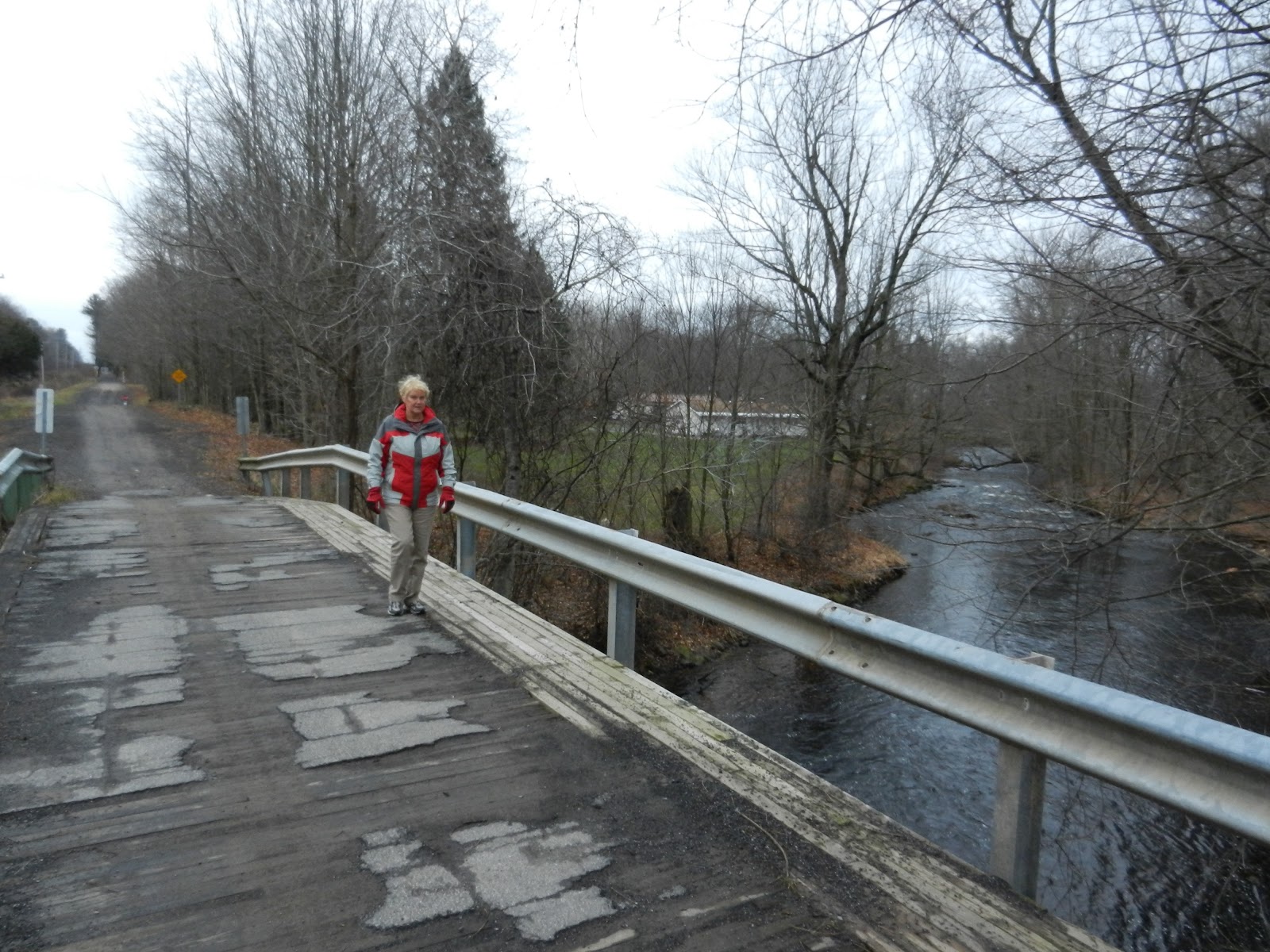
Take the Oswego County Recreation Trail, for instance.  Running the bed of the New York Ontario & Western Railroad (abandoned in 1957), it’s the easiest, most convenient path you can take through our past. Stretching for roughly 26 miles, from Maple Avenue in Fulton to a little east of North Street in Cleveland, its gentle grade is ideal for hiking, biking and snowmobiling.

The OCRT is actually two trails: the western arm reaches from Fulton to Central Square, where it’s blocked by Interstate 81 (the highway was built after the railroad was abandoned, and no one thought of tunneling the trail under it); the eastern stem picks up on the other side of the interstate, about 1000 feet west of CR 37, and runs all the way to the county line in Cleveland, beyond which it becomes rutted and beat as it continues for a short distance into Oneida County.

In Oswego County, the well-maintained path slices through a patchwork of developed and natural areas. And while the scenery along its entire length is worth the trip, the eastern section is longest and offers the most diverse habitats.

Spawned on its west end at a dented guardrail preventing vehicles from going over the edge of the demolished railroad bridge over Little Big Bay Creek, the east branch cuts through agricultural fields and pastures, skirts woods and small parks and crosses creeks and brooks, offering a menu of splendid scenery, including golf courses, Toad Harbor Swamp, the dam on Scriba Creek, (just upstream of the Oneida Lake Fish Hatchery), thick, dark forests, scenic back-country beaver meadows, even a backyard pond in Cleveland that sports its own bridge over a feeder brook, and a cannon protecting it.

Access is easy. From CR 37 to the edge of Constantia, roads heading south off NY 49 cross the OCRT; and there’s parking at the shoulder of Toad Harbor Road. On the east side of the village, the trail crosses NY 49 and, from here to its end, is accessible by all roads heading north from the highway.

In Constantia, shoulder parking for about 10 cars is off Hatchery Road, a few hundred feet north of the NY 49 intersection. East of the hamlet, parking is allowed on the shoulder of some cross-roads and North Street.

The trail gets a little tricky in Cleveland. On the east side of its junction with Center Street, the OCRT widens, turning into Sand Street. But a few hundred feet later, on the other side of North Street, it assumes the charm of a trail agaiin.

Snowmobiling, cross-country skiing and horseback riding are also allowed on the trail.  Motor vehicles, other than snowmobiles, trail groomers, Oswego County highway equipment, and authorized emergency vehicles, are prohibited from the trail. ATVs are only allowed on the eastern-most section of the trail between Toad Harbor Road and the Oswego-Oneida county line.

At press time, coils of gray and white rolled over the barren, late autumn landscape lining the OCRT. Soon, hopefully before Christmas, winter will shroud this natural canvas in sparkling snow punctuated with ice, adding frosting to the Holidays.

Merry Christmas.

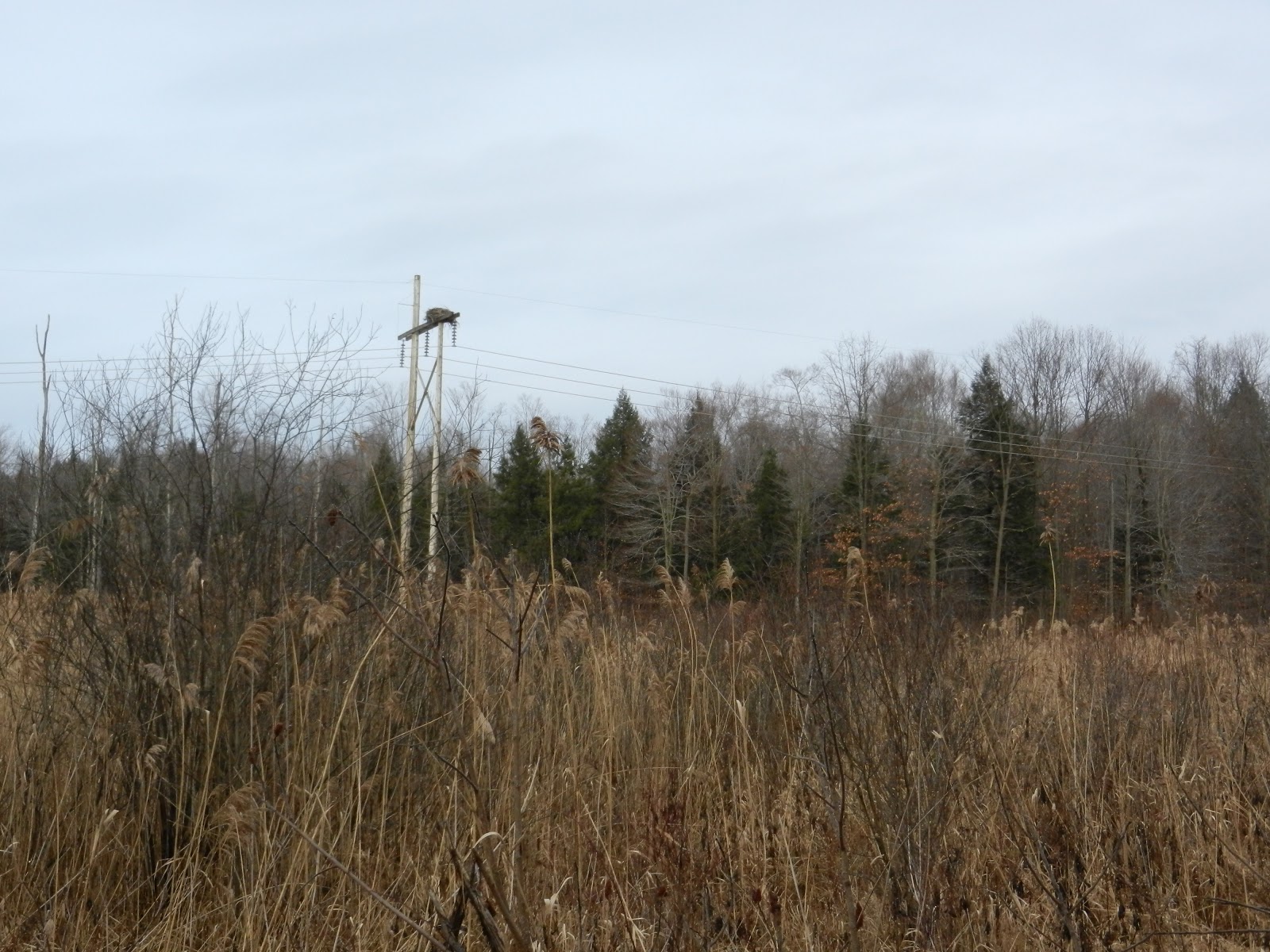
Osprey nests...


Woods...

The OCRT runs past marshes...


Hayfields...


Over abandoned beaver meadows...

Wooded brooks...

And Creeks.


Wednesday, November 21, 2012

Deer Season’s Opening Weekend


By Spider Rybaak


Scott Timmerman and sons (l to r) Logan and Brandon pose with his monster 8-pointer, taken in the southern zone, just east of NY 3.
The Southern Zone’s Deer season dawned on Oswego County in spectacular fashion. The beasts were plentiful; hunters were, too; and the weather was as deer-hunter-friendly as you could hope for.

As in the past, areas containing a good mix of farmland, forest and marsh were most productive.

The NY 3 corridor was especially so.

The reason: “Last winter’s mild weather was gentle on the local deer population,” says David Ouellette, part-owner of Deer Creek Motel and Pheasant Shooting Preserve (315) 298-3730. 

“In addition, our close proximity to Lake Ontario gives us a lot of moisture, which translated into good crop growth on local farms last summer. Finally, we have a lot of state parks in the area where gun hunting for deer ain’t legal; and numerous wildlife management areas loaded with dynamite deer habitat. Combine these factors and you come up with one of the best deer hunting areas in the state,” he adds.

Two guests of Deer Creek Motel and Pheasant Hunting Preserve had the carcasses to prove it.

On opening day, Roger Babeu dropped a nice buck on property leased by the motel in the southern zone, near Grindstone Creek. The farmland he was hunting is gently rolling. What’s more, it’s a short distance from Selkirk Shores State Park, a spot notorious for ideal deer habitat.

Pete Surette, on the other hand, took a nice four-pointer right behind the motel, in the northern zone. The area he was hunting was also gently rolling and watered by Deer Creek.

But Oswego County ain’t just for opening day. Scott Timmerman proved it by shooting a massive eight-pointer on Sunday, the morning after, when deer that survived the first day are notoriously super paranoid.

That’s another plus Oswego County has going for it. You see, world class fisheries like the Salmon River and Grindstone Creek draw lots of anglers. The same goes for spectacularly scenic Selkirk Shores State Park which gets loads of campers, picnickers and hikers. 

As a result, our deer are a lot more comfortable with human scent wafting through the woods than they are in other regions of the state and that makes them a little more careless…often just enough to help a competent hunter fill the freezer with delicious, corn-fed venison.
Roger Babeu, Groveland, MA, with a nice buck he took with a 7 mm last Saturday.
Pete Surette of Middleton, MA with a crotch-horn he took behind Deer Creek Motel on Opening day.

Friday, November 16, 2012

Oswego’s Rapids Carpeted in Golden Brown


By Spider Rybaak


Alex Korol, a SUNY Oswego student, holds one he landed while float-fishing a bead with a centerpin rig

This month all of New York is blanketed in the fading reds and golds of an aging autumn. But there’s still a lot of brilliance and vibrancy out there if you know where to look. And one of the best places to feast your eyes on the year’s last moments of splendid beauty is the city of Oswego.

But don’t look on shore. You see, the river running through the city is loaded with mature brown trout. Vying for mates, they’re decked out in their finest colors: dark brown backs fading into rich golden sides glimmering with red spots. There’s so many trout, in fact, the stream throbs with all the life traveling through it.

OK, that might be stretching things a bit. Still, there’s more brown trout in the deep tailrace stretching from the north end of the power dam to the tail-out where the heavy current breaks into whitewater than anyone can remember.

And it’s not like great quantities of salmonids is something new to the spot, either. Indeed, Pacific salmon pile into the tailrace in such numbers in October, the high wall seems to lean under the weight of all the anglers.

What’s unusual right now is the incredible number of trophy browns…big ones, up to 20 pounds.

No one was more surprised to see so many fish than I. Kwame Belle, a journalism major at SUNY Oswego, is doing an assignment on a “Bucket List” of stuff to do in the city of Oswego, and felt fishing should be included. I agreed.

Well, the salmon runs are over, so I called driftboat /charterboat  operator Captain Andy Bliss, (315) 591-4578, my favorite source for fishing information on the Oswego River, for suggestions.

“Browns are easy to get right now off the wall below the powerhouse,” he answered. “There’s a lot of ‘em because the water’s been so low, they’re milling around waiting for it to rise before running up to the dam.”

He wasn’t kidding. In the two hours or so Kwame and I fished, I personally saw 20 browns and five steelhead landed, and at least that many lost. (Kwame and I got zilch—so it goes, I guess.) The guys were bottom bouncing: casting out, letting the bait sink to bottom and walking it downstream. Most were using beads.

Browns are traditionally available in the river until late December.  This weekend, however, promises to be one of the year’s most propitious for a trophy: the weather’s supposed to be clear, water low and opening day of deer season should move half the anglers off the wall and into the woods, reducing competition considerably.
Kyle Buck of Hammondsport with one of his browns.
Bob from Colorado comes up to Oswego each year in November for the splendid fishing.

Kwame Belle, a SUNY Oswego student, tackles his "Bucket List" on the Oswego River.

Belle may have left fish-less, but the smile says it all!

Wednesday, October 31, 2012

Hot Steelie Action on the Salmon River


By Spider Rybaak

Typical October-run steelie.


Anglers have been catching steelhead in the Salmon River for most of October. Like the stream’s flow, however, they only ran in trickles. 

Until last week’s rains changed everything. As water levels rose, massive quantities of steelhead poured upstream. They were still coming Sunday night, and the whole river is loaded with ‘em.

And they’re huge. Fish weighing in excess of six pounds are more common than smaller ones.

And fight…? I watched three fish get hooked at once in the rapids at the head of a popular hole in downtown Pulaski. After spending the first few seconds stubbornly struggling against the flow, they all jetted back into the pool. Guys standing along their path had to hop, bend--including backwards--duck, dodge and jump in a surrealistic dance to get out of the way. Back in the hole, the fish started leaping, porpoising, tail-walking, making the water look like it was boiling over with molten silver.

These fish are fresh, boasting olive backs fading into speckled, chrome-plated sides that’ll temporarily blind you if the sun reflects off them and strikes you in the face.

And careless…they act like they’re still in the safe, open waters of the lake. I watched several slide effortlessly upstream along the edge of the river, in water that barely covered their backs. I don’t know if their gutsy strategy was evolution or just plain luck, but-- to my amusement and surprise--they snuck past the gauntlet of anglers focused on the middle of the stream.

As the week progresses, things should only get better. You see, Hurricane Sandy’s heavy rains will raise water levels further. As Oswego County’s rivers rise, they’ll penetrate deeper into Lake Ontario, drawing even more fish upstream—and that includes skinny creeks like Grindstone and Little Sandy, maybe even Deer Creek, and brooks like Orwell and Trout.

One man’s perfect storm is another’s opportunity for a wall-hanger. So don’t be a victim, go fishing instead. The time is ripe for the fish you’ve been dreaming about to come into your life.
The steelies just kept on comin'.
This steelie hit a tiny glo-bug the size of a trout egg

Thursday, October 18, 2012

Ducks in the Wind

By Spider Rybaak

Dock side.


Just about any time you look into the friendly skies over Oswego County this month you’ll see and hear chevrons of migrating Canada Geese.  The reason they’re more cautious (they’re flying much higher, and unwilling to come down near us) than the geese we’ve seen all summer long is because they’re truly wild, not the locals that were mostly harvested during last month’s early season. Hailing from the Arctic Circle, they’re on their natural fall migration to swamps in the south and don’t want anything to do with humans.

You’ll notice a similar paranoia displayed by a lot of the mallards and other ducks, too. And while their hunting season doesn’t start until October 27, a lot of these guys are also new arrivals from the great white north and they cotton to humans about as readily as cats to rats.

That’s why there are so many duck blinds along the shore of Oneida Lake. In order for hunters to get close enough for a shot nowadays, they have to dress in camo, hide in a blind surrounded by spreads of decoys, call the waterfowl in and pop up to shoot them as they’re coming in to join the decoys.

This form of duck hunting requires a lot of work setting everything up, teaching a dog to retrieve and learning how to properly call the fowl.

What’s more, shooting the birds requires a lot of skill. They move fast, especially when a hunter pops out of his concealment, scaring them all half to death, and shooting a couple if he’s lucky.

But the thrill of having done it makes it worthwhile, especially in Oswego County.

You see, we’ve got some of the hottest duck hunting spots in the state. For instance, Lake Ontario offers hunting opportunities for open water species like buffleheads, while its bays and barrier ponds offer mergansers, mallards, black ducks, you name it. Similarly, Oneida Lake and the sprawling wetlands in its Three Mile Bay/Big Bay Wildlife Management Areas (3,495 and 120 acres, respectively) offer world class waterfowling.

And then there’s always the Oswego and Oneida Rivers and the wetlands in our northern WMAs, especially Happy Valley.

One of the most exciting ways to hunt is with a canoe. Stan Oulette, owner of Deer Creek Motel (315-298-3730), suggests float down Deer Creek, feeder to another popular Oswego County WMA, Deer Creek Marsh. 

“Paddle along quietly,” he advises, “and you’ll get shots at ducks you’ll spook at every bend in the stream.”

The state Department of Environmental Conservation’s access site on NY 3, a couple miles north of Port Ontario, offers a beach launch for car toppers and parking for about 10 cars.

For information on everything from hunting zones and hunting seasons to the “Rational for Waterfowl Hunting Seasons,” go to www.dec.ny.gov/index.html and click on hunting seasons. For a map of state forests and wildlife management areas in Oswego County, go to http://visitoswegocounty.com/fishing-hunting/hunting/where-to-hunt/.
Among the waves.
Beach house. 

Tuesday, October 9, 2012

Oswego River Comes Alive


 By Spider Rybaak


Migell Wedderburn with a nice king he caught fly fishing in the old riverbed between the middle wall and Leto Island. "They're all over, and I hooked so many they tore my leaders to pieces," claimed Pennellville resident.

Huge schools of salmon started charging into downtown Oswego over the weekend. Hundreds are staged in formation in the power company’s tailrace. Suspended anywhere from 18 inches to three feet below the surface, averaging more than 20 pounds each, they look like a surrealistic raft of monster sardines on a hari-kari mission outside of a processing plant. In reality, they’re waiting for the river to rise a little, and offer them an easier, safer path upstream

Adding to this once-a-year angling extravaganza are legions of brown trout ranging from 6 to 15 pounds. Only about 1/3 the size of the kings, the water level is much more comfortable for them and they look and act like giddy aces, darting through the assembled Chinooks like fighter planes tearing into a formation of sluggish bombers.

The vast majority of salmon is still decked-out in fading silver to olive drab, the color of fresh-run fish. However, black specimens (precocious salmon that matured a little quicker than average) slice through the group, heading upstream to spawn. Easy to spot if you’re wearing polarized sunglasses, you can see them carelessly jet over the school,  jump the low barrier atop the ancient riverbed directly in front of the turbines (see photo below), and, sometimes, even follow their dorsal fins cutting the surface of the whitewater as they beeline-it for the dam.

Most of the fresher fish still have a few days to go before their biological clock sets off the alarm that’ll force them willy-nilly into the dangerous shallow rapids. They’re milling around, waiting for rain to swell their passage, or at least the cover of darkness, before making their run.

Still, all the good seats in the tailrace are filling up fast. Some of the more independent salmon, feeling crowded, join the single file of scouts steadily going over the top into the no-man’s land of whitewater. Even though their numbers are small compared to what’s waiting down below, there’s enough in the bubbly to offer world class fishing.

Surprisingly, few anglers were around on Sunday. In fact, less than a dozen fished from the high wall downstream of the powerhouse. A lot more were in the rapids upstream, especially around the dam, but nowhere near what you usually find during the peak run.

Rains were heavy in the Finger Lakes and Oneida Lake regions and the water is sure to come up this week. This run is a good one, maybe even one for the record books.

Brookfield Power Inc. has issued a new dress code for the river between the dam and the powerhouse: you must wear a personal flotation device to enter that part of their property. A guy sitting in the crane on top of the falls that clears debris from the intake canal is watching and throwing anglers out who aren’t conforming. It’s no sense giving him a hard time because the power company owns the western half of the riverbed and has the right to regulate who fishes there.

Regardless, be careful in the rapids. The water can come up at any minute and one of the best ways I know to ruin a fishing trip is to get carried away by the current, PFD or not, getting all wet and losing your rod and reel. Before entering the river, make a mental note of where the water is on a rock or retaining wall, and the flow pouring over the dam. If it seems to be going up, get out quick. If you gotta err, err on the side of caution; you can always go back in if you misjudge.

Robert Donegan of Caughedenoy holding a king he caught on the Salmon River on 10/8/12.

Father and son catch a big brown...and a memory.

Frank Panek, Uncasville, CT holding his king.
King going over the top.
Jump for freedom: One that got away.
The number of anglers on the Oswego River this past weekend was surprisingly small for the peak run.