Thursday, October 27, 2011

Walleyes Return to Shore

Beach Scene: Oneida Lake at dusk, in Autumn.

A few nights ago, I noticed a bunch of cars parked at the abandoned bridge at the mouth of Oneida Creek. I turned around and went to investigate. Roughly 15 guys were fishing from shore, and in the 10 minutes I stood there watching, four landed walleyes.

I returned to my car…rubbing my hands in glee. You see, I knew the reason they were there wasn’t because a large school of walleyes came in—if that had been the case, I would have seen a lot more caught.

The reason they were putting up with shoulder to shoulder competition on the east shore was because a stiff wind was blowing out of the south, sending whitecaps slamming into the entire length of Oneida Lake’s north shore, making for uncomfortable fishing.

And if my 50-something years of fishing have taught have me anything, it’s that this marvelous species loves the wind, and, as often as not, follows it.

So I aimed my wheels for Oswego County’s southeastern corner.  When I got to the Cleveland Dock fishing access site on NY 49, the wind was blowing so hard I was afraid it would wrap the violently swinging, wooden DEC sign around its holder.

Still, several guys were standing shoulder to shoulder in its shadow. The most successful were casting into the channel leading into the tiny harbor at the mouth of Black Creek. Unfortunately, there’s only room for one, so anglers had to wait their turn. When the guy on the spot caught his limit, he’d leave and the guy next to him would take his place, catch his limit...

That wasn’t the only productive spot, however. Walleyes sweep in and out of the dock all night long, heading for the mouths of its two tributaries to pig out on the minnows gathering there each evening this time of year.  Both are on posted property. However, the fish come within range of anglers casting from the harbor’s sagging concrete wall when they round the corner from the west.

Hardy anglers take their fair share of walleyes by wading out off the southern edge of the FAS and casting from the decaying breakwall lying there like a broken concrete snake. While they have to put up with waves and wind slamming into them, they’re rewarded by having three directions in which to cast, any one of which can be carrying  a school of “eyes” heading in.

From now until first ice, walleyes will be cruising the lake’s shoreline at night following schools of minnows looking for warmer water. The bite can happen at any time and can last anywhere from one fish to everyone’s limit.

Vary your retrieve. The fish will respond to a Rapala Husky Jerk retrieved steadily one minute, jerked the next, worked slowly and steadily the next cast, and twitched, with barely any movement at all, after that.

Other public spots worth trying are the park at Taft Bay, and Phillips Point at Three Mile Bay/ Big Bay Wildlife Management Area.

Autumn at Cleveland Dock at dusk

Night bite.


Cleveland "Eye"


Rich Carew with one of three walleyes he caught in less than 30 minutes at Cleveland Dock.


Jill Jerominek, of Osceola, with a nice "eye."

Tuesday, October 25, 2011

Oswego Drainage Cats


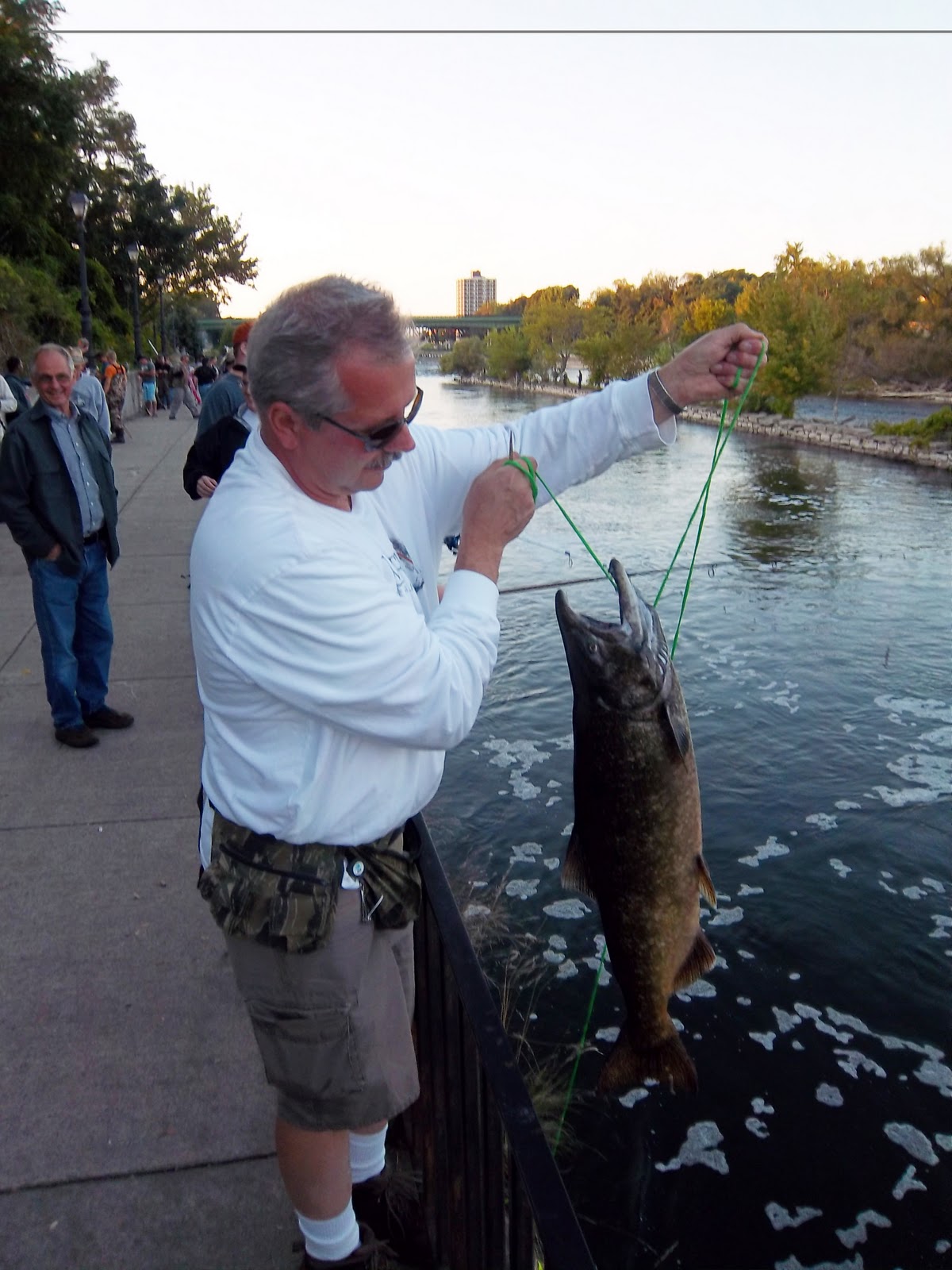
The author with a nice five-pounder taken in the city of Oswego.


Catfish, the Rodney Dangerfield of the aquatic world, is finally getting some respect; of all places, from  the State Department of Environmental Conservation. The DEC launched these handsome bottom feeders into the spotlight by placing a gorgeous specimen on the cover of its “New York Freshwater Fishing: 2011-12 Official Regulations Guide.” And while other species are included in the guide’s main theme, “Those Other Fish,” none is quite as popular as the catfish.

In fact—depending on who you talk to, of course--catfish are considered America’s most sought after fish. Available in all the Lower 49 States, they’re relatively easy to catch, grow huge, fight well when hooked and make pretty decent table fare to boot.

And while Oneida Lake is listed in Jim Everard’s piece: “Fishing for New York’s Big Cats,” as one of the state’s top seven spots for trophies, he could have just as easily included the Oneida and Oswego Rivers, too.

I know it, and so does a select group of locals who places cats right up there with the more glamorous tackle busters in their lists of favorites, alongside the likes of bass, walleye, pike...

Since they’re one of my favorite species, especially in autumn when they’re at their biggest and hungriest, I figured I’d spend a few days fishing for catfish pictures so I could do a blog on ‘em. My idea turned out to be loaded with thrills I’ll never forget.

You see, I went to a few spots from my youth, when cats were always readily available to boys whose only transportation was a bike. What I found was that the fishing is better, the catfish bigger, than existed in my fondest memories.

Oswego River Drainage

This fabulous watershed is loaded with cats...big ones. Some of the largest come right out of the river in downtown Oswego. Right now, salmon cadavers literally carpet the floor in food, so you have a lot of bait competing with you. Still, the wait can be worth it:  I’ve seen cats in the 15-lb range taken off the park walls lining both sides of the river in the heart of the city.

What’s more, catfish thrive in the entire river. Access is plentiful in Fulton and all the villages along the way.

Further upstream, specifically the Oneida River, also boasts good populations of these horny critters. Caughdenoy is famous--by locals, anyway-- for its trophies, both above the dam and in the plunge pool below. The canal in Brewerton is also a big cat hot spot.

Then there’s Oneida Lake. Channel cats, NY’s native breed, like deep, moving water. And that’s mostly found in the channel running the length of the lake, out of bounds for bank anglers. However, Oswego County provides a solution: Cleveland Docks. Located in the village of Cleveland, this spot has deep water right below its sagging concrete walls, and the lake’s cats find it a comfortable place to hang out while picking off individual minnows straying from the massive baitballs that swim in and out of the harbor constantly.

Notorious scavengers, catfish will hit just about anything, including lures. Still, a minnow, cut bait, shrimp or commercially produced offering like Berkley Gulp Catfish Dough and Berkley Powerbait Catfish Bait (they don’t feed, bleed or need refrigeration—perfect for keeping in the trunk or glove compartment), fished on bottom, work well.
Worms are good, too, but you might have to put up with everything in the drink stealing lots of your bait before a fat cat gets to it.

For everything you need to know--plus a whole lot more--to catch NY’s largest whiskered fish, read DEC Fish Biologist Jim Everard’s article “Fishing for New York’s Big Cats, ” in the current fishing regulations guide, available for free wherever fishing licenses are sold.


Mark Davis of Westmoreland holding a nice, 13-lb cat taken at Cleveland Docks.


Utica Native, Poelash Anm, showing a six-lb catfish he took on a minnow at Cleveland Docks.

Wednesday, October 5, 2011

Skinny Creek Salmon

A couple dudes who requested anonymity--and their cohos weren't talking, either.

Eastern Lake Ontario witnessed the beginning of the largest salmon run of the season--thus far, anyway--on the night of September 28th. By the following morning, reliable sources on the Salmon River reported fish where plentiful throughout the river.

And Pulaski wasn’t the only spot hosting spawn-happy salmon.

Oswego got massive quantities of fish, too. On cue, their run was spurred by heavy rains that drenched Central New York, especially the Finger Lakes and Oneida Lake regions, last week, raising water levels in the Oswego River by almost a foot. So many fish charged the River in the city, folks driving south on NY 48 Thursday evening could see salmon trying to jump the Varick dam. Fortunately, the water was so high at the foot of the structure, the effervescence so thick, it cushioned the blows and the fish didn’t get seriously hurt slamming into the barrier, only a little humiliated and a bit frustrated; but they tried and tried again until exhausted.

This writer’s favorite form of fishing is for large fish on skinny creeks. Summer smallmouths in the Salmon River, steelhead in Little Sandy Creek, big native browns in Scriba Creek, and, most of all, huge salmon in Oswego County’s creeks and brooks.

So I went and tried my luck on Thursday  afternoon. I stopped at Trout Brook, at the New York State Department of Environmental Conservation Fishing Access Site on the shoulder of cty. Rte. 48. I was a bit disappointed to see the water was at normal levels. Once I got in, however, I was excited by all the fish. I counted at least 15 fish, a mix of kings and cohos, in about ½ mile, and caught a coho.

I never made it all the way to the mouth but a couple guys  who passed me heading back to the road, two limits of kings in tow , said the whole creek was loaded. “The further you go downstream, the more fish you’ll see,” one added with great excitement.

After about an hour, I split for the mouth of Grindstone Creek, at Selkirk Shore’s State Park. When I pulled into the parking lot, a line of guys stood atop the concrete wall at creek’s end--its mouth wanders and without the wall it would have sliced through the parking lot long ago.

Before I could wet a line, three guys had fish on at the same time. All three landed them.

I wasn’t so lucky. I hooked a couple but they split back to the lake and the last I knew, they were heading for Nine Mile Point, probably on their way to the Oswego River.

The skinny creeks are loaded with fish right now and will remain so for as long as the rain keeps coming. Other Oswego County thin streams worth trying are Little Sandy Creek and Orwell Brook.

So, if you’ve never experienced the thrill of hooking a monster salmon high on hormones, in a creek so small you can walk across it on most days, now is your best chance of the season.


Peter Barnes, a native of Dingman's Ferry, PA, straining over a king he took in Grindstone Creek.

Mike Isabella, Rotterdam, NY, takes a king from Grindstone Creek.

Schenectady, NY's, Larry Millen with his Grindstone Creek king.

Oswego Swollen with Kings

Glen Lystash, Hardwick, NJ, shows off his hard-won trophy.

Nothing spurs ripe kings and cohos to charge into Lake “O’s” tributaries like an autumn moon washed by heavy rains.

True, Oswego County escaped the brunt of the inclement weather that shrouded much of Central New York last week (September 18-24). However, her largest river, the Oswego, drains thousands of square miles, including the Finger Lakes and Oneida Lake.  And it takes a while for all that water to finally reach the city at its mouth. When it does, it signals the salmon waiting out in the lake to start revving their fins because it’s party time!

So, Saturday morning I called Larry Muroski, over at Larry’s Oswego Salmon Shop (315-342-2778), to see if any new fish were coming in.

“Yup,” he replied. “The river’s full of ‘em.”

Larry’s a man of few words but great on enthusiasm. When I heard his tone, I knew the fish were on the move.

The lake launched this season’s most significant run on Friday. The following morning, anglers who were expecting “just decent” action by the steady numbers trickling in all week were surprised by all the fish that were present, prompting one,who was retying after a king broke off, his fifth loss in less than two hours, to complain  “These fish are so big and so fresh I can’t hold onto them.”

“I’m a 20-year veteran of the Oswego River’s salmon runs and I’ve never seen so many fish in September,” he added.

And it’s only just begun. If the past is any guide, this run will continue for the next few days, until the water drops.

But even then, fish will enter this large stream regularly for the next four weeks, at least. A good way to gauge your chances of success is to follow weather and temperature patterns: cold nights generally send new fish upstream, and so does rain.

Some browns are present, too, but I didn’t see any steelhead. Browns will bearound in great quantities all of October. Good numbers of steelhead should start appearing the second week of the month and continue pouring in through December.

For Safety’s Sake

With all this water feeding it, the Oswego River is probably the most run-of-sensitive stream in the state. Combined with the extreme fluctuations caused by ebbs and flows in hydroelectric power generation, the river can rise a foot or more in seconds…and I’m not exaggerating. Make a mental note of water levels on rocks, walls and depth gauges, how much is coming over the dam, before stepping in. If you see, or feel, the water rising, get out immediately. If you hear sirens, followed by warnings, head for shore. Finally, wear a personal flotation device—it can be a life saver.

While nowhere near as slippery as the Salmon River, the Oswego has its slick spots. Wear Korkers or similar traction devices to help you keep your footing. A pair of Polarized sunglasses helps penetrate the surface glare so you can see where you’re stepping—and easily spot fish, too.

Fulton Carp Action

On September 17, carp, another of the river’s popular leviathans, were the object of the Wild Carp Club of Central New York’s attention. Seventeen members of the group reportedly caught and released over a ton of the beaststhat day in Fulton, New York.

For more on the club, including this season’s last three events, call Jason Bernhardt at 315-427-7109; Jason@wildcarpcompanies.com.


Bobby Fuller and Jeff Proctor with an average-size king.

Donata Taylor, Redding PA, uses some fancy rod handling techniques on an uncooperative king.

Auburn, NY's, Lee Rusin with his day's catch.

Friday, September 30, 2011

The Returns are Here Again


Salmon Update: This season's largest run of kings entered the Salmon River Wednesday night, September 28. They're still entering the river as of this update, 11:30 a.m., Thursday morning. With rain predicted straight through the weekend, they should continue pouring in until the beginning of next week.

Owen Baxter, and his dad Don, of Boonville, N.Y. show off a Salmon River king

All the rain we’ve been having lately has spurred salmon into running Lake “O’s” tributaries a little early this year. In fact, enough fish entered the Salmon and Oswego Rivers in the first week of September to raise angler excitement to peak-run levels. And while a lot of guys got early thrills, these initial fish haven’t put a dent in the regular runs. Which, are just getting started.


Within the last few weeks, major numbers stormed the Salmon River (the Oswego always turns on a little later and should pick up this week). Anglers have reported tackling with near record numbers of kings and cohos.

Fortunately, for fish and fishermen alike, decent rain at regular intervals coupled with forecasts for more, means river conditions should remain almost perfect and stream banks and bottoms should be full of both for the next several weeks.

While Mother Nature is doing her part to make the angling experience more enjoyable, we are also realizing better conditions as the NYS DEC has been diligent in their efforts to eliminate lifters and snaggers from the environment.

“Now that lifting, lining, whatever…aren’t fashionable anymore, the chances of catching a clean fish are better than ever,” says Sean Rae, a Syracusan who fishes the river. “I’ve caught two today; neither one had wounds or hooks in its body.”

All the usual offerings are producing. Plastic eggs still seem to be the bait of choice but a lot of anglers are tossing flies, egg sacs and sponge to good effect, too.

What’s more, folks targeting early steelhead with everything from beads and Berkley Floating Trout Worms to yarn flies are finding their offerings are luring a lot of salmon.

Good numbers of fish are available throughout the river. Indeed, they’re stacked like cordwood below the bridge in Altmar.

The stream’s population of salmon should remain relatively consistent throughout the day for the next month or so as Brookfield Power continues to help balance the ebb and flow of natural precipitation. You see, the power company has agreed to release a steady stream high enough to draw and hold the beasts throughout the spawning season, a partnership that almost guarantees your trophy will be there waiting for several weeks to come.

For Safety’s Sake

The Salmon River is one of the slipperiest in NY. Wear clean Korkers or similar traction devices to help you keep your footing. A pair of Polarized sunglasses should be worn to help penetrate the glare so you can see where you’re stepping—and easily spot your prey.

Spawned in the Tug Hill Plateau, the Salmon is very sensitive to run-off and can rise quickly. Make a mental note of water levels before stepping in. In other words, note its location on a large object like a rock, bridge abutment, root ball or windfall. If you see, or feel, the water rising, get out immediately. Experts advise wearing a flotation device—it can be a life saver.


A hen coho taken by the author on September 21. 

Triple Deuce Charter's Matt Rubley, a Pulaski native, admiring a large male coho he took on September 21. 

Fishing at Ellis Cove on the Salmon River 

Watching the fish from the bridge in Altmar 

Stanley Cole of Snowcamp, N.C. fly-fishing for kings in the catch-and-release section of the river in Altmar.

Ron Haney of Altmar, who lost his right arm in an accident, shows how he fishes for kings

Tuesday, September 27, 2011

Pond Hawgs

 Pat with an average-size Sandy Pond bucketmouth.


Sandy Pond is mostly known as a splendid sandy beach bordered by majestic sand dunes where sunbathers toast themselves to a symphony of high winds, roaring waves and the cries of water birds of every feather.

On the other side of the dune sits the real Sandy Pond. Covering roughly 2,400 acres, it’s the largest embayment in the Eastern Lake Ontario Dune and Wetland Area, a 17-mile long natural barrier system containing the tallest sand dunes between Cape Cod and Lake Michigan.

The beauty of the place makes it extremely popular. Much of its shoreline is developed with camps, homes, and campgrounds. The place gets so crowded in summer, I never gave its warm weather fishery any thought.

However, I always knew “the Pond” was a well for northern pike and perch in winter, and crappies after ice-out. Some guys I normally consider reliable sources of information claimed it was a bass hot-spot in summer, but when I went with them, we got skunked every time. So I ignored it from then on.

That was, until I went fishing on Oneida Lake with Pat Miura last July (see blog post of Aug. 2, 2011). One of the most popular fly-fishing guides on the Salmon River (315-777-3570; pmiura@aol.com ), Pat spends his summers pursuing bass.

As often happens, our conversation drifted around our fishing experiences. I mentioned my lousy luck on Sandy Pond.

“Really!” he said, incredulously, “There’s a lot of bass in Sandy Pond…Some really big ones, too.”

“Oh yeah,” I countered, “Prove it.”

“OK,” he replied.

Late last month we fished the place and I’ve been eating humble pie ever since.

Only averaging 8 feet deep, it’s loaded with bass habitat: docks, creek mouths, windfalls, sprawling weed beds, boating channels leading to campgrounds and summer camps, reed fields, you name it. The problem is, you gotta look for the stuff.

You see, Sandy Pond has…lots of sand; sandbars stretching for hundreds of acres, in fact. And you wanna avoid fishing over these barren spots.

Once we located a fishy looking area, all the usual suspects worked: floating lures like Zara Spooks and buzzbaits in calm areas, Berkley Powerbaits, especially Texas-rigged  4-inch Finesse Worms and Carolina-rigged 6-inch Finesse Worms in and along weed edges, Smithwick Rogues jerked in deep water and Berkley’s Heavy Weight fat Sink Worms fished wacky style.

During the heat of the day, I found finesse presentations extremely gratifying. A good braided line like Nanofil on my spinning reels and Spider Wire Fluorobraid on my Abu Garcia Revo and Toro Winch allowed me to feel even the slightest take.

This time of year the pond prepares to hibernate.  Most of the boating crowd has gone back home. With hunting and salmon seasons just around the corner, a lot of local pressure is removed from the waves, making it possible to find some peace on the pond.

Pat says autumn is one of the best times to fish Sandy Pond. The bass are big, fat and cooperative, the scenery is colorful, and the days are brisk, making for the kind of trips you’ll be telling your grandkids about.


 Casting to some heavy brush.

 Bassin' in the reeds.

My biggest of the day came out of some heavy cover clinging to a sand dune.

Tuesday, September 6, 2011

Curtiss Gale Wildlife Management Area: Fulton’s Primordial Woods

Trees so tall you can't see where the canopy begins.


About a mile south of Fulton, a New York State Department of Environmental Conservation sign hangs on the west shoulder of Cty. Rte. 57, its golden letters announcing the Curtiss Gale Wildlife Management Area.

You search in vain, left and right, up and down the road, for a parking site or access point (the road on its north end is a private driveway).The only way in is from the shoulder of the highway or from the WMA’s 1,000 or so feet of Oswego River waterfront.

And if you decide to hike in, don’t expect to find even the barest amenity like a trail.

No, this lack of human intervention isn’t a sign of our tough economic times and things to come; it’s the result of DEC honoring an agreement it made with the pair of gentlemen who gave this magnificent patch of woods to the state to insure its rare, primordial beauty is never blemished by human kindness and remains a refuge for wildlife.

You see, H. Salem Curtiss and Thomas K. Gale donated the area to the DEC with the stipulation that hunting and trapping are prohibited.

That’s one of the things that make the spot unusual: hunting is a management tool used on all the other WMAs in the state.

Seems the donors’ kind restriction was contagious, spawning a rare moment of cooperation among all concerned.

Normally when a pristine piece of property this close to a metropolitan area is acquired, selfish interests band together to develop it, usually destroying its natural makeup with bathrooms, fences, and groomed trails, making it look like a franchise of the state park system.

Instead, they left the place to nature’s devices; and wow, what a job she’s done!

The forest has never seen mechanized equipment. Its rolling complexion doesn’t have one rut. Instead, the ground is carpeted in a uniform patchwork of plants and forest litter.

And the floor is old; older than the old growth trees reaching so high you need binoculars to recognize the leaves.
I know…I got a stiff neck trying.

I had to identify several by their bark.  A black cherry boggled my mind; how it managed to grow so straight and tall is nothing short of miraculous. Tulip poplars, maples, oaks, hickories, beechnuts, you name it, tower to heights I never knew the species could reach. They’re so far up there, in fact, it’s surprising the Federal Aviation Administration doesn’t make them wear blinking lights. 

These behemoths aren’t the exception; the forest’s full of majestic old growth. Adam Perry, a wildlife biologist with the state Department of Environmental Conservation puts it in a nutshell: “There’s a lot of really old, big trees there. If you’re into big trees, it’s the best place in Oswego County to see a bunch in a small area.”

Covering only 45 acres, Curtiss Gale WMA is one of the smallest in the system. Straddled by the highway and river on the east and west, and posted  signs to the north and south, it’s virtually impossible to get lost--or even disoriented--in the place.

And that’s great for family groups and others who fear wandering off the beaten path. The moment you step in, the trees start to dwarf you but never so much you have to worry about losing your way out.

To learn more about WMAs, including their locations, go to www.dec.ny.gov/outdoor/7768.html.

 One of countless giant tulip poplars.


No trails through Curtiss Gale WMA's magic forest.