Wednesday, August 8, 2012

Salmon River Summer Salmon


By Spider Rybaak

Local fly-fishing guide Pat Miura (315-777-3570) holding a trophy landlocked Atlantic salmon he took last spring from the Salmon River's Douglaston Salmon Run.

When you’re as pretty--and mildly wild-- as the Salmon River is, everyone wants a piece of your beauty and grace. And while the stream is lined with beaten paths for fishermen, hikers, bird watchers, yodelers, wildflower lovers, you name it, the only way to satisfaction for whitewater enthusiasts like kayakers and tubers is to get all wet. So in the spirit of making everyone happy, the power company conducts special releases each month during summer--two in July.

This year’s releases have mostly already taken place, and August was cancelled because of low water levels in the reservoir. So there’s only one more planned officially, the first weekend of September.


However, there’s always a chance we’ll get some heavy rains this month; and if we do, the river will come up all by itself. If that happens, grab a rubber tube, air mattress, kayak or anything that’ll float while you’re in it, and a buddy--you wanna have two cars so you can leave one at put-in and take-out—and launch on a whitewater thrill so mildly exciting, you’re guaranteed to get wet.

No craft?...Not into whitewater?...No sweat. There’s more to do during high water.

Take fishing for landlocked Atlantic salmon, for instance. Indeed, the Salmon River is the best fast lane in the U.S. for catching a keeper trophy landlocked Atlantic. Our Atlantic salmon are stocked by the NYS DEC.  (Natural strains of Atlantic salmon are ocean-running fish, and are on the endangered species list.)

Known as the king of fish in Europe because of its superb beauty, extraordinary leaping prowess, incredible power and stamina, and ability to survive the spawning ordeal and do it a second, even third time (it’s the only American salmon capable of spawning more than once), pursuing this fabulous critter is one of the most worthy challenges anglers face in freshwater.


Up until the 19th century, Lake Ontario boasted the world’s greatest population of these marvelous game fish. Pollution, over fishing, dams blocking migratory routes, and exotic species nailed their coffin shut before World War I.

The feds and NYS Conservation Department (precursor to today’s NYS Department of Environmental Conservation), spurred by the increased environmental awareness spawned during the hippie era (the 1960s), decided to restore the species into the tiniest Great Lake.

Late in the last century, the authorities stocked various Lake Ontario tributaries with baby Atlantics in various stages of development. But the lion’s share of their attention went to Little Sandy Creek, the northernmost skinny creek in Oswego County. It was stocked heavier than the rest, and was even placed off-limits to fishing during the salmon runs to protect the returns. The experiment failed.

Alewives, exotic forage that entered the Great Lakes system through the Erie Canal, were waging biological warfare on the Atlantics and winning. Rich in Thiaminaze, an enzyme that breaks down thiamine, a vitamin essential to salmon reproduction, the salmon were eating themselves to impotence. The condition was called the Cayuga Syndrome, after Cayuga Lake where it was first fingered. Oh, the fish still went through all the moves--run upstream, court, lay their eggs, fertilize them--but the offspring died before they could get beyond the sac-fry stage. Mortality was total.

Finally figuring out what was happening, the authorities lifted the ban on fishing the Little Sandy and got used to the idea that the only way to maintain a token presence of the species in Lake Ontario was by stocking, often with fry from eggs washed in thiamine.

Thousands of Atlantics have been stocked annually over the past 20-something years. While these numbers are tiny compared to the quantity of Pacific salmon stocked each year, the effort gives anglers a chance at catching this highly desirable and coveted native New Yorker.

The most warmwater tolerant salmon, a few Atlantics are in the river all summer long. Periods of high water, like after a rain or during whitewater releases draw fresh fish upstream. What’s more, the food rich higher water often spurs a feeding binge.

So if you’re into fishy challenges, the Salmon River offers one of the toughest in the fishing world.

But there’s more.

“For the past three years, 2009, 2010 and 2011, we’ve netted as many as 48 naturally reproduced fingerlings in the river in any given year,” claims Dr. James Johnson, ecologist and branch chief at the USGS’ Tunison Laboratory of Aquatic Science in Cortland, NY. He attributes this exciting development to “changes in lake conditions: fewer alewives--less Thiaminaze.”

There’s no shortage of theories. One even speculates the round goby, an exotic species indigenous to the Black Sea, is the hero in this wonderful mystery.  

I asked Dr. George Ketola, a research physiologist at Tunison Laboratory, if the gobies could be helping the salmon replenish the thiamine status in their eggs.

“That makes good sense,” the Dr. replies. “Gobies are high in thiamine and with the availability of that food source before spawning…if they have a month or so of exposure…it should make a difference. And I suspect it helps their spawning.”

A little over three years is a long spell in salmon time, long enough to reach trophyhood. The possibilities are the stuff of fantasy, and if you participate right now, you could be one of the pioneers in this developing fishery.

How do you tell a naturally spawned fish from a stocky? Scott Prindle, fisheries biologist at the Cortland office of the NYS Department of Environmental Conservation says about the only sure way is to look at the belly fins. If the leading edges are kind’a thick and wavy, there’s a good chance it’s a hatchery fish (they get calloused from bumping and rubbing their tank’s bottom). If the fins are straight and narrow, it’s probably the real thing.

By heading up to the Salmon River you’ll experience the thrill of a naturally warmed rushing river, and the chance of catching a naturally bred trophy landlocked Atlantic salmon, something that ain’t been seen around these parts for over 100 years.  

So c’mon up to the Salmon River; we'll keep the stream up for ya...for a little while, anyway.


Fran Verdoliva releasing a nice landlocked Atlantic salmon he took in the summer of 2010.

NY007  John Kendell showing a trophy he took from the Salmon River in the summer of 2010.

Tuesday, July 24, 2012

Tournaments are for Families, too.


By Spider Rybaak


Kids love competition, too.
A lot of people think fishing tournaments are a lot like the playoffs in college basketball. And while some of these contests fit this format, staging numerous eliminations to determine the field that’ll vie for the top prize--the Bass Masters comes to mind—others like the Lake Ontario Pro-Am are open to everyone who doesn’t mind paying a small fee to indulge in a day of competition.

One of the nicest things about being an outdoor writer is that I get to go to new places and experience things in Oswego County’s great big back yard. Although I’ve been fishing for almost 60 years, and writing for more than half that time, I’ve never fished a tournament. So when my boss asked me if I’d be interested in competing in the Recreational Open Division in the Oswego County Pro/Am, I jumped at the chance like a steelhead going for wooly bugger.

Next thing you know I’m on the Green Dock at Wrights Landing asking Captain Bill VanWormer for permission to board his craft, the Lucky Dutchman II.

“Permission granted,” replied the good captain with a smile as big as the rising sun. I found a spot for my cooler among the stuff my four teammates brought along and settled down for the fierce competition I was sure awaited us just beyond the Oswego lighthouse.

I never met any of these guys before. But we were embarking on a challenge that brought us together like family. It was heartwarming for this old man to watch five strangers (the captain included), grown men, no less, put away their petty little concerns and concentrate on cooperating in achieving a common goal. Watching these young men enthusiastically contribute their efforts for the good of the group convinced me America’s future was in good hands.

Captain Bill effortlessly motored us beyond the breakwalls into the open lake. Having chartered for over 25 years, and competed in more tournaments than he can remember, he put us at ease with his angling skills, vast knowledge of fishing open waters beyond the sight of land and marvelous wit.

No one else on board knew much about fishing three miles out in over 300 feet of water (talk about feeling insignificant). I’d been here before but never as a contestant in a competitive event. The other men had some experience in ice fishing contests, events that at least offered them the comfort of solid footing.

But the captain was sure footed even in the early morning swells. He stood at the stern and set more rods than a smart man can count on one hand, all the while steering the ship by remote control. He set some few baits over 100 feet deep, several about 80 feet down on Dipseys, and flatlined a couple lead core lines off planer boards; all without veering more than a couple degrees off course…and even then only for a second or two.

When the first rod tripped, the guy closest to it grabbed it and the fight was on. Unfortunately, the fish got off but the DipsyDiver never released so the fellow had a good workout bringing it in. At the boat, the reality of the situation etched disappointment on his face but playful ribbing from the rest of us helped him see the humor in what just happened.

The next rod that went off met with collective patience. Everyone wanted to grab it but no one dared for fear of looking selfish. The fish got off.

That was the last time that happened. Every time the rod went up after that, someone was on it like a fly on rot.

At day’s end we managed to land a short steelhead and king. Not through any fault of our own. It was just one of those days when the fish seemed to have lockjaw. We did manage to bring in two, and, if you go by my philosophy that every fish is a good fish, we succeeded wonderfully.

Most of all, however, we had a lot of fun. Not just in giving one another moral support during the battle with fish and the playful ribbing that followed, but also by learning intricacies of fishing for salmonids in this freshwater sea, and that in the world of open fishing tournaments, everyone has an equal chance at the big bucks and the accompanying glory.

Numerous tournaments take place on the tiniest Great Lake each year. Two to consider are:

Fall LOC Derby, stretching from August 17 through September 3;                          

A-Tom-Mik Invitational, Aug 11, 2012; www.atommikinvitational.com/index.htm.

Competitive angling is a great way to get the family involved in a common goal steeped in collective excitement…and, if you’re lucky, showered with the winnings.

For more information, contact Oswego County Tourism: www.visitoswegocounty.com ; 800-248-4FUN.
Waiting for a bite: "It's got'a be out there somewhere."
Everyone jumps into action when there's a fish on. 

Friday, July 20, 2012

True Tales from Lock 6


By Spider Rybaak

Lock 6 has bass, too.
Disappointment only disappoints if you let it.

This was proven to me about the hundredth time last Friday.  I had agreed to help my good buddies at McGrath & Associates Carp Angling Services (315)882-1549) treat some nursing home residents to a couple hours of quality fishing at a local pond. Arriving at the picnic site on the beach, we were dismayed to find no one there. Just then Mike McGrath gets a call on his cell informing him our guests had been there earlier but were driven away by the extremely high temperatures and blistering sun.

So there we stood, four adult males loaded with fishing gear, staring at a shallow pond loaded with sunfish. Not that we have anything against bluegills…but we’re healthy, competitive dudes and sunnies just don’t cut it. We decide to go for carp, McGrath’s specialty, a critter he feels is totally misunderstood; a resource underutilized in our neck of the woods.

Our caravan hit the road. Rounding the last major curve on NY 481, the steam station’s two giant smokestacks appeared like they dropped out of the sky, signaling we were on Oswego’s southern limits. The mild-mannered river came into view, followed by a rest stop and the Lock 6 access road at its end. We turned in, parked, gathered our stuff and head for the bottom of the lock.

The City of Oswego’s massive water works unfolded before us, revealing how man reduced Lake Ontario’s second largest tributary to a wimp. You see, according to accounts written by the Jesuit Fathers who discovered the stream for the French Crown, the river dropped forty-something feet in its last half mile, tumbling into a mighty set of rapids that roared downstream under a constant mist.

Not anymore. Man’s intervention has utterly tamed the place, forcing its flow into submission with steel and concrete. Indeed, on the lock side, you can hear the water murmuring as it starts over the dam and hissing as it slides down the concrete. But when it hits the hydraulic at the bottom, it gives up. There isn’t even any discernible current on the east bank. The only indication the water is flowing is the surface foam swirling in a leisurely dance downstream.

But don’t let the serenity fool you. Below this gentle surface lurk some of the biggest bottom feeders in the Empire State.

First you got ‘a call ‘em--so to speak. McGrath, probably the most proficient master of carp culture in the Western World, does this by chumming up an underwater storm. He throws all manner of grains, soaked in tantalizing sauces and delicious juices, into the drink to whet their appetites. Slow beasts by nature, it takes anywhere from a few minutes to an hour—sometimes a little longer--for the carp to come around.

In the meantime, the lock pool’s other residents are fair game.

Pulling out my favorite casting rig, an Abu Garcia combo, I throw a YUM Dinger rigged wacky style. The first cast meets a smallie weighing about a pound, launching it through the surface film. Giving me a look that would scare a mad dog, the fish shakes its head, shooting the hook right back at me.

Marshall, a McGrath associate his peers nicknamed “Animal,” grabs the rod and says “Let a man show you how it’s done.”

After two casts he’s fishless and I’m smug in my knowledge that he’s just a youngster about to eat a heaping helping of humble pie.

Next cast he’s into a smallie. It gives him the evil eye, too, but Animal just laughs…or maybe it was a snarl. Shortly the fish is in his hands and he’s asking me: “See how it’s done.”

Kids, I mutter under my breath and take the rod back.

In the meantime, he’s tying a jighead tipped with one of my Berkley Gulp Three-inch grubs onto an Abu Garcia spinning outfit I brought along. Before he can cast, several carp begin jumping and swirling below us.
“They’re here” McGrath announces and orders his associates to man their stations.

I figured I might as well try the grub Animal just put down and cast it into deep water. Right when it hits bottom, it gets hit hard, sending me into a reverie: I’m gonna show the kid. A split second later the line goes limp. I reel in the jig in and find the point broke off when I set the hook.

A carp grabs McGrath Associate Darrell Stories’ bait. He sets the hook and the fight is on. We gather around his wheelchair to give him moral support.

The line goes slack.

As we’re forming into single file to take turns expressing our sympathy over his loss, Animal’s rod goes into convulsions and starts heading for the drink. Grabbing it, his reel’s drag screaming in protest, he explodes into a joyous outburst. A short time later, Mike McGrath is up to his shins in water landing the 20-pounder.

During the excitement, Darrell gets another hit, feels the thrill of a large fish resisting on the other end, and loses it.

I tie on another jighead, tip it with a 3” GULP grub and begin working it expertly. I’m really feeling good about my splendid skills…and I get a hit. There’s no fight, though. I bring it in and it’s a round goby stretching the tape at a little over 6 inches, my biggest to date.

And even though the goby was a trophy of sorts, my elation was short lived: Darrell was into another carp; Animal baited up and cast out again; and McGrath was preparing a pack (encasing his hooked bait, a corn pop, into a ball of chum) to cast out.

Smitten by the brute power of Animal’s catch, I put away my jighead and setup for carp.
Animal Starting his cast. Note pack swinging in the air off to the right.
McGrath packing the line baits.

Animal releasing his prize.

My trophy gobie.
McGrath attempting to land Animal's carp.
Line baits prior to being wrapped in a pack.
Darrell Storie fighting one that got away.
Animal feeling for the final take: carp nibble on the entire pack, and when they reach the line bait, they get hooked, and, feeling the sting, take off like a rocket.
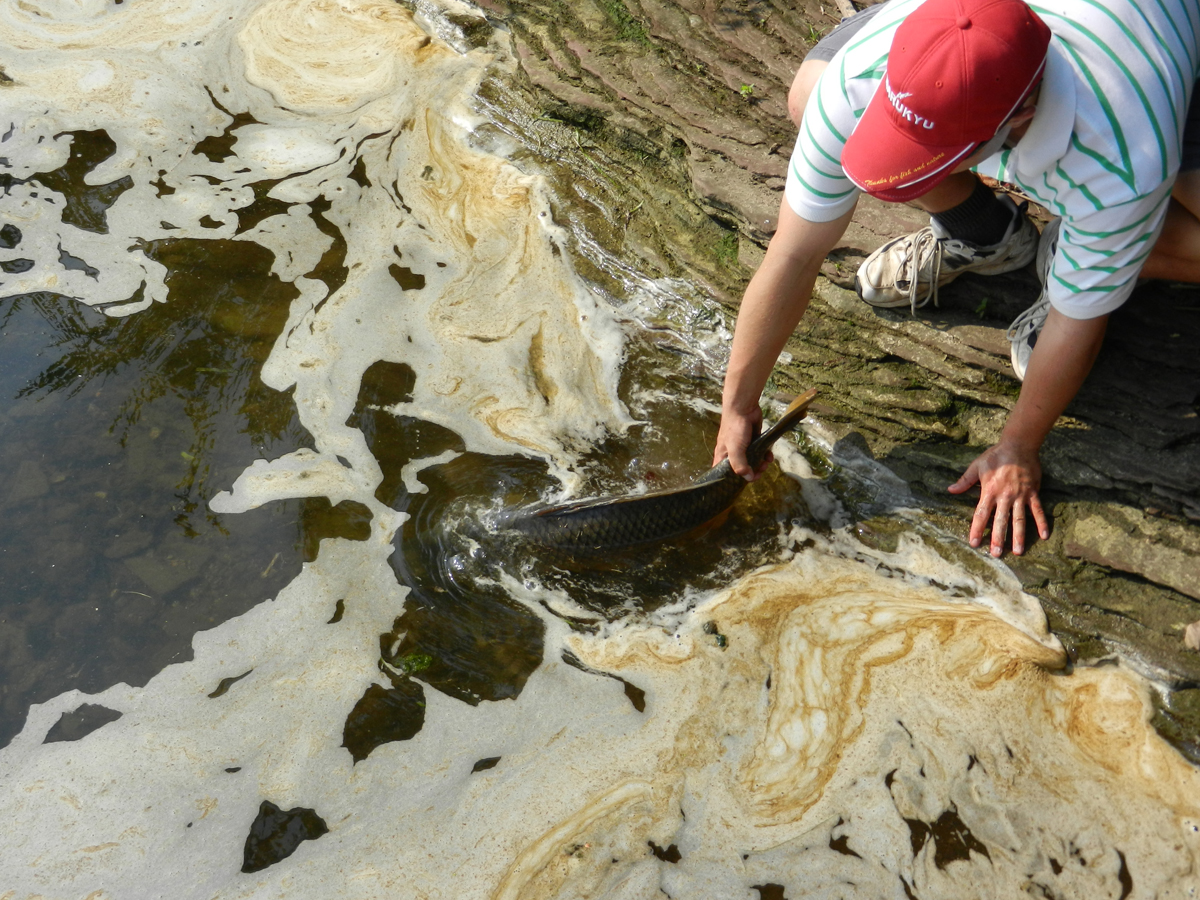
Success.  Note the lamprey scar on the carp's belly. 

Friday, July 6, 2012

Oswego: The Fishing’s Hot Even When it’s Slow


By Spider Rybaak

Janet gets her brown.


The past few days have seen some awfully bright sunlight steeped in hot temperatures. Not exactly ideal fishing weather, especially if you’re getting a late-morning start. But there’s nothing average about the open waters off Oswego and when temperatures are sticky and the fishin’s lazy, you’ll still hear a lot of sizzling lines and screaming drags.

This was brought home to me for the hundredth time on Tuesday. A few days earlier, Capt. Richard Stanton (Stanton Charter Service, www.stantoncharters.com; 315-685-0651) dangled an offer to take me and Oswego County Tourism’s Janet Clerkin fishing so I could get photos and quotes for an upcoming book.  We bit. Little did we know it would turn out to be the best fishing day of the year…so far.

I ran into some construction and bad traffic getting to Wright’s Landing so we started late, 8:45 a.m., to be exact. On the way out of the harbor, boats were already coming in with their limits of kings, punctuated with browns, lakers, cohos and steelhead. One guy allegedly even nailed a trophy landlocked Atlantic salmon.

We trolled for a couple hours trying to figure out what the fish were hungering for. The sun was beating down on us like the upper heat element in a toaster oven. The lake was flat. I was having some serious doubts. Having run charters for 38 years, Capt. Dick has great intuition, for finding fish…and reading clients. “The fat lady ain’t sung, yet, Spider,” he says, “and we ain’t done until we’re done.” (Or something like that).

Suddenly, one of the rods goes off. “There’s a hit,” shouts Ron Marlett, one of the captain’s buddies who came along for the ride.

As he handed Janet the rod, Capt. Dick observes: “Look at that little guy jump!”

Bright as a mirror reflecting sunlight, it comes clear out of the water like a curved, silver rocket at least four times. A couple minutes later, it’s in the boat, getting unhooked and released.

Fifteen minutes later, another rod goes off. The fish is much bigger. Janet makes short work of it, though, and after a few minutes of battle, she brings a five-pound brown trout to the net.

We no sooner set the line again and another rod trips. A powerful fish, it tormented the drag—and Janet’s tiring arms—for a couple seconds before spitting the hook back at us with no respect at all.

But there’s no rest for the weary.

Before Janet could get comfortable, another rod tip pops up then dives for the drink. Janet beats everyone to the rod again and the fight is on. The fish tears off at least 20 yards of line before stopping. The poor lady on the other end is reeling for all it’s worth trying to catch up. But the beast isn’t in a playful mood and takes off for Toronto. Janet struggles for another 10 minutes, brings the beast to the side of the boat and just as the captain’s getting the net ready, the lure comes flying back at us.

Janet sits down, Capt. Dick sets the rod again, Ron’s in the cabin feeling bad for Janet…and I’m yapping my head off; nothing important, just talking to talk…irritating everyone on board.

And then the meanest salmon in our part of the lake takes one of our Michigan Stingers. This time I’m on top of things; growling, swinging elbows “it’s my turn!!!!!,” I demand.

The 18-pound chinook took me on a whirlwind lesson in kingly behavior. Fighting like the devil one minute, then jumping, diving, racing right at me. At that point I actually thought he got off but Ron ordered “He’s  running at you, reel like crazy.”

I’m glad I listened because right about then the slack tightens as the fish makes an abrupt about face and makes the fight honest again by storming for Niagara Falls. To make a long story short, it takes me another 10 minutes to land him.

By now the heat was getting to us and everyone except Capt. Dick—he wanted to keep fishing--agreed it was a good time to split.

Oswego’s territorial waters are so salmonid friendly, the fishin’s great even when it’s slow…And that’s hard to beat.

Deadly Trio: (top to bottom) Gobey, Honey Bee and Modified Stinger.
The face of battle: Janet Clerkin.
Capt. Dick and Janet holding an average king


Monday, July 2, 2012

Summer Evenings on the Oswego River


By
Spider Rybaak

Off the wall walleye.


Everyone who knows walleyes knows the river running through downtown Oswego is one of your best bets in the state for nailing big ones in the spring. After that, according to common knowledge, the water supposedly warms up too much for their comfort and they beat fins for cooler temperatures deep in the lake.

Well, that sounds good in theory. But don’t let it discourage you in real life.

You see, uncommon guys like me who’ve fished for these delicious beasties a lot know that walleyes are a warm water fish that thrives in rivers and can take the heat a stream dishes out. That doesn’t mean they like it—indeed, most of us don’t like a steady diet of temperatures in the high 80s either—but they tolerate it until the next rain storm or string of cold nights cool things down again.

Even during the height of a heat spell, you can find hungry fish downtown. But not just anywhere. You gotta targetthe cool spots. In the morning that means fishing the shady east bank; the west bank towards evening. Then there’s always deep spots in the harbor and bridges;as long as it provides shade, it offers comfort.

I went out a few days ago around 6 p.m. to see if my uncommon wisdom still held true. Parking in the fishing access lot abutting the south side of the post office on West 1st Street (NY 48), I headed down the ramp toward the river and proceeded toward the Utica Street bridge. Buildings blocked the sun casting shade over most of the river.

A couple groups were already there. One included a couple boys who spent more time casting than fishing. Apparently they were competing to see who could reach the farthest. Still, during periods when one or the other hesitated a moment to get a soda, tie his shoe, feed the ducks…a white perch or round goby would hit.

It was almost too easy; and it might have spoiled them.

Fortunately, a guy fishing just below them hooked a walleye, luring everyone’s attention toward him. A good-sized fish, it gave him a decent run for his money. Upon landing it, the boys and some adults went over to admire the catch.

He held his good fortune like a wizard’s wand. One stroke later it was on the grass behind him…and the boys simmered down and concentrated on their rod tips, hoping to be next to land a fish big enough to shower them with adoring attention from passersby.

They never got it.

Their uncle did, however. Setting the hook on a bite that threatened to flip his rod into the drink (it was resting upright on the rail lining the linear park wall), he didn’t even have to say anything to draw attention. His rod was bent in half and everyone just knew it had to be something…worth waiting to, see.

It ran upstream…then downstream…turned and headed for the wall in the center of the river. When that didn’t remedy the feeling that it was being led by a stinging sensation in its mouth to go where it didn’t want to go, it charged for the abutment of the pedestrian bridge. That didn’t work either and it reluctantly came in, putting up resistance that a pit bull shaking a rag would have appreciated.

All for naught; it was quickly netted. After admiring it for a split second, the uncle released it. The boys cheered—and cast out to where they thought it went.

A little while later, another group showed up to fish for catfish. I didn’t stick around long enough to see if they were successful, but I know from personal experience there’s some monster cats in the river—sheepshead and carp, too-- and summer’s the best time to catch them.

So, the next time you find yourself bored in the evening, and get the urge for some action in the fast lane, head for the river in downtown Oswego and bottom-fish a crayfish or worm, or work a jig or crankbaitin the current for some cheap thrills you won’t soon forget. 


The river's loaded with hard-hitting, pan-size white bass.


Downtown smallmouth.


Thursday, June 21, 2012

Sandy Pond

By Spider Rybaak

Angry, the large northern swims just below the surface as if trying to figure out how to handle its tormentor.

Sandy Pond has always had a reputation for dishing out monster northern pike. Still does.

The difference between then and now is that once upon a time pike were recognized as fresh water tigers, second only to muskies, their larger cousins, in terms of ferocity. Toothy critters with a propensity for violently attacking lures--and hands that got too close to their mouths--anglers treated them with respect and admiration up until the end of the 20th century. Indeed, it was customary to cut off the heads of large ones anddisplay them by nailing them over garage doors and trees—and porch posts on Halloween.

Nowadays, the majority of anglers don’t have time to consider the fish’s noble characteristics. Oh sure, people still travel from all over the world to pike hot spots like the pond in hopes of tackling with a trophy; but to most, they’re a pain in the... because they’re too hard to handle.

Still, many are taken incidentally by anglers participating in the pond’s numerous bass tournaments. You see, this is the best largemouth spot on Oswego County’s stretch of the Eastern Lake Ontario Dune and Wetland Area, a fantastic, 17-mile-long collection of sand dunes, bays and ponds. And even though there’s usually money at stake and every second lost to unhooking a pike means less time to fish for the tournament winning hawg, sportsmen who appreciate the mystery of nature’s wisdom see northerns as an important component of the aquatic world and treat pike with patience and reverence.

So when my good buddy Pat Miura uttered “Oh-oh…I think I just nailed something big…maybe a musky” during a recent walleye/bass trip on the pond, I had a feeling it was a large northern.

We were jerking Smithwick Rogues over breaks and the edges of weed beds for walleyes. When the northernfelt the sting of the hooks, it took off like a jet ski in the direction of the outlet.

“The only way to handle a fish this size, especially with treble hooks hanging from its mouth, is to let it tire itself out completely,” Pat reasoned.

A professional guide for almost 25 years, he’s an old hand at controlling large, uncooperative leviathans like trophy steelhead, monster landlocked Atlantic salmon, and boss hawgs.  Within a few minutes, the pike was circling the boat in an exhausted, last ditch attempt to avoid meeting the man up close and personal.

When it was at the side of the boat, Pat jerked the rod tip gently to see if the beast had another round of battle in it. Nope…It just lay on its side, gasping.

Close up: Note the 6-inch Smithwick Rogue in its teeth.

Oh yeah...We got largemouths, too.

And some more largemouths.

After a while, even the biggest grows tired.

Monday, June 11, 2012

Sturgeon Alert

By Spider Rybaak

Carl Rathje, a fish culturist at the DEC's Oneida Lake hatchery, holding one of the facility's resident lake sturgeon.

The funniest thing happened to me while fishing below the Caughedenoy dam for bullheads last Sunday. Something powerful took my slice of gizzard shad, sending my drag into a fit. Figuring it was a catfish, I set the hook and waited for the drag to stop.

It never did. Whatever hit stripped almost 200 yards of 6-lb test line off my reel like it was taking a walk in the park. I’ve caught 20-something-pound carp, a 12-pound cat, even a 7-pound sheepehead on the same rig. But this thing spooled me; for the first time in my life!

After hours of struggling to figure out what species was powerful enough to do that, I’ve come to the conclusion it was a sturgeon. They’re in Lake Ontario and Oneida Lake; and the Oneida River at Caughedenoy is between the two… which kind’a doubles my chances of hooking one… don’t ya think?

Last year several were reported caught in the city of Oswego. In addition, rumor had it that several were also caught in the Erie Canal at Sylvan Beach and Brewerton. So chances are good that the fish that made a fool out of me a few days ago was one of the primitive beasts.

Sturgeon go back a long way in Oswego County. They were here before the Indians. In fact, they swam with the dinosaurs. Up until the middle of the 19th century, the Great Lakes had so many of them, they were netted commercially, dried and sold to the railroad for fuel.

That kind of abuse, combined with habitat destruction, dams blocking migratory routes and pollution just about wiped them out in the 20th century. Fortunately, a few survived. Larry Muroski, owner of Larry’s Oswego Salmon Shop, remembers seeing a 10-footer come to the surface (jumping out of the water to make a big splash is part of their courting ritual) when he was a boy fishing for silver bass in the Oswego River, behind the Canal Commons in the Port City.

DEC at work

Still, it would have taken centuries – if ever – for the survivors to repopulate their former range in any significant way. The NYS Department of Environmental Conservation stepped in to help them out in 1993 by stocking 35 sturgeon into the Oswego River. They were hatched from eggs taken from St. Lawrence River fish. The Oneida Lake hatchery went to work raising roughly 5,000 annually for distribution throughout the region, including Oneida Lake.

According to Carl Rathje, fish culturist at the Constantia facility, the stocking program came to a screeching halt in 2004. Viral Hemorrhagic Septicemia, the virus responsible for massive fish kills in the Great Lakes in the late 1990s and early 2000s, was discovered and the sturgeon rearing program was suspended to prevent infecting Oneida lake.

Mother nature smiled on the program; however, you see, Oneida Lake is very sturgeon-friendly.

“They’re the fastest growing lake sturgeon in the entire U.S.,” claims Rathje. “This year Cornell has netted several pushing 100 pounds. They’ve collected fish that had mature eggs and they believe sturgeon are spawning in Fish Creek.”

Your chances of seeing or hooking one are growing greater all the time. If you should be using a heavier line than I was last Sunday, or simply hook a smaller, more manageable fish, please remember sturgeon are listed as a threatened species in New York and must be released immediately.  To ensure you inflict no further damage, the DEC advises the following:

·         - Avoid bringing the fish into the boat if possible.
        - Use pliers to remove the hook; sturgeon are almost always hooked in the mouth. 
l      -Always support the fish horizontally. Do not hold sturgeon in a vertical position by their head, gills or tails, even for taking pictures.
-            -Never touch their eyes or gills.
·       -   Minimize their time out of the water.

For more information on this native son, check out “DEC Advises Anglers to be on the Lookout for Lake Sturgeon in the Great Lakes and Oneida Lake,” at www.dec.ny.gov/press/82097.html; and the “Lake Sturgeon Fact Sheet” at www.dec.ny.gov/animals/26035.html.


Lake sturgeon up close and personal.