Friday, November 19, 2010

Fish the Skinnies for Chromers


Skinny Creek Chromers are as big and beautiful as their big water counterparts.


This fall has seen rainfall just short of biblical proportions. So much, in fact, the Oswego River has been all but unwadeable for days on end. And right when the stream went down enough last week for guys to be able to walk across its upper rapids, we get another burst of rain, raising it to levels normally only seen in spring.


Rains that make river anglers go to bed crying, however, send creek anglers to sleep smiling. You see, when skinny creeks are swollen to the point of pouring over their banks, chromers rush into the expanding whitewater to pig out on all the trout and salmon eggs the heavy current sweeps out of the pebbles and carries downstream like a conveyor belt loading corn into a silo.


Doug at Fat Nancy’s Tackle Shop (877-801-FISH) says “the ¾-inch of rain we’ve had the last couple of days has the creeks so high, yesterday one guy complained they were unfishable. But they’re going down today, and should be at perfect levels by Friday.


Equally important is that the weather forecast calls for intermittent rain over the next couple of days, keeping the creeks at optimal levels, and steelies swarming in, all weekend long.


“What’s more,” Doug adds “this is the first week without a whole lot of people around. There’s a lot of room on the Salmon River now and that’ll keep the locals fishing there, leaving the skinny creeks short of anglers and full of fish.”


The best skinny creeks, primarily because they offer public access, are Little Sandy and Grindstone which feed “Lake O” directly, and Trout and Orwell Brooks, tributaries of the Salmon River.


Little Sandy Creek can be accessed from the DEC’s Norton Road fishing access site (off CR 15) and at the bridges in the village of Sandy Creek. Grindstone Creek can be accessed from Selkirk Beach State Park, the NY 3 bridge, and DEC access sites on CR 28. Trout brook has a fishing access site on CR 48, and Orwell Brook has a little access around its mouth.

Thursday, November 18, 2010

Boundary Deer

Pulaski native, Stan Oulette, with a 10-pointer he took with a bow on the northern side of the Northern-Southern Zone line near his home.


Most deer hunters agree your best bet for bringing home the venison is on opening day.


But which opening day? The northern or southern zone’s; bowhunting’s, or the regular season’s. And if you really want to split hairs, maybe it’s Suffolk County on Long Island which has its own opening day.


After a moment’s thought, a reasonable guy would conclude that most deer are taken on opening day of the southern zone’s regular season. Mainly because it covers the biggest part of the state, and almost all of NY’s primo agricultural land, the most productive deer range.


Still, there’s one small part of the southern zone that’s far more productive on opening day: the edge where the two zones meet. You see, the first shots fired on the northern edge of the boundary send surviving deer over the border. And they stay there, in massive numbers, for as long as they’re not being shot at. Come November 20th, the boys and girls who hunt the southern edge of the boundary will have more than their fair share of deer to chose from--for a day, anyway.


Oswego County is one of the few in the state that boasts both zones, and the line splits us almost in half. What’s more, our portion of the southern zone includes the Lake Ontario plains, an area known for massive quantities of above average size deer.


And this year’s crop promises to be one of the best in recent memory. Stan Oullette, a Pulaski native known for his excellent hunting skills claims “this year’s rut is one of the best I’ve ever seen, and we have some huge bucks running around.”


To prove his point, Stan showed me a 10-point buck he took the second week of November with his bow just north of the Salmon River, on land he manages strictly for trophy deer.


After taking my fill of photos, I complimented him on his prize. He looked me in the eye and said, without flinching, “Spider, I’ve seen two deer this year that would make this one look like a spike horn.”


Taken aback by his comment, the seriousness of his tone, I blurted out “You mean you got atypicals running around your preserve that have single horns poking out of their heads like Medusa’s snakes?”


“No, you…” (I can’t finish the sentence in a family oriented blog),” he replied. “This year we got bucks with horns as big around as my wrist!”


That’s saying something. Stan, a former Marine who spent half his life running heavy construction equipment, is built like a bear. A deer with horns that big is definitely a wall-hanger. Two in the same neighborhood prove how marvelously deer-friendly our range is.


All of Oswego County’s southern zone is in private hands. You have two options. Knock on a farmer’s door and ask if you can hunt his property--the most he can say is no, but he might say yes. Or you can hunt on private property for a fee; two that come to mind are K&G Resort Inc., and Deer Creek Motel and Pheasant Shooting Preserve (315-298-3730).

Friday, November 5, 2010

Rainbows among the Browns--and Golds--of Autumn

Mike with his biggest brown ever!


Runs of coho and kings have petered out on the Salmon River. Still, some can be found in the whitewater…And they’re huge. I saw a king landed on October 30 that went forty pounds if it went an ounce. Indeed, it was almost as big as the guy trying to carry it--and drag it--to his car.


The scale of this year’s run is still obvious. Cadavers are everywhere; stuck between the rocks and wrapped around submerged branches, they wave in the current like muddy banners left by a defeated cavalry charge. Late spawners, now reduced to living dead, mill around in the ripples and pools. It’s a sad end to the noble beasts, but it’s the price they pay for their 3 ½-year sensual feast as the biggest, baddest kids in the drink.


Their loss is the trout’s gain. The river is loaded, from Douglaston Salmon Run to the fly-fishing only section, with huge browns and steelhead. Unlike the salmon, these guys ain’t there to spawn and die. On the contrary, the browns are there to spawn and the chromers are there to thrive by feasting on the caviar deposited in the gravel by the salmon.


Living classroom


With all the fish sure to be around, I called my cousin a few weeks ago and invited him to bring up his three oldest sons for the fishing trip of their dreams.


“Sure!” he responded.


He came last weekend.


We hit Altmar on Saturday, and saw quite a few steelies landed, and the huge king mentioned above. But we couldn’t buy a solid hook-up if we waved a fist-full of flies, egg sacs, whatever in the current.


Sunday was a different story. We started at Deer Creek at first light. The water was low and the fish weren’t in.


An hour later we headed for Pulaski, hit the staircase and worked up to the base of the village pool. Along the way, I got nine hits and landed one fish--what can I say, they were faster than I was.


Mike, Iggy’s oldest, got two hits and landed an eight-pound steelie and a 10-pound brown--ah, the speed and stamina of youth--all granted by the forces of nature to a guy who had only caught stockies until then.


Andy, Iggy’s 16-year-old, lost a couple fish, but the “excitement was well worth it!” he claimed.


And John, a 13-year-old with a smile that could make the sun blush, nailed a nice 18-inch steelie, too small to keep…except in his fondest memories.


We used single, plastic eggs fished in pockets and the edge of the current.


The kids had a ball and assured me they’d be up again soon, and often. Now, that’s a thought for a bachelor bracing for retirement.


The browns are in heavy now and should remain for the rest of the month, their numbers declining as November wears on. The steelies will be there till spring.


The fish are cooperative. It’s a great time to go out and tangle with one of these beauties. And while you’re at it, bring along a youngster and show him the ropes. It’ll be a lesson the kid will carry in his memories for the rest of his life.


You don’t really need any highly specialized tackle, either. The young men above used my Shakespeare spinning combos, pretty standard stuff you can get at any outdoors store that carries fishing gear. There are plenty to choose from throughout Oswego County and Central New York.


Being a professional, I like to look like one and use an 8 weight Pflueger Trion Fly-fishing combo.


By the way, these fish didn’t get big by being careless. While they’re not exactly leader shy, what they don’t see won’t distract them. Use a fluorocarbon leader like Berkley’s Professional Grade Trilene 100% Fluorocarbon. It costs a little more but it’s well worth it.


The Salmon River is super slippery. Use traction devises like Korkers.

Andy showing off brother Mike's steelie.


John holding his first steelie.

Thursday, November 4, 2010

Withdrawing Walleyes from the Bank

Oneida Lake is on the edge.


Fishing the surf.

To the New York State Department of Environmental Conservation, it’s the biggest geographic feature splitting the state into northern and southern tiers. For meteorologists, it marks the southernmost spot of the lake effect snow region. And come fall, walleye anglers see it as the best spot around for taking massive quantities of delicious walleyes from its edges: the surf and bank.

Late September’s cooling water temperature starts the fish moving inshore. But the major forays to the shallows don’t start until mid-October.

And they’re in right now…Boy, are they ever.

Normally, reasonably competent anglers expect to catch at least one walleye ranging from 15 to 18 inches every night they go out, doubles sometimes, and a limit at least once.

This year it’s different. The fish are larger. I’ve seen more 22-inchers already than I’ve seen any other autumn so far this century. In addition, I’ve seen a couple two-footers, and one that went 25 inches.

The hottest spot is Oswego County’s southeastern edge, particularly the area around Cleveland. On any given night, a line of anglers forms on the sagging concrete wall of the Cleveland Dock Fishing Access Site, working stickbaits in the shallow water parallel to the north shore.

Others walk out on the decaying breakwall on the southern end of the FAS and take walleyes from the surf by casting due west.

The “eyes” are there pigging out on massive schools of buckeyes and shad, in water so shallow, the whites of their bellies look like whitecaps as they take the minnows on the surface.

If you think that’s exciting…it gets better. In fact, the autumn bite provides the greatest sensual feast fishing has to offer. For example, on windless nights you stand a good chance of seeing a school of bait moving right for you. Appearing like a choppy spot on the glassy surface, the patch of ripples slides silently past ya, often erupting into a jumping rain as walleyes charge into the group for dinner.

Equally thrilling is when a walleye--or sheepshead, bass, whatever--takes the lure at your belly right when you’re getting ready to pull it out of the water. Sometimes the hit is so violent, it’ll send a small tsunami into your waders.

This fabulous bite will continue until mid-November, slowly petering out until ice seals the lake for winter.


Osceola's Wayne Carew with a typical walleye taken at the Cleveland docks.

A good night's catch.


The night fishing scene at the Cleveland docks.


This 22-incher shows 2010's crop of walleyes are larger than normal.

Friday, October 22, 2010

Minetto Cats

Eatin'-size cat


Salmon and trout ain’t the only fish spurred into action by early autumn’s meteorological changes. The higher water levels and lower temperatures of October jump-start bottom feeders, too; particularly channel catfish, Oswego County’s favorite, fast lane lowlife.


Bearing a face only a mother could love, able to eat just about anything organic--dead or alive--it ain’t exactly the classiest critter in the drink. But its inclination for heavy current, Herculean hardiness and stamina, make it a perennial winner in any fishy popularity contest.


Channel cats are named for their bias for moving water; the faster, the better. And, mile for mile, the Oswego River offers more public bank-fishing access for this marvelous beast than Lake Ontario tributaries 10 times its length. And the village that offers the largest stretch--relatively speaking--is Minetto.


Less than five miles upstream of the city of Oswego, the river runs right down the middle of this sleepy hamlet. And the catfish are there, in massive quantities. Mostly small guys ranging from 12 to 18 inches, the kind that’ll eagerly take a worm, piece of shrimp, minnow or Berkley Gulp’s Catfish Dough or Catfish Chunks fished on bottom.


The size pictured above is the most popular among most anglers because it tastes best. Once a cat reaches 20-something inches, it tends to taste too gamy for your average palate.


What the big guys lack in flavor, they make up for as competitors, though. And the place has a good population of larger than average cats, some up to 20 pounds. These fish like a large meal and one of the best right now is a strip of salmon, a gob of raw skein or even a strip of milt (you can generally get some at the fish cleaning stations in Oswego). Don’t wait too long, however -- The catfish bite starts seriously slowing down when water temp gets below 50.


Minetto is about as fisherman-friendly a place as you’ll find anywhere. The River View Park on the west bank above the dam is one of the best fishing spots. It boasts a hard surface boat launch, riverside picnic tables, rest rooms, ample shoulder parking, even a convenience store/gas station right across the street.


Minetto at Dusk


Autumn decorations along the canal at Minetto.


Fighting a big one that got away.

Friday, October 8, 2010

After the Storm

Fishing in the public access parking lot, Altmar, October 1.

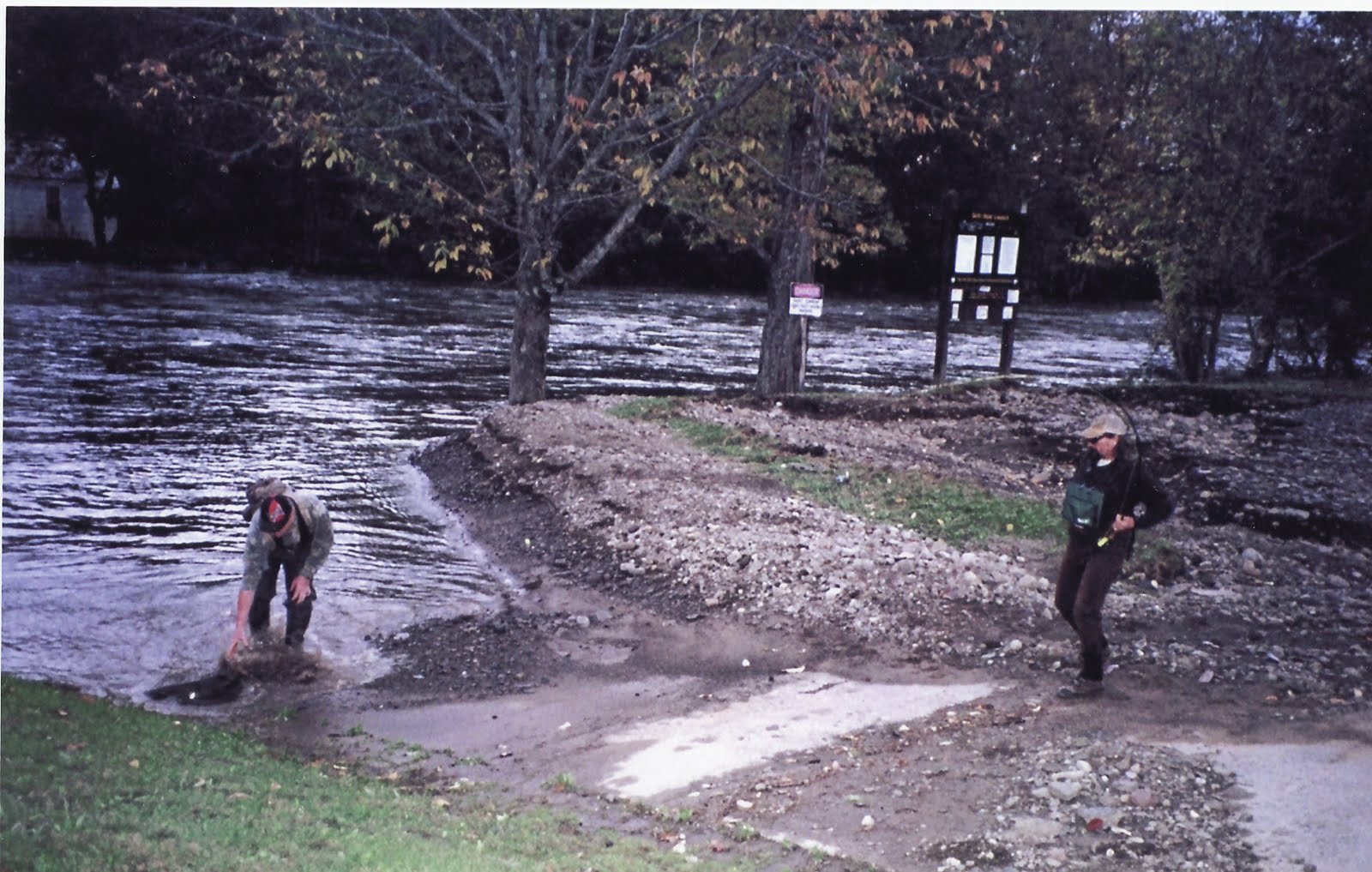
Last week’s hurricane generated rains swelled Lake Ontario’s tributaries to the bursting point. By Friday afternoon, the Salmon River peaked, but not until it ran over the north end of the CR 52 Bridge in Altmar.

“That don’t happen often,” said a village resident. “When it did this time,” he continued, “a few guys fished on the bridge, in the ripples running over the pavement. One nailed a 20-pound king and another took a nice 10-pound male.”

I’ve heard of pounding the pavement, painting the pavement, laying pavement…but fishing the pavement???

By the time I arrived on the scene at 5:30 p.m., the water was on its way down. But it was still way up there, higher than during your average spring thaw. A side channel with a good current plowed through the fishing access site on the northwestern corner of the bridge. I watched two kings get hooked in the parking lot. They were huge, at least 35 pounds each, and when they decided to head back to the main river, the anglers couldn’t stop them and they broke off.

An eddy developed at the drift boat launch on the other end of the bridge. I saw a guy holding a bowed rod high over his head. It danced in time with the thrusts made by the mighty king on the other end of the line.

Now, a sight like that normally doesn’t warrant a second glance. But this time, the guy was Ron Haney, an Altmar resident who only has one arm. You gotta see this guy fighting a fish to believe it. He holds his rod high while the fish has the upper hand, letting the drag, current and bent rod do all the work. When the fish tires and starts giving a little, Ron hangs the reel over his thigh and reels in the line.

He actually got the fish to shore, but it was a stubborn critter full of hope. Right when everyone watching thought the game was over, the fish waved its tail good-bye and snapped the line.

“That was a nice fish. But the conditions are tough,” Haney stoically remarked, staring out over the raging river.


Ron Haney holding on while an angler tries tailing his king. It got away at the last minute.

High water is good for salmon and they were everywhere. Unfortunately for “sports,” the water was too much to chase after the beasts and few were landed. Sunday saw the water down enough for anglers to have a fighting chance. I saw fish get taken in every pool I visited on the Salmon River. Kings mostly, with a few browns and steelies mixed in.

Water in the River Park's walkway, downtown Oswego, October 3.

South of the plant, more than two feet of water surged along the concrete wall lining the riverbank, forcing folks to fish from the sidewalk. Some brave anglers entered the water at the trail’s end but heavy current wouldn’t let them get more than 15 to 20 feet from the staircase.

Anglers fishing on the walkway upstream of the power plant, an area they usually fish from a dry bank.

Above the power plant, the stairway ended in water on Sunday.

Under normal conditions, salmon mill around in the lake waiting for high water before storming in. Usually, it comes after autumn showers that only raise the river a few inches to a foot per storm. As a result, the runs are staggered.

This year three months of rain fell in one day and the water rose to Global Warming proportions. It’s a good bet that a lot of salmon will take advantage, and come in groups to spawn, offering super fishing over the next several weeks.

So, there’ll still be plenty of salmon to catch, with late-running fish all month long.

In addition to kings with record-breaking potential, steelhead and brown trout runs should be off the charts. The high water will draw massive quantities of both species into the Salmon and Oswego Rivers; browns until the end of the month, chromers from now through spring.

The fish are huge, so’s the water. Put the two together and we stand to have the best fishing Oswego County--aka water of champions--has seen in 25 years.

When the water came down on Sunday, anglers began landing fish again.
.
.
A happy Sunday morning angler on the Salmon River
Friday, October 1, 2010

Salmon are In…and They’re Huge!

Notice: Given the recent weather conditions, the Salmon River and the Oswego River have become extremely dangerous. We urge anglers to consider fishing techniques other than standing directly in the water, such as fishing from streams, piers or driftboat, until the high water levels subside.

Normally, the last week of September sees waves of kings and cohos climbing the rapids of the Salmon River to spawn. This year the runs are on time but there’s one noticeable difference: the fish are the biggest they’ve been this century.

And that was expected. Fish that were taken from the tiniest Great Lake over the summer were huge compared to recent years. A lot of 35-something pounders were landed, including a 39 lb. 8 oz. fish that took America’s Fall LOC Derby. Better still, the Great Ontario Salmon Derby, a Canadian tournament sponsored by the Toronto Sun, was taken by a 40 lb. 2 oz. fish caught in July. The fish were so big, rumor had it charter boat captains were whistling “Happy Days are Here Again.”

I called some bait shops the last weekend of the month and they all reported the river was loaded with fish. One, under condition of anonymity, claimed so many fish were taken right in the heart of Pulaski, Main Street’s sidewalks were coated in a layer of fish slime.

I had to see that. But I couldn’t break away from other commitments until Monday night.

I got to Pulaski around 5 p.m. Parking on the shoulder on the side street heading to the ball park, right where US 11 banks west before crossing the Salmon River, I strapped my corkers to my sneakers (in case the sidewalks were slimy, you see) and headed for the bridge.


Salmon are everywhere in the river.


There was only about a dozen guys fishing on both sides of the crossing, but what the river lacked in anglers, it more than made up for in salmon. They were everywhere. I saw anglers fighting salmon, salmon frolicking on the surface in the Village Pool, and salmon climbing the rapids just upstream of the bridge.

I went to the Ball Park and the story was the same. Anglers were stretched out in comfortable distances from one another along the stream. Everywhere I went, someone was fighting a fish.

Kings ranging from 15 to 30 pounds made up the vast majority of fish I saw on stringers. But cohos ranging from 10 to 18 pounds were strung up with em in many cases…and that’s big for the species.

Again, that shouldn’t really surprise anyone, considering the world record coho, a fish indigenous to the Pacific Ocean, came out of the Salmon River several years ago.

All the salmon activity has spurred steelies into action. Several anglers I talked to, including PA resident Kurt Kmetz (see photo), have been catching steelhead ranging from 5 to 10 pounds on streamers like egg sucking leeches.

Thankfully, the unethical behavior spawned by snagging practices that were encouraged in the 1970s and early 1980s is a distant nightmare. There are fewer guys running up and down the river swinging hooks at everything with fins, and ethical anglers are reprimanding those who still try, so the fish have calmed down and are remarkably eager to hit a fly.

This world class salmon fishing is playing now through the middle of October. Get there early to claim the good seats.

PA resident, Kurt Kmetz, holding a 25-lb. king and a 15-lb. coho.


Village Hole