Monday, August 5, 2013

Between a Muskrat and a Toad


By Spider Rybaak


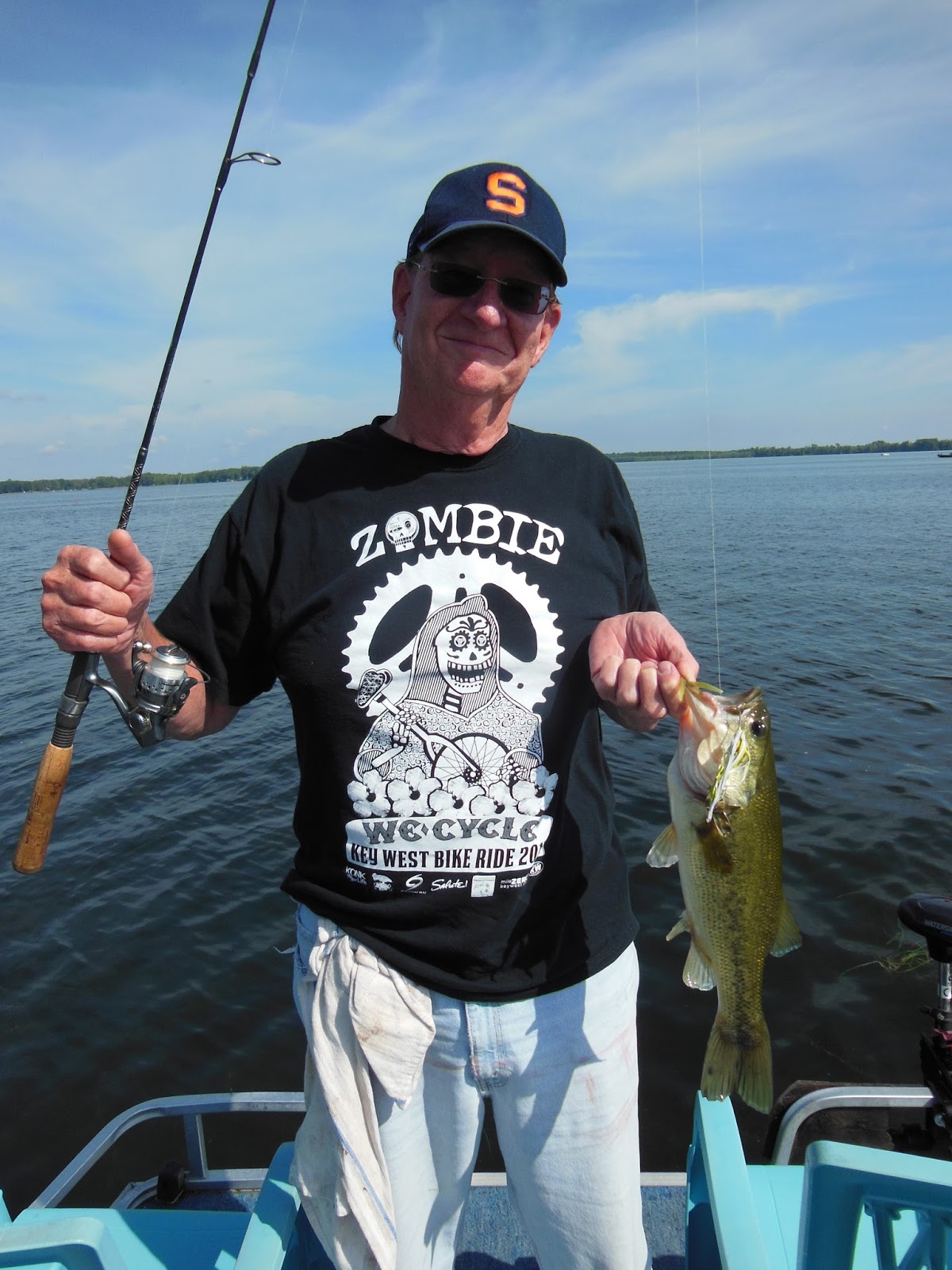
Bucketmouth taken on a spinnerbait on the shoals due north of Oneida Shores County Park
I’ve found myself between a rock and a hard place many times.  I’ve flown in planes and fallen in love, so I’ve been between heaven and earth, too. But yesterday’s fishing trip with Ray Chittenden was a first:  between a toad and a muskrat. 

Literally. You see, we went to Oneida Lake and concentrated on the fish-rich waters between Muskrat Bay and Toad Harbor.

While other parts of the lake may harbor the lion’s share of walleyes right now, few can compare with the massive quantities of various fish species found in this magical piece of Oswego County’s territorial waters.

What makes it so productive is its wealth of structure and habitat. Windfalls, reeds and docks line the south shore, while marsh and forest, watered by creeks and springs, cling to the north side’s wildlife management areas. Off to the west, I-81 provides riprap and bridge abutments. And down the middle of it all, flanked by fishy drop-offs, runs the main channel’s deep currents.

And Ray knew how to milk it for everything it had…except walleyes. 

Our first fish is a rock bass weighing at least half a pound. A pickerel comes aboard shortly afterwards, followed by a monster pumpkinseed; all in the first half hour.  

Searching for Mr. Walleye, we move east, into deeper water. Ray puts away the worms and starts casting. His efforts pay off with a three- pound bronzeback taken on a YUM Walleye Grub dragged on bottom along the drop-off west of Buoy 136, and a two-pounder that took a Berkley Power Teaser tipped with a Honey Worm and worked around Buoy 137. 

“OK,” he says, “We got enough smallmouths, let’s go for a  bucketmouth,” and aims the boat for the weed bed due north of Oneida Shores County Park boat launch. As soon as his spinnerbait touches the water, a largemouth of about two pounds nails it.

“We’re on a roll,” he boasts, and suggests we try for some panfish. 

We drift along Muskrat Bay’s shoreline, past residences ranging from simple cottages to palatial homes fit for a bank executive. Six perch and a blue gill later, our time running out (I only had four hours to fish) Ray asks “do you want to give walleyes another shot?”

You bet’cha!”I answer.

We head back for buoy 136 and start drifting. I’m jigging a Sonar; Ray’s working bottom with a worm on a spinner harness. The wind blows us toward the river.

A few minutes later he’s into another fish, a legal bucketmouth. 

While anglers just about everywhere are complaining about the summer blues, smart pluggers are enjoying great fishing on the west end of Oneida Lake. 

Come on over and give it a try.


 Ray with a nice smallie taken on a YUM Walleye Grub.

Monster pumpkinseed's like the waters between Muskrat Bay and Toad Harbor, too.

Bass pros scouting the west end of Oneida Lake

Friday, July 19, 2013

Kings are back in Town


By Spider Rybaak


First mate Kevin holding Chad's brown.


            Good buddy Dick Stanton called Sunday night.

            “Hey Spider…The kings are back in town. I’m heading out tomorrow with some close friends.  You’re welcome to come along.”

            “Is Kevin first mating?” I asked.

            “Are you kiddin’??? “ he asked rhetorically with such emotion I could hear his eyebrows rising in disbelief.

            “He’s the best,” claimed Dick. “I don’t even think about other first mates when he’s around.”

            Well, I’m not one to refuse a seat on a charter boat, especially when Big Dick’s in charge and Kevin Rodrigues (the Portuguese spelling, I’m informed) is playing second fiddle.

            “I’ll see ya at the dock at 6 a.m.,” I promised.

            Dead calm sat on the lake, squeezing its surface into a mirror finish. A light fog frosted its edges.

            Kevin starts setting lines after we clear the breakwalls at the mouth of the river.  Less than a half-mile out, he’s busy letting out the third rig when a 4-pound brown devours the Sigg’s Rigs fly. Ron Marlett , a retired NYS Trooper, tells his grandson to grab the line.

            Moving with speed I can only dream about, 16-year-old Chad Tyson is reeling the brute in. A few minutes later, we’re all high-fiving the youngster.

            Kevin no sooner gets the line down again when another fish hits, prompting the good captain to suggest, with the calm of a seasoned pro, “Someone ought’a grab that rod.”

            In a blur, Chad’s up there again. Heck, I didn’t even have time to turn my neck to see which rod it was.

            This is a much bigger fish. After battling for about 10 minutes, a 16-pound king is in the boat.

            “When do these fish start converging on the waters off Oswego,” I ask Capt. Dick after everything settles down.

            They start showing up in June and their numbers grow steadily through September, when the biggest show up. Still, even now you can easily get kings weighing 20 to 30 pounds,” he says.

            As if on cue, another rod trips with such ferocity I swear the boat went backwards for a split second. The fish hit the copper line which was out over 100 yards. I knew it would be tough bringing this one in, so I decided to go to the head.

            George Panarites, another old friend of Dick's, passes too.

            Fortunately, we had Chad aboard to do the heavy work. What a sport, I thought, as he took the rod.

            Fifteen minutes later, Kevin lands the 23-pound king. Everyone but Chad is panting after the battle. The youngster just wants another one.

            A short time later, George notices one of the outside rods acting funny and decides to bring it in. A keeper lake trout is on the other end. “Ah, a nice griller,” he remarks, contentedly.

            This kind of action is average from now until the leaves start turning. If Capt. Dick (315-246-4767; www.stantoncharters.com) is booked when you wanna go out, he’ll be able to refer you to someone almost as competent. If you’d rather do it yourself, check out the list of charter captains on Oswego County’s website; www.visitoswegocounty.com.

Chad battling a big king while grandpa Ron offers encouragement.

Kevin netting the prize.

Chad with his biggest king.

George with a griller.

Thursday, July 18, 2013

Whitewater Summer


By  Spider Rybaak

Photos by Susan Rybaak

A family of tubers floating through the Trestle Pool.


A web of exciting whitewater slices through Central New York. Unfortunately, much of it is too dangerous (Black River), shallow (Scriba Creek) or short (the rapids at Caughdenoy) for most of us to play in. The Salmon River, on the other hand, is just right.

Running for roughly 13 miles, from the spillway at Lighthouse Hill Reservoir to its mouth, this world-famous trout and salmon stream’s base flow is kept at 185 cubic feet per second year-round. That’s the minimum required to keep its rapids at the right speed and level to maintain the sensitive habitats that mature salmon and trout need to spawn; and their offspring require to carry them through their first few months of life and their trek to Lake Ontario.

Serious whitewater enthusiasts rank the Salmon River as a pitiful Class II, about as exciting as spit in the bucket.  But for average folks, its pleasant, safe pace allows for leisurely floats in tubes, kayaks and canoes, down playful rapids lined in riverbanks teeming with colorful plants and wildlife, all under the graceful flight of bald eagles to ospreys.

Still, even the meekest among us harbor fantasies of risky adventures some of the time. Several years ago the authorities, after gentle coaxing by whitewater interests, decided it wouldn’t hurt to shift the  Salmon River ‘s thrill level higher periodically and decreed that the power company release additional water five weekends each summer for recreational purposes.

The second of this season’s flow increases took place 4th of July weekend and legions of folks took to the rapids in everything from tubes to over-sized rubber duckies to indulge in some bubbly. About the only complaint competing with the laughter wafting over the whitewater was that the water didn’t stay up a little longer.

Good news. This year ain’t typical, and when the screws were tightened on the water gates, the rapids didn’t slow down a bit. The above average rainfall pouring over the region since the beginning of summer hasn’t drained off the countryside yet; and at this writing the level is at 650 cfs, well above the normal for this time of the year. Considering the size of the river’s drainage, it’ll take all of a week, maybe longer, for the flow to resume its typical summer level.

While the thought of a stream flowing so high above average is enough to send the fear of rapids coursing through your veins, it’s really not that bad in a shallow stream like the Salmon River.

That doesn’t mean you can throw caution to the wind and jump in carelessly.

 What it does mean is you can enjoy a long, comfortable, relatively safe float down whitewater averaging 70 degrees. But you gotta play smart. Here’s some tips to keep you safe:

- Always wear a life jacket.
- If you go by tube or air mattress, make sure it’s big enough to float your body weight.
- If you get thrown into the fast water out in the middle, don’t try to stand; you might get your feet wedged between rocks and the force of the rapids can submerge you. Float on your back, feet first, until you come to a slow moving shallow area before trying to walk out.

If you go by canoe or kayak, bring along a fishing outfit. Atlantic salmon and Skamania—summer-running steelhead--are drawn into the stream by high water. They’re in top shape this time of year, guaranteeing you a run for the money.

If the water goes down before you can make it, no sweat: additional whitewater releases are scheduled for the weekends of July 20-21, August 4-5 and August 31-September 1.

Launches and take-outs with parking areas line the river. Some of the most popular include:

- CR 52 Bridge in Altmar
- Sheepskin Road, about 100 yards east of its intersection with CR 48, Pineville.
- Northeastern corner of the CR 2A Bridge, about a mile east of Pulaski.

Enjoy…and stay safe.

Spider casting  a streamer for Atlantic salmon as kayakers watch.

The river's at the perfect height, the weather's just right,
for a float trip.

Fishy encounter: Kayak angler and Spey-caster at the Trestle pool.

Wednesday, June 26, 2013

Deer Creek Marsh Wildlife Management Area

By
Spider Rybaak

Canoeing the pond, Deer Creek WMA.


Oswego County is blessed with some of the largest, most awesome wildlife management areas in New York.  None, however, comes close to offering the wide variety of recreational opportunities, steeped in natural beauty, Deer Creek WMA provides.

One of three WMAs punctuating the Eastern Lake Ontario Dune and Wetland Area, a 17-mile-long barrier system boasting the tallest sand dunes between Cape Cod and Lake Michigan, Deer Creek WMA sprawls over 1,771 acres. Tucked between the mouth of the Salmon River and Sandy Pond, two heavily developed areas famed for their splendid beaches and sunsets, it’s like a breath of wilderness among the cottages; and it’s all close to the road.

Its most popular feature this time of year is a mile-long cobblestone beach. It used to be sandy, but the jetty that keeps the mouth of the Salmon River from wandering blocks currents from sweeping sand off a submerged dune out in the lake and bringing it close to the beach where it's picked up by waves and deposited  on shore.  

Without this continuous supply of sand to replenish what the waves wash away during high water, all that’s left on the beach when the water goes down is cobbles.

Fortunately, the order of this natural masterpiece prevented man’s folly from turning its undulating habitats into a level wasteland. You see, a dune and wetland area is comprised of six zones stretching from the water to the upland forest marking the end of the barrier system: the beach, fore dune, trough, secondary dune, back dune and wetland. Like the front in a battle, the fore dune is the system’s first line of defense, protecting its interior from the worst Lake Ontario dishes out. Luckily, it did its job long enough for environmentalists to see the sand slipping through the stones  and take measures to prevent further erosion.

A saddle-like trough separates the fore dune from the back dune. A trail, cut over the years by hikers, slices through its patchwork of beach grass and poison ivy. 

Beyond the trough, the secondary dune begins its steep ascent, climbing up to 40 feet in spots. Clumps of beech grass cling to its sandy sides all the way to the crown cropped in mature cottonwood s. On the other side, the back dune descends into a pond created by Deer Creek on its last leg to its mouth. By this point it moves so slow, it seeps into the sand before reaching the lake.

The stream’s water temperature keeps the system cool enough to support thriving populations of fish, including largemouth bass (some over 6 pounds), northern pike (most are axe handles, but some go 30 inches) bullheads up to a foot long, and yellow perch and sunfish averaging 6 inches. It even harbors bowfin; a native species that’s been around since the Jurassic period and can breathe air.

Canada Geese, mallards, blue herons, kingfisher, osprey, and a variety of less common water fowl; and mammals like mink, muskrats and beaver find Deer Creek Marsh to their liking.  Pheasants and cottontail rabbits flourish in the WMA’s grasslands. Whitetail deer, raccoons and turkeys flourish in the woods tracing its edges.

Most argue the best way to see the marsh is by canoe.  “You can silently paddle up to everything from beavers to geese,” argues cousin Staash.

The access site on NY 3, 2 miles north of Port Ontario, offers parking for about 10 cars and a beach launch.

Others prefer to hike it’s two most prominent features, the beach and sand dune. Although climbing and walking on dunes is prohibited, the trough between the fore dune and secondary dune has a ½-mile long trail running through it, and a couple of boardwalks allowing folks to cross over the fore dune without hurting it or brushing the poison ivy that grows on it like a weed. The southern boardwalk ends in a fishing platform looming over the pond.

Get there by heading north on NY 3 from Port Ontario for a little over 2 miles. Turn left on Rainbow Shores Road, drive to the end, turn left on South Rainbow Shores Road (unmarked), bear left at the fork a few hundred feet later and continue to the parking lot.

WMAs are managed…you guessed it, for wildlife and related recreation: primarily hunting, fishing , bird watching, stuff like that. 

Off-road vehicles, camping, and camp fires are prohibited.

Boardwalk.

Walking the Trough.

Gateway to the beach.

Monday, June 17, 2013

High Water Eyes


By Spider Rybaak

Pennsylvania native Robert Entler with the 18 incher he took with a tube.

Cousin Staash called Thursday afternoon. “The rain just keeps coming,” he complained. “The National Weather Service has issued flash flood warnings for Oneida Creek until 7:30 p.m. That means the little creeks on the north shore should be roaring, drawing the walleyes in close.”

“Wanna go fishin’ tonight?,” I asked.

“Can’t,” he replied, and hung up.

He’s always been stingy, even with words, I think, and brush off the tinges of hurt and anger his curtness sends creeping into my head.

A couple hours later I’m at Cleveland Docks. Black Creek is high, its mouth roily; the boats in the harbor are rocking.  The current is so strong, it sweeps my 3-inch Berkley Power Grub, tipped on a 1/8-oz jighead, a full 90 degrees, from east to south, by the time I work it in.

Still, the weight is enough to get it down and after about 15 minutes I’m into a 20-inch walleye. A half hour later, I’m into another but he gets off. 

A group of bass tournament anglers from PA were renting the grey house with the pink shutters looming over the harbor. A couple of them see me land the fish.  The heavy rains sweeping the area earlier discouraged them from going out to practice for the weekend’s bass tournament. But my fish spurs them into reconsidering.

They start throwing bass baits.  Half an hour later, hitless, they leave.

Another couple of guys renting the house across the street come over. Hailing from PA, too, they’re there for the tournament as well.

One of ‘em, Robert Entler, a contractor, strikes up a conversation with me and casts a 3-inch tube parallel to the north shore. After a half dozen casts, he nails an 18-inch walleye.

I get another hit but lose it.

In the span of two hours, I land two walleyes and lose two; all from shore.

 High water conditions like this don’t happen often and when they do, they don’t last long. After the smaller creeks return to normal flows the walleyes will move back into deep water. Large streams like Scriba, Chittenango, and Oneida creeks will remain high until the middle of the week, and their plumes should be loaded with fish.

A nice 20-incher that took a 3-inch Berkley Power Grub.


Thursday, May 23, 2013

May Bites


By Spider Rybaak


Scott showing his walleyes as friends Anthony Sokolowski (left, Phoenix) and
Austin Pollmanteer (center, Central Square) cheer.


May sees some dramatic changes in Oswego County’s world class fisheries.  Most notably, steelhead move out of the tributaries-- out of the minds of most anglers-- and are replaced by walleyes: the other fish everyone wants to catch.

Walleyes prefer to spawn in rapids, too. In average situations, they procreate in creeks and peel out for deep water soon afterwards. Not in Oswego County.

You see, our walleyes are spoiled. They have major river systems to court in. Feeling safe in the relatively vast and deep rapids of the Oswego and Oneida Rivers, they aren’t under  any real pressure to beat fins back to the lake immediately afterwards, and stick around in the warm, caressing currents to pig out on all the minnows playing in the whitewater. 

Normally, the action is best the first week or two of the season. This year, however, for reasons varying from late bursts of unseasonably cold weather keeping the streams cool,  to the heavy rains we’ve had recently, the walleyes are extending their stay in the bubbly. 

Three hot spots of note:

Caughdenoy: The plunge pool below the dam has enough walleyes to draw lines of anglers on both sides of the river around dusk. Crankbaits like Smithwick Rogues account for most of the fish.

Phoenix : After years of so-so opportunities, this place is coming back…in spades. By 9 p.m. last Saturday evening (May 18), native son Scott Davie caught two fish about 20 inches long in the rapids on the west bank on a Thunderstick. 

Oswego: Larry Muroski says: “On a scale of 1 to 10, the walleye bite is at 7. The action stretches from the railroad bridge downtown, north to the former Coleman’s Restaurant. Shad Raps and Challenger Minnows are catching most of the fish,” continues the colorful owner of the Oswego Salmon Shop, (315-342-2778). 
But that ain’t all. 

“The dam in Oswego offers an unbelievable smorgasbord right now,” reports Muroski.  “Massive quantities of bluegills, yellow perch, monster rock bass, 15-pound sheepshead , and huge smallmouths are up there.”

[Smallmouth season is closed until June 15, but catch-and-release fishing with artificial lures is permitted: editor]

“Huge channel cats are in the tailrace below the powerhouse,” Muroski adds, suggesting: “still-fish half a shiner on bottom .”

If catfish are the apple in your eye, “The placid water above the dam in Caughdenoy holds trophies,” says Rob Goffredo, owner of Bartel Road Bait and Tackle (315-676-2144), Brewerton’s newest tackle shop. “Fish cutbait on bottom,” he advises.

Bear in mind, the rapids below the dam in Caughdenoy are the Oneida River’s only fast water and draw loads of catfish, too. While trophies are always possible in the plunge pool, most of these guys are spawning age, generally running from 16 to 22 inches, perfect eating size. They’ll take worms and shrimp.

2013’s Free kids Fishing Classes

May’s one of the best times to go fishing—and to teach kids how to fish.

This lesson was brought home last Saturday. Mike McGrath and I conducted our first kids fishing class of the year at Fulton’s Lake Neahtahwanta. 

Owner of McGrath & Associates Carp Angling services, Mike is the East Coast’s foremost expert on these freshwater behemoths. He proved it by landing 20 of the beasts ranging in size from 7 to 20 pounds, raising the eyebrows of all the youngsters and adults at the event.

Back at the gazebo, I was instructing the kids on how to fish with worms and lures, and showing them how to keep the bait out of the reeds and bushes. Roughly 15 showed up, and everyone caught a sunfish or white perch. 

Two more kids fishing classes are scheduled for this summer on Lake Neahtahwanta:

June 8 

July 13

And three are scheduled for the Veterans Memorial, on the west bank, in Oswego :

August 10

September 21

October 19

Sponsored by Berkley, Alvey, Shakespeare, Sampo, Mustad and Marukyu Baits of Japan, the classes are held from 10 a.m. to 1 p.m.
Tackle and bait are provided; or bring you own.

Kids 16 and over must possess a fishing license.
For more information, contact McGrath at 
mmcgrath2@twcny.rr.com ; 315-882-1549; or Spider at srybaak@yahoo.com.
Rob Goffredo, owner of Bartell Rd. Bait & Tackle, Brewerton's newest tackle shop,
fishing with a friend for cats above the Caughdenoy dam.


Fishing for walleyes in Caughdenoy.


Scott Davie unhooking one of his walleyes.
Marshall Kise, McGrath's main man, holding a carp caught by his student Dominick Evans of Weedsport.

Oswego's Carp Master, Mike McGrath, explaining the mysteries of his favorite fish.

Allie Waldron, Hannibal, holding her sunnie.

Ma Holden of Hannibal holdin' one of three pumpkinseeds caught by her daughter.

Tuesday, April 30, 2013

The Friendly Skies over Derby Hill


By Spider Rybaak

Sign marking the spot.

Oswego County is a fowl paradise. Hunters take to the open waters of Lake Ontario and the swamps around Oneida Lake, the deep woods of Winona State Forest and patchwork of ponds, forests and clearings of the Happy Valley Wildlife Management Area to pursue birds of every feather.

But there’s a magical corner of Lake Ontario that sees more birds each spring, particularly large raptors, than some sovereign nations do all year: Derby Hill. Indeed, on March 12 alone, 110,000 snow geese flew over the place like a blizzard in the sun, punctuated by raptors ranging from bald and golden eagles to turkey vultures and ospreys.

Onondaga Audubon Society’s Michele Heligan says the reason so many large birds use this corridor is because of thermals, “heat waves coming off the ground. Raptors use these currents to gain and maintain altitude. The clearer the day, the higher they can reach on the thermals,” she explains

In other words, this time of year Lake Ontario sucks in the sun’s heat like a magnet and raptors heading back north naturally avoid its drag in favor of flying over land and exploiting the lift which thermals bouncing off the ground provide.

The big bird fly-over season runs from March 1 through May 31, so you still have a month of decent viewing ahead of you. According to the Audubon website, some species are restricted (ospreys, for instance, are most active from mid-April through mid-May) while others, like bald eagles, flip restrictions the bird and appear whenever they want to during the season.

OAS member Bill Purcell reports it’s been “a good year so far” for raptors; and colleague Gerry Smith adds: “There are more bald eagles around now than there were at any time during the 20th Century. So your chances of seeing America’s favorite bird are pretty good.”

Unfamiliar with the ways of birds and need guidance?

You’re in luck: The OAS is staging its FREE bird festival on Saturday, May 11, 10 am-5 pm at Derby Hill. Gene Huggins, president of OAS, will lead ½-mile-long bird walks, over moderately difficult terrain (i.e. hills) throughout the day. OAS volunteers will also be on hand to offer assistance and intelligence.

Other features planned for the festival include a display of live raptors, face painting, vendors selling everything from food to jewelry, hawk identification, raffles…stuff like that.

Volunteers are needed. If you’d like to help, contact: oabirdfest@gmail.com or call 315-474-3778. Their website is www.onondagaaudubon.com.

Derby Hill Observatory is located in the Town of Mexico on Sage Hill Drive, off NY 104B, about a mile east of Texas.

Michele Heligan searching the sky for hawks.

The tally up to April 28.