Friday, October 14, 2016

Salmon Are In

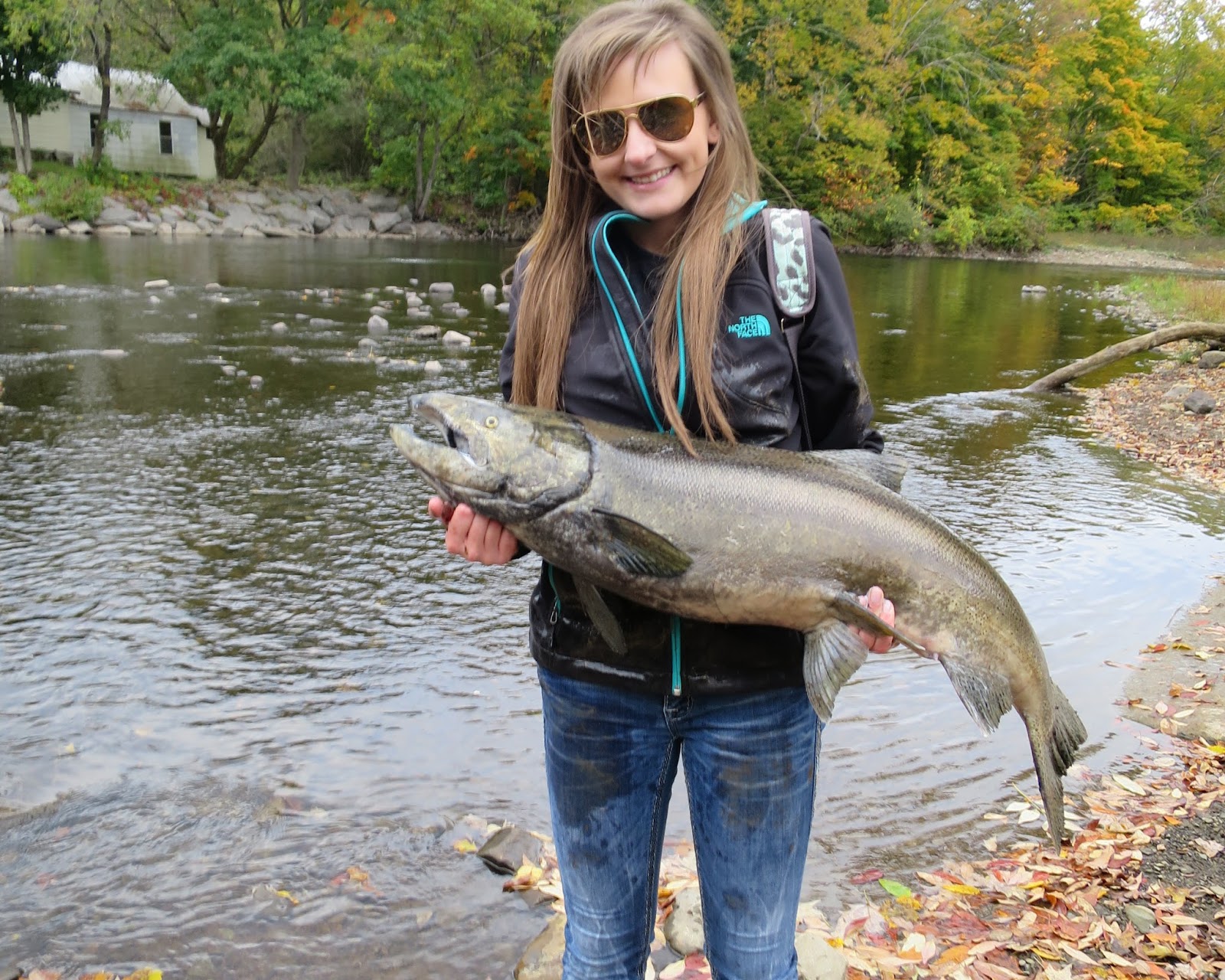
Typical Salmon River King
An old saying goes: The only things that are certain are death and taxes.

Well, that adage is due for revision; around these parts, anyway.

It should claim: The only things that are certain are death, taxes and Pulaski’s salmon run.

Indeed, the river running through this Oswego County village has been on the radar of the world’s most enthusiastic anglers for a couple centuries, now.

Back in the old days the Salmon River was the best stream in the state for trophy landlocked Atlantic salmon--it was named after them, in fact.

It’s still the best spot; only now the fishing is much better.

Atlantics are the first salmon to spawn. Entering the river in summer, they do their thing and beat it back to the lake. Oh sure, late bloomers hold off running until this month, some even wait until November, but their numbers are so few, they don’t draw much attention from anglers. If they’re caught at all, it’s usually incidentally.

Kings and cohoes to the rescue. Pacific salmon don’t start running in significant quantities until mid-September, and when they do, they storm the river in such numbers you could cross it on their backs…If they weren’t so slippery, of course.

While it’s well known Pacific salmon stop feeding when they return to the river to spawn, they will hit a streamer or lure.

Talking heads believe that’s because they’re used to being the biggest kids on the block. Extremely aggressive to begin with, they naturally get meaner in route to the spawning beds, striking out at anything that gets in their way.

The main salmon run stretches through this month, with stragglers showing up into November…even later.

This month the salmon will be joined by trophy brown trout and steelhead.

Decisions... Decisions...

Thursday, September 22, 2016

Fishing the Rapids during the Run

Coho taken in the rapids at the bottom of the Long Bridge Hole in Pulaski, N.Y.

This week marks the time to get excited about Oswego County’s salmon runs.

Oh sure, a few precocious kings and cohoes have been teasing gung-ho, big-game anglers since the end of August; but you ain’t seen nothin’ yet!
Thousands of kings and cohoes will rip through the rapids from now until late next month. So many, in fact, cousin Staash claims “they’ll raise the water level a couple notches.”

You can bet the fish are gon’na draw legions of anglers from all over the Northeast, too.
Inexperienced in the ways of salmon in the fast water, most of these guys will think like humans and surround the big, deep  holes,  thinking they’re  the best spots to catch the trophies swimming around in their imaginations.

The fish are sure to be there, and fishing the rapids is one of the surest ways to find them.
You see, out in the big pond salmon are accustomed to being the biggest kids on the block. They bring that attitude with them when they enter the river, aggressively striking anything that gets in their way. Their confidence quickly fades after tasting the sting of a hook, or encountering excited anglers chasing after them.

That sends most of them heading for cover in the deep pools…where they encounter more hooks and more fish. So what’s a salmon to do?
Run!

And into the rapids it goes.
An exciting way to catch one is to swing a streamer through the current. Good patterns are wooly buggers in trout colors (brown or chartreuse) and Mickey fins.

Good spots to try on the Salmon River include Pineville Pool, Long Hole, Trooper Hole, Ball Park Run and Staircase.
Don’t be aggressive. Simply cast the streamer across the river and let the current swing it back to your side…and hold on.

After all, any fly-fisher can tell you: The drug is the tug!


Wednesday, September 14, 2016

Estuary Perch

Stan Oulette of Deer Creek Motel; Pulaski, N.Y.


Back in the early 1960s, catching Pacific salmon and steelhead in Lake Ontario was just a dream entertained by fish and game officials and dreamy-eyed anglers, many of whom had fished out West.

To your average local angler, the targets of choice were warm-water species like smallmouth bass, northern pike and yellow perch. The estuary, the slow-moving, lower stretch of the Salmon River running from the last set of rapids to the mouth, was one of the best spots around to catch ‘em all, especially a bucket of yellow perch.

“Still is” boasts Stan Oulette of Deer Creek Motel, located on State Route 3, a couple miles north of Port Ontario. “In fact,” he claims, "it’s Oswego County’s best kept secret.”

Stan and his brother David are local experts on the lower river. With good reason: both, along with their families, love to eat fish, and perch are their favorite. 

“The estuary always holds fish,” claims Stan, “but they change with the seasons… northern pike are plentiful in the spring, bass are in all summer long, salmon and brown trout come through in the fall, steelhead in winter and spring, and perch…ahh, perch,” he goes on, dreamlike  “… they’re always around.”

The bait of choice for these tasty panfish is a minnow fished on bottom or suspended a few inches off the floor below a bobber. Squeamish anglers and those who prefer artificial lures will catch a batch by jigging a Berkley Atomic Teaser tipped with a Power Honey Worm.

An angler inexperienced in the ways of Lake Ontario tributaries would probably conclude the perch—indeed, all panfish—flee the estuary at the first sight of a salmon.

The exact opposite is true; panfish are drawn into the estuary and spurred into a feeding frenzy by all the salmon eggs and tiny life forms that feed on salmon cadavers.


Friday, July 1, 2016

Lower Reservoir

By Spider Rybaak


Spawned by the completion of the Lighthouse Hill dam in 1930, the Lower Salmon River Reservoir in the town of Orwell covers 164 acres. Dropping to a maximum depth of 50 feet, and averaging half that, the place offers good fishing for warm water and cold water species.

Rick Smith, a local guide (315-532-5937) who knows the reservoir intimately, says large mouth bass are the most popular game fish. Most range from 12 to 18 inches; and 20-something inchers are taken regularly. Five-pounders are caught each year and 6-pounders have been reported.

Hanging out along the reservoir’s edge, they hit all the usual suspects. Locals are particularly fond of catching them on surface lures, especially fly-rod-sized poppers worked along the shoreline.

“Small mouths are also available,” says Smith. "There aren’t as many as there are large mouths, but they average two pounds, always seem to be hungry and fight every bit as hard.”

Rainbow trout fry are stocked regularly; 4,300 last spring. Most end up as snacks for bigger trout and bass but enough survive to make the place a local hot spot for “bows” ranging from 8 to 12 inches.

The trout are easily accessible, too. The CR 22 Bridge at Bennett's Bridges is only a little over 100 yards downstream of the powerhouse discharge. And although you can’t fish from the bank below the power plant, "you can cast real close to it from the bridge.”

On the other side of the road, the Salmon River Project Bennett Bridges Day Use Site offers a beach launch (no motors allowed), parking for about 20 rigs, easy access to the mouth of the Salmon River and several hundred yards of bank fishing.

Finally, the reservoir is loaded with pan fish. Smith claims “There’s a lot of yellow perch in the 8 to 10-inch range, fat rock bass averaging a solid 8 inches and slab crappies.”

Get to Bennett's Bridges from I-81 exit 36 by heading south on NY 13 for 6.8 miles to Altmar. Turn left on Cemetery Road (at the Salmon River Hatchery sign), and continue straight (it turns into CR 22) for 3.4 miles to the double bridges.

Thursday, June 16, 2016

Salmon River Reservoir

By Spider Rybaak


Set into deep woods on the west side of the Oswego County hamlet of Redfield, the  6.9-mile long Salmon River Reservoir spills over 2,260-acres. Fed by streams and springs pouring  off the Tug Hill Plateau, one of the most remote and least developed regions of the state, its squeaky-clean waters average  20 feet deep and drop to a maximum depth of 57 feet.

Called Redfield Reservoir by locals, it’s the best fishing hole totally within the borders of Oswego County.Boasting warm and cold water species, the place is best known for its superb largemouth bass and black crappie fisheries.

Smallmouth bass made it into the system late in the last century and are gaining a foothold. Still their numbers are small.

The NYSDEC stocked walleyes into the place from 2003 to 2008. A survey conducted in the fall of 2008 to evaluate the success of the program came up bare. Curiously, another survey, in 2013 caught 23 walleyes ranging from 9.5 to 22 inches.

These results convinced the authorities that “natural reproduction is taking place…” and it was decided “to continue stocking the species to “help maintain the walleye population.”

What’s more, according to the DEC: “Many of the streams entering the reservoir are stocked annually with rainbow, brown and brook trout; some of them may make it into the reservoir.”

According to Brian Eisch, the reservoir is “primarily shale rock…not too much vegetation…that’s why the smallies are small…usually about 1-1/2 pounds. Large mouths typically go 2 to 3 lbs. with a lot of ‘em reaching up to 5 pounds,” continues the retired Army Ranger and master sergeant, who lost his left leg in Afghanistan.

His favorite bait is a rubber skirted jig tipped with a Cray Phish Trailer manufactured by his company, Tricky Phish Bait Company, in the Oswego County hamlet of Lacona. Other baits he likes to keep handy are chatterbaits, bladed jigs, swimbaits and spinnerbaits.

Eisch suggests fishing for largemouths in vegetation: “There isn't much and you’ll have to search for it 15 to 20 feet from shore. It’s literally a line of grass…” he explains.

Access to the reservoir is plentiful. Boat launches with parking and hard surface ramps are located at:

  • CCC Road, off Orwell-Redfield Road, 4 ½ miles west of Redfield; 
  • Jackson Road, off Orwell-Redfield Road, 5 ½ miles west of Redfield;
  • County Route 17, south of Redfield;
  • County Route 17, across from Hayes Drive, Redfield.

Eisch is featured in WPBS-TV's production of "Fishing Behind the Lines" with Don Meissner.  The series features active and retired military personnel and their fishing experiences,  and is sponsored in part by the Oswego County Tourism Office .  To learn more about Brian's bass fishing tactics, go to http://watch.wpbstv.org/video/2365698104/.

Monday, March 21, 2016

Spring Trout Stocking Reports

By Spider Rybaak


The New York State Department of Environmental Conservation has just released its Spring Trout Stocking list for 2016.

While most anglers decide well in advance where they want to fish on opening day, forces ranging from Central New York's iffy weather can force an angler to change plans overnight, sometimes even while standing in the middle of a stream. After all, a skinny creek that looks highly fishable when you step into it, can quickly turn high and muddy when run-off from a rainstorm upstream finally hits you.

Or, just as bad, you target a "crick" others set their sights on, too. After wading awhile without a hit, the reason for your lack of results becomes crystal clear: someone else is fishing the stream just ahead of you.

OK, you think and start fishing downstream. But on some days, Murphy's Law clings to you like a famished mosquito and a couple of bends in the stream  later, you spot guys fishing down there, too.

It's a free country, you think, and they have the same right to the stream as you do. Still, you can't help getting irritated as you slip and slide back upstream to your car.

Now, if you know the area well, there's probably other fishing spots around, and you have plans B, C, maybe even D to save the day.

But if you're unfamiliar with the area, your fishing may be over until next time. Even if you back-track to some other promising spots that hooked your imagination earlier, there's no quick way to learn whether they're worth the water flowing through them or not, and you risk wasting a whole day trying to find out.

DEC's annual stocking list can come to the rescue. It tells you what creeks were stocked and when,  the average size of the fish, and even the township, important when fishing a stream you're unfamiliar with.

You can find all the information in the NYSDEC's stocking reports available online at http://www.dec.ny.gov/outdoor/fishing.html.  Scroll down to stocking information and click on spring stockings.

Here's the skinny on Oswego County's trout "cricks:"

- North Branch Salmon River: Stocked with 3,020 brook trout ranging from 8 to 9 inches; paralleled by CR 17 in Redfield.

- Salmon River (upper): Stocked with 840 brook trout and 1,150 rainbow trout ranging from 8 to 9 inches; paralleled by Waterbury Road in Redfield.

- Rice Creek: Stocked with 340 brown trout running  8-9 inches; paralleled by Cemetery and Ridge Roads west of the city of Oswego.

- West Branch Fish Creek: Stocked with 1,380 brown trout ranging from 8-9 inches; paralleled by CR 30 in Williamstown.

- Black Creek: Stocked with 430 brown trout running from 8 to 9 inches; paralleled by Black Creek and Kingdom Roads, and crossed by CR 45, north of Fulton.

Tuesday, February 23, 2016

Tottering but Not Out

By Spider Rybaak

By Capt. George O'Brien
Lately, poor sports have been slandering Lake Ontario with reports its fishery is drying up.

Don’t believe it!

While there’s some indication the lake is experiencing a small drop in salmonid populations lately, experts attribute it to the boom and bust cycles every world class fishery experiences.  And although you can’t expect to limit-out on trophies every time you hit the water nowadays, there’s still enough big fish around to fill your dreams from ear to ear, and adorn a bare spot on your wall.

That point was brought home to me--again--last week when I accepted an invitation from John Kopy to float-fish the Salmon River. Native to the area, Kopy’s been fishing the stream for more than 50 years, and boasts 40 years of float-fishing experience under his oars. Plying rivers from Alaska to New York, he’s earned a reputation as one of the best steelhead guides on Great Lakes tributaries.
So when I called him last week to get some quotes for my upcoming book, “Fishing the Salmon River,” (Burford books, scheduled for release in 2017), he was eager to help me out; and then some.

“We can talk till the cows come home,” he adds a couple minutes into the conversation.  “But the best way for you to get a good feel for the current fishery is to come up and try it.”

“Are you free next Wednesday?” he asks. “I had a client cancel on me and if you have time, we can go out for a few hours.”

A couple days later we’re floating the river below Pulaski in Kopy’s drift boat. He’s manning the oars; I’m watching the rods for strikes.

We nail three steelies in about four hours, including a 30-incher.

“Good work,” he says as we head back to shore.

That’s what puts on the short list of the river’s best guides.

Check Kopy out at www.littlejohnjustfishes.com, or give him a call (315) 387-6343.

*Spider Rybaak is the author of Fishing Eastern New York and Fishing Western New York, the most complete guides ever published on recreational fishing in the state’s waters.  Available at all fine book stores and on-line.  Signed copies available from the author: srybaak@yahoo.com.

Friday, January 29, 2016

Late Season Hunting in Oswego County

By Spider Rybaak

Happy Valley Wildlife Management Area provides habitat for a number of species, including snowshoe hares. (photos by Janet Clerkin)
Oswego County crosses the line. It’s one of only six counties in New York that boasts territory—in almost equal measure—in the state’s northern and southern zones. While that may seem inconsequential, it plays a big role in game populations.

For instance, we’re one of the few counties in the state that boast cottontail rabbits and varying hares, commonly called snowshoes. While both belong to the family Lagomorph and look the same, the resemblance stops there. Hares are almost twice as big as cottontails, don’t burrow, bear young dressed in full coats of fur, and hit the ground running almost as soon as they’re born. What’s more, cottontails stay brown year-round and cotton to fields; whereas snowshoes turn white in winter and thrive in woods.

Cottontails are the state’s most common rabbit. One of the main reasons is because they’re burrowing critters, and run for the safety of their holes at the first sign of danger. Their favored habitat is fields, particularly in farm country.

Snowshoes, on the other hand, are forest creatures. Their preferred range is early successional habitat, particularly stands of young pines offering low branches for cover.

Their preference for hiding under bushy trees rather than jump into a hole makes them extremely vulnerable to predation, especially by coyotes. So a small wood patch won’t do. They need large forests--like the ones found in northern Oswego County--to keep a safe distance from predators.
Snowshoes had their heyday in the middle of the last century, after massive numbers of hardscrabble farmers gave up trying to eke a living out of the poor soil in the county’s northeastern corner and abandoned their homesteads. Nature took over, spreading new growth over the barren fields.

Snowshoes from “Up North” came down, found the browse to their liking-- and settled in. The rich food supply and ample cover lead to an explosion in their numbers.

The forests are older now, their branches too high to offer snowshoes much food or cover. Still, there’s enough low browse around to support hares. Indeed, Oswego County is famed for being one of the varying hares’ southernmost ranges in the state.

There ain’t many of ‘em--compared to cottontails--so you’ll have to work to get them. Bear in mind, however, they’re twice as big as bushytails so you don’t need as many.

The best spot to hunt them around here is 8,645-acre Happy Valley Wildlife Management Area. Roughly three miles of NY 104 runs along the north end, about four miles east of I-81.

A few other good spots to try include the 538-acre Salmon River Reforestation Area (split in half by CR 2, about 10 miles east of Pulaski) and 8,020-acre Little John Wildlife Management Area (off CR 17, in the northeastern corner of the county).


Thursday, January 7, 2016

Oswego’s Happy Hunting Grounds

By Spider Rybaak

Observation deck provides a nice view of the marsh.
Oswego County boasts a reputation as one of the world’s premier fishing destinations. Its claims to fame include Oneida Lake, the walleye capital of the Northeast, and the Salmon River, the best salmonid stream in the Northeast, and source of the world record coho salmon; a species native to the Pacific Ocean, no less.

However, the county’s wealth of fish-rich waters isn't the only thing that spurs outdoor enthusiasts to salivate when hearing our name. Indeed, Oswego is rich in forests and fields, too, places that draw legions of hunters, photographers, snowshoers, you name it.

One of the most popular outdoor destinations is Deer Creek Marsh Wildlife Management Area. Located off NY Rte. 3, a couple miles north of Port Ontario, this 1,195-acre public area offers a couple miles of scenic, easy paddling from the canoe launch off the highway to the mouth on Lake Ontario, hiking trails through lowland forest, and one of the finest examples of a wetland in the 17-mile long Eastern Lake Ontario Dune and Barrier System.

Formed over the millennium by sand piled up along the shore by the lake’s incessant wave action, our sand dunes tower above Lake Ontario like the sides of a bowl, offering the finest example of Great Lakes dunes this side of Lake Michigan.

Although most popular with warm weather travelers, the dunes near the mouth of Deer Creek have their winter fans, too: hunters, snowshoers, and photographers.

Hunters are drawn by the plentiful game: deer and turkey in autum; squirrels, partridge, pheasants and cottontails right now. Snowshoers and photographers are lured here by lake-washed fresh air and striking winter scenery.

Then there’s snowmobiling, Oswego County’s greatest winter activity. Rest assured, whatever part of the county you may find yourself in, there’s a snowmobile trail nearby.

Oswego County has more than its fair share of magical natural wonders to explore year-round. Still, winter is the most magical season around these parts. Our snow is plentiful, our winter fisheries are legendary, and our hospitality is something to write home about.

Paddlers enjoy a leisurely trip. 
The beach is part of a 17-mile freshwater dune system. 

Monday, November 9, 2015

Lake Neahtawanta: Best Kept Fishing Secret in Oswego County

By Spider Rybaak

The Pier at Lake Neatahwantha is a great place to teach kids to fish.
Covering roughly 750 acres on Fulton’s west side, skirted along its north bank by NY 3, Lake Neahtawanta affords easy access to the city’s 11,800-something residents.  Yet this huge pond on the edge of town doesn’t see many people at all.

You can blame its lack of fame on the Oswego River, the state’s second largest stream. Running through the heart of the city, boasting two sets of fish-rich rapids and a long stretch of canal, all lined with hundreds of yards of easy access, the river draws a lot of fishing pressure.

Natives don’t mind, however. Not because they’re altruistic and want to share their bounty; but because they have a plan B: Lake Neahtawanta.

Iroquois for “little lake near the big lake,” Lake Neahtawanta averages 6 feet deep and drops to a maximum depth of 12 feet. Roughly 75 percent of its shoreline is wooded, but its northeastern corner is wide open and public, offering loads of access on manicured lawns.

Savvy natives fish the place from the bank and boats. If you ask them how the fish are hitting, most remain calm, just shrug, and confess to catching some white perch, maybe a bullhead or carp. Not exactly something worth writing home to mom about.

That’s about all the attention most anglers give the place. And that’s a terrible shame.

Hailing from the south shore of Oneida Lake, I have all the dynamite fishing I want close to home and never found a good reason to fish this lake until 2010. That’s when Mike McGrath, my partner in a kids fishing program, suggested we do a couple sessions at Lake Neahtawanta. He took me up there and introduced me to the place.

The fishing was good. We added the spot to our list and have been staging a couple kids fishing classes there every year since.

Warm weather angling for white perch, bullhead and sunnies is popular from Bullhead Point Park. A pier stretches out for nearly 100 feet, and is favored by anglers who wish to fish in relatively deep water. The rough shoreline along the parking lot, and the manicured lawn that wraps around the northeastern corner for several hundred yards, are popular with folks who just want to kick back and relax while watching their rod tips for communications from the deep.

A few northerns and largemouth bass are also present, keeping things interesting. In fact, a local I know claims everything you find in the Oswego River, including unusual species like bowfin and gar, thrive in these waters.

Perhaps Neahtawanta’s greatest claim to fame is ice fishing.  In fact, its hard-water bite for crappies and panfish is legendary, drawing more anglers onto the ice than spring through fall.

While it’s possible to launch car-top craft from Bullhead Point, a more suitable spot is North Bay Campground. Located a couple hundred yards west of the point, at the end of Phillips Street, it offers a hard surface ramp. In addition, it has 36 seasonal sites and 42 day sites--each with easy access to the water--a camp store, a hard surface launch, a beach, bathhouse with showers, and a playground.

White perch are the lake's most cooperative fish.

Thursday, October 15, 2015

Central NY’s Best Surf Fishing

By Spider Rybaak

Surf Fishing

Most folks think surf fishing is only productive off the beaches of big waters like the Atlantic and Pacific oceans. However, big lakes will do when oceans are few; and Oneida Lake ranks right up there with the best of 'em.

But there's a catch: beach fishing on New York's biggest lake is only productive in spring and fall when in-shore water temperatures range from the upper 50s to the lower 70s, drawing massive schools of minnows, with walleyes hot on their tails.

If you're like most guys, carrying a thermometer to check water temperatures isn't up your alley; you go by intuition instead. Die-hards wade for pike as early as late August and continue through November. Your average Oneida Lake surfer, on the other hand, hits the waves during their most productive time: mid-October through mid-November.

Don't confuse bank fishing with surf fishing. When you fish from shore, you're firmly on solid ground; whereas surf fishing leaves you standing in water up to your thighs or even higher with nothing but determination supporting you in the wind and waves.

But the rewards are great. Walleyes love the surf. That's because minnows in water that's only 2 to 5 feet deep have less room to escape than those in deeper water.

Best of all, fishing for walleyes in the shallows is very sensual. They often break the surface while chasing their prey, and while fighting to get off the hook.

The best way to fish the surf is with minnow-imitating crankbaits like Rapalas and Storm Thundersticks. While many believe rattling baits generally draw more strikes when the fish are aggressive, others say silent bait works all the time, even on moon-lit nights when the walleyes are skittish.

Toad Harbor Wildlife Management Area's Phillips Point (from NY49 in West Monroe, take Toad Harbor Road to McCloud Road) is the most popular spot to wade because it's remote and easily accessible from a public road.

There are other good spots, too; the shelf along the metal breakwater on the northeastern corner of the I-81 Bridge, for instance; and the rocky point reaching south from the Cleveland Docks Public Fishing Access Site off NY 49 in Cleveland.

Sunset: Best Time for Walleyes

Mixed Bag of Anglers in the Surf

Tuesday, September 29, 2015

Salmon at the Gate

By Spider Rybaak

Stairway to Salmon Heaven.

Early birds have been complaining the kings and cohos are running late this year. But as anyone with a little knowledge about the species can tell ya, they gotta run sometime; and that sometime is soon.

Last Saturday sparked a few into moving. Not massive numbers, mind you, just enough to keep things interesting. In Altmar, visitors attending the hatchery’s annual open house were treated to a steady stream of cohoes and a smattering of kings climbing the fish ladder all day long.

Downstream, cohoes were porpoising all along the river, challenging anglers to come and get ‘em. Those who were savvy in bait presentation, and knew how to handle a rod connected to an angry salmon, caught their limits.

Rob, over at Fat Nancy’s, says guides are reporting the mouth of the Salmon River is loaded with fish.
Rick Miick, owner of Dream Catcher Charters and Guide Service (315-387-5920) agrees. “I was out last Sunday night and the place was loaded with fish. The mother lode of kings is 50 feet deep, about a mile straight out in front of the mouth,” he adds.

“The cold temperatures and rain the weatherman predicts for this week are bound to drive them upstream,” predicts Miick.”

Once the ball gets rolling, salmon will continue running heavy all of October, slowly petering out by mid- November, just in time to make room for the steelhead that’ll be lured upstream in search of salmon eggs swept from the spawning beds by the current.

Presently, Beaverdam Brook in Altmar is swollen with salmon making their way to the hatchery.

Visitors to the facility, located on CR 22, can expect to see cohoes averaging 8 pounds and kings weighing up to 40-something pounds climbing the fish ladder all day long.

While loads of salmon are already milling around the gate waiting to be admitted into the hatchery, the vast majority is still too green to be stripped of spawn. Hatchery personnel are expected to start collecting and mixing the ingredients around Columbus Day.

The public is invited to watch. Call the hatchery (315-298-5051) for details.

At the last rung.


Thursday, September 24, 2015

The Kings are Back in Town

By Spider Rybaak

At the west Dam in Oswego.

Boasting one of the most popular campuses in the State University of New York system, Oswego sees its share of out-of-towners. But the return of students in late summer isn’t this port city’s only surge of visitors. A river slices through the heart of town and when the salmon run its rapids this time each year, the license plates in the parking lots on both banks hail from all over the country.

The first fish trickle into the inviting current as early as late August. They don’t all come at once, but stagger their return: one here, a couple there, a dozen up the middle. A few today, more tomorrow, none the third day, and so many on the fourth day the river seems to push upstream.

Typically, late September sees the migration accelerate. Conditions are never exactly the same from year to year so there’s no sure-fire formula for when great quantities of fish will be there. The only thing that’s certain is that the fish will come…and anglers will follow hot on their tails.

One magical morning--sometimes as early as the second week of the month, other years not until the beginning of October--so many fish ascend the fast water, colorful locals swear the river rises a foot or more. Guys who wade the river encounter so many fish they have to dodge ‘em or risk being knocked over.
Last week saw groups of fish ranging from a dozen to a couple hundred running the rapids each day.
By Sept. 17, word got out and anglers punctuated the rapids like waving, multi-colored ribbons. Saturday saw massive numbers of anglers weaving through the fast water, many tugging straining stringers attached to salmon averaging 20 pounds.

The action petered out by Sunday, but enough fish kept climbing upstream to keep patient anglers plugging away at them all day long.

Ritch, an employee over at the west bank’s Larry’s Salmon Shop, claims “salmon are stacked up in the pools below the dam.”
“As a matter of fact, we get a good morning-bite right behind the bait shop,” he adds.

Salmon numbers will increase in the river steadily until the end of the month, when they’ll stabilize, offering  action bordering on fantasy through the month of October.
Football-sized browns will join them next month, offering world class trophy fishing for this popular species until December. They’ll be followed in mid-October by large quantities of bragging-sized steelhead which will continuously run upstream until early spring.

From the looks of the run so far, the bubbly in the city of Oswego will host another bumper crop of salmonid this season.

Come on up and cast some flies or egg sacs at this big water’s monster trout and salmon. The only thing that’s certain is your arms will get tired. You'll have a better than even chance of hooking the fish of your dreams; a thrill that’ll turn your aches into bragging rights.

Off the wall. 


Wednesday, September 16, 2015

Lighthouse Hill Reservoir

By Spider Rybaak

Sign at the parking site on CR 22.
Cool September nights are starting to spur salmon into spawning mode. As of Monday, 9/14/2015 a few fish are trickling into the Salmon River, but “nothing too exciting yet!” according to an angler throwing streamers last weekend in the rapids upstream of the US 11 bridge in Pulaski.

From the looks of it, the run will follow the usual pattern: A few fish here and there up through this week, followed by major runs from next week through October, and then slowly petering out, all but disappearing from the stream by mid-November.

If you decide to head up this week and good numbers of fish aren’t in yet, a good alternative is to hit the Lower Reservoir for rainbows and browns. Also known as Lighthouse Hill Reservoir, this 164 acre impoundment is stocked annually with 4,000 yearling rainbows running 8 to 9 inches, and offers naturally spawned browns up to 5 pounds, and holdover rainbows averaging 2 pounds.

Summer sees the fish move to the 50-foot depths out in the middle where they’re pretty much ignored by anglers because the impoundment’s small size makes trolling for them hard work…and relatively boring. Still, the water filling the reservoir is drawn from the cool depths of the upper reservoir. Carried down the hill by a huge pipe, it’s protected from the sun and remains cool all the way to the powerhouse at Bennett Bridge.

September’s longer nights conspire with the flow released by the powerhouse to lower water temperatures enough to draw trout into shallow water. By the middle of the month, the fish move in close enough, especially at dawn and dusk, to be within range of guys casting spoons and spinners from shore.

The hottest action is at the reservoir’s tailrace where the cool, highly oxygenated rapids run at the perfect temperature and pace for trout. A good way to target them is by casting streamers across the current and letting them swing downstream. The fish usually strike when the fly hits the edge of the fast water and straightens out. Hold on tight because the strike is always violent, leading to the phrase: “the drug is in the tug.

Spinners and spoons cast upstream and across the current produce, too; and worms fished on bottom along the currents edge work after a rain.

Getting to the fish is easy, too. A fishing access site, complete with parking for about 10 cars, sits right off CR 22, between the bridges--one goes over the tailrace, the other over what’s left of the original Salmon River. Another access site is off Hog Back Road, on the east bank. The state’s regular trout regulations govern the water above the reservoir’s dam.


Tailrace Point powerhouse discharge on the left

Friday, August 28, 2015

Fishing in Fulton

By Spider Rybaak

Fishing lesson below Lock #3.

Oswego means different things to different folks. To most, it’s simply the county hugging Lake Ontario’s southeastern corner. History buffs recognize it as Lake Ontario’s oldest port city. And academics think of its SUNY campus, one of the state’s greatest teachers colleges.

Anglers, on the other hand, appreciate Oswego for its original Indian meaning: mouth of the river. From October through March, they’re drawn to the city with dreams of catching trophy trout and salmon the size of the ones swimming through their imaginations.

Unfortunately, chinooks and browns won’t be in the city’s fast waters until next month.

But that’s OK. You see, the remaining 22 miles of river, stretching from Three Rivers to the top of its last dam, is the haunt of massive quantities of popular warmwater game fish like walleyes, northern pike and black bass, and lesser species like sheepshead, catfish, carp, panfish, bowfin, gar, you name it.

What’s more, much of the river’s most productive water is accessible to the public and easy to reach. You see, the water’s natural course is fairly steep, and it tumbles over some serious drops in places like Phoenix and Fulton.

The rapids were tamed by locks and dams when the Barge Canal was built early in the 20th century. Harnessing the river’s power opened a tsunami of economic opportunity. Hamlets around the dams flourished, becoming cities. Before long, riverside communities built recreational infrastructure like river walks, parks and public launches.

Fulton is especially blessed. Its east bank offers access sites at both of its bridges.

The South First Street access site (at the southeastern corner of the NY 3 Bridge) offers parking for about 20 cars and pedestrian access. You’ll have to climb a long set of stairs to get to the water. You won’t be able to reach the rapids from here, only the deep, slow moving water in the canal, and the channel coming out of the powerhouse.

The northern (Oneida Street) bridge offers similar access on its southeastern corner, also off South First Street.  From this site you can walk north on the canal’s western retaining wall for about a quarter mile, to a spillway, arguably the hottest fishing spot in Fulton.

Before the State stocked salmon and trout into Lake “O,” Fulton was considered the hottest fishing destination on the Oswego River for everything from walleyes to monster catfish.

Still is, in fact, and its wealth of public access makes it one of the most convenient fishing spots in the state for warmwater species.

View from the top of the lock.


Friday, August 14, 2015

School for Bassin’

By Spider Rybaak

Randy Howell
Back in the old days, vacation meant a break from school or work so you could fish to your heart’s content. Nowadays, a lot of guys take vacations to go back to school…to learn how to fish.

Fishing classes have been around since the days of Christ when ancient Romans cast flies made of dyed wool for rainbows in the Tiber River. More recently, mail-order giant Orvis has been offering fly-fishing lessons for years. This author has been conducting free kids fishing classes each summer since 2004, and is up to 25 sessions annually (contact Oswego County Tourism for a schedule).

Now a bass fishing school is coming to Oneida Lake.

On August 2, 2015, Get Hooked Fishing Academy,  billed as “the top Northeast bass fishing school,” held a promotional event in Brewerton, kicking-off a six-month, hands-on course “designed to improve participant’s skills and knowledge in the sport of bass fishing.”

Get Hooked will teach students how to catch bass consistently, in all seasons. You’ll be trained in “different rod and reel set-ups, differences in fishing line, fishing knots, artificial baits and lures, all while learning to think, adapt and react instantly to the fishing environment.”

Mike Pikulinski, one of the founding members, says “the program has been in the works for a number of years now. Our hope is that these classes will be a fun and healthy way to bring the community, youth and families together …”

“Some of the pros scheduled to appear include Randy Howell, 2014 Bass Master Champion [he just won the August 6-8, 2015 Bass Masters Opener], Brent Chapman, Jacob Powroznik and more.”

Picking Oneida Lake for the course is a no-brainer.  Ranked 40th on the list of the country’s top bass lakes, its fish-packed waters have been floating bass tournaments, including major national competitions, for years.
What’s more, its location just north of Syracuse, a major metropolitan area, subjects the water to heavy fishing pressure. Its bass get stuck a lot, quickly becoming seasoned veterans, challenging to catch and perfect teaching models.

Get Hooked’s mission statement reads: “To improve all anglers’ skill level as it relates to fishing, environment, conservation, but most of all to enjoy the sport of fishing. Let’s all strive to become better people that will contribute to nature and society in a positive way.”

For more information, visit GetHooked.us., call (315) 634-9493, or email info@gethooked.us.

Brent Chapman
David Dudley


Tuesday, August 4, 2015

Summer Time and the Fishin’s Easy

By Spider Rybaak
Easy fishin  below the dam at Caughedenoy.
An old timer I know loves to drift and troll. He’s easy to find because he loves to sing. Unfortunately, he has a terrible voice and it's powerful enough to cut through everything from Oneida Lake’s heavy boat traffic and high winds to the water noisily squirting through the sides of the flood gates at Caughdenoy and the gentle roar of the rapids below.

But a voice terrible enough to force flies off a sun-ripened carp cadaver ain’t his only claim to notoriety. He adds further insult to the natural world by endlessly singing the same refrain over and over…hundreds of times in one fishing trip.

I heard him in Caughdenoy a couple days ago. He was sitting on the bank, drinking a bear, bottom-fishing in the plunge pool below the floodgates and singing: "Summertime... and the fishin's easy."

“How they hittin’?” I ask.

“A rockie and sheepshead,  he replies, and resumes singing.

I start casting a Bass Pro Extreme minnow about 10 feet below him. Fifteen excruciating minutes, and a sheepshead later I inquire: “Is that the only tune you know?”

My question sends him into deep thought, almost trance-like. It was the longest quiet spell I’ve ever experienced in his presence.

Just as I'm getting up to check his pulse, his lips flap to life.
“I’m just singing about what we’re doin’” he replies. “Look at us, we’re just sitting here pot-luck fishing, hoping for a catfish, sheepshead, sunny, sucker, whatever. It’s late summer and the fishin’s, easy."

Several folks around us were taking it easy, too. Some fished the deep, slow water above the dam, others the pool and rapids below.

One guy was standing out in the middle, in the mild rapids just below the pool. Sticking his rod into his hip boots so his hands were free for a beer and a smoke, the rod tip poked out of his head like an antenna, and the cigarettes smoke wafting around him made him look like he was short-circuiting.

The sun was high and the wind was refreshing. And in the long spells between hits, talk and laughter filled the air.

But there were a lot of silent spots, too, where folks just sat, forgetting about life for a little while and watching the river run by.

Bottom-fishing above the dam at Caughedenoy
The rapids below the dam offer easy fishin', too

Tuesday, July 21, 2015

Ladies Rule the Range

By Spider Rybaak

Ladies preparing to rule the range at Fulton's Pathfinder Fish and Game Club: (left to right) Rose Bentley, Trinity, FL; LouAnn Daniels, Oswego, NY; and Joy Lower, Mexico, NY.

LouAnn Daniels loves to shoot.

The Oswego native is so good at it she participates in shooting events like the Ladies Charity Classic, a National Skeet Shooting Association affair which raises money for worthy causes ranging from Ronald McDonald House and Rochester’s Strong Memorial Hospital to the Wounded Warrior Project and Fisher House Foundation.

But her activism doesn’t stop there. Indeed, her love of shooting, and the freedom and empowerment it provides, has led her to teach countless women how to handle firearms, skillfully and safely.

In July 2013, she wanted to reach more women and started Ladies Rule the Range, a day-long shooting event designed to teach beginners the thrill of shooting sports.

Events are held each summer at Fulton’s Pathfinder Fish and Game Club. Club members serve as instructors.

“The first year 51 ladies, ranging in age from 14 to 80 years old, entered the competition. The second year 81 entered. This year we hope to break 100,” claims Daniels.

This isn’t simply a fund raiser.

“It’s a social event,” says Daniels, “with a lot of camaraderie and laughing.  Ladies pack everything from pistols and shotguns to lever action rifles,” she adds, “and they shoot skeet, five stand, archery…”

Daniels considers recreational shooting a family affair. She tells how one man brought two daughters and his wife to an event and they all took to it like a spark to gun powder.

“One actually loves it,” she boasts.

Daniels even taught her 27-year-old son how to shoot.

He loved her gun, so she made a deal with him. If he beat her at skeet 3 times in a row, she’d give him the gun. Two months later it was his.

She didn’t mind, however, because it gave her the incentive to buy the pump gun she always wanted a year later.

This year’s Ladies Rule the Range event takes place at the Pathfinder Fish and Game Club on Saturday, July 25th.  Doors open at 8: a.m.; “shooting starts promptly” at 8:30.

A $25.00 fee entitles participants to the use of a gun (bring your own if you got it), ammunition, targets and lunch which will include pulled pork from a wild boar.

Cowgirl and cowboy action shooters will give demonstrations on a set depicting the Old West.

For more information, contact Daniels by calling (315) 409-6566; or email her at tdaniels002@twcny.rr.com.

LouAnn Daniels spotting for Rose Bentley
-  -  -  -  -  -  -  -  -  -  -  -  -  -  -  -  -  


Seven year-old Sonya Benhassen of East Syracuse struggling with a huge largemouth bass she caught at the June 27 Kids Fishing Class Spider conducted at the Oneida Lake Fish Hatchery.

Another fishing class is scheduled at the hatchery, located on NY49 (right at the bridge) in Constantia, on August 22. Class runs from 11 a.m. to 1 p.m. and all equipment is provided FREE for the day; or bring your own.

Thank you.
Spider

Thursday, July 9, 2015

Christian and Polish Woven Nymphs

By Spider Rybaak

Christian Snyder releasing a brown he caught on a Polish woven nymph.
Christian Snyder knows his way around Oswego County’s trophy trout streams. Hailing from Phoenix, he knows the Oswego and Salmon Rivers intimately.   And while he catches his fair share of nice Skamania on these world-famous streams, there are times when he wants to pull big trout out of small places. When he gets the itch, he heads for one of the county’s famed skinny creeks.

Places like Sandy Creek, for instance, a stream so narrow and low this time of year, your average angler only looks at it fleetingly, decides it’s too small and continues down the road.

Snyder, however, is anything but average. He knows from experience that Skamania, summer-run steelhead, spawn in “skinny cricks” during hot weather.  And that they’re in there right now.

Don’t expect the number of fish you see autumn through spring, however. Just one here and there, separated by long stretches of shallow, squeaky-clean water running through pristine summer pastures and woods.
While just about any nymph or streamer will do, Christian prefers Polish woven nymphs. Also called European nymphs, they’ve been catching skittish European trout for years. And they work here, too, but most Americans just haven’t heard about ‘em.

Constructed with a bead head and a small strip of lead wire wrapped around the hook to give it weight, it’s finished by being wrapped in thread to give it a soft, caterpillar-like look and feel.

They’re most effective when dead-drifted through runs and pockets. You’ll catch a lot of small trout, but that’s OK because you’ll be giving them valuable lessons in life like the importance of exercising extreme caution around hooks bearing food.

Every now and then you’ll experience a hit so powerful, it’ll startle you. That’s because the human mind is naturally skeptical about seeing huge fish swimming in water barely deep enough to cover their backs, especially this time of year.

But a small number is there, offering fishing experiences bordering on miraculous.

While the state’s most productive Skamania stream is the Salmon River, its feeders, as well as just about any Lake Ontario tributary that flows through Oswego County, also draw lake-run fish.

Steelhead are typically thought of as cold weather fare.  And the majority fit that mold. But a sizeable number runs summer streams, giving pleasant weather anglers trophy opportunities under balmy, sun-drenched skies. Good spots to try are Sandy and Grindstone Creeks.

Chris sells his flies, and guides for skaminia professionally. Call him at: (315)  748-2393

The last three rows contain a selection of Polish woven nymphs.

Thursday, June 18, 2015

Scriba Creek: Bass and Panfish

By Spider Rybaak

Family Effort
Scriba Creek runs through Constantia New York. A dam on the north side of town, about a quarter-mile above the lake, blocks fish from migrating further upstream. Wild brown trout occupy the cool waters above the barrier, warm water species like bass and walleyes spawn down below.

Most walleyes complete their business before opening morning and beat fins back to the lake. Still, opening day always finds a few late bloomers in the plunge-pool and rapids. Savvy locals usually catch them all before sunup.

While most fish are good at keeping on schedule, there’s always a few that aren’t. So I conducted a kids fishing class at the hatchery last Saturday hoping someone would get a late-blooming walleye.
About a dozen kids showed up for class. Before the second line was even out, the boy who made the first cast was into a fish: a 2-lb. largemouth.

It conducted itself in noble fashion: jumping twice, tearing off for the other side (drag screaming for mercy) and stubbornly circling below our feet for over a minute. Finally, fish and boy exhausted, the hawg reluctantly came to the bank. A couple hero shots and high-5s later, it was released.

A two-year-old girl was next. Watching her bobber circle, she grabbed the pole and was about to set the hook with the force of a lumber jack. Her dad told her to be patient. And when the bobber dove, she pulled back and the fight was on.

The bass was a bully, however, and a couple seconds later dad had to take over. Out came a two-pound bucketmouth. The little girl hid behind her father initially, but came out with a little coxing, and even petted the fish.

The day’s tally was three bass of about 2-pounds each, 18 sunfish and 10 rock bass ranging from 3 to 6 inches, and a few finger-sized fall fish.

The next free fishing class at the Oneida Lake Hatchery will be held on June 27, 11 a.m.-1 p.m. Free bait and tackle will be available, compliments of yours truly and Oswego County Tourism. Or bring your own.

The Oneida Lake Hatchery is on NY 49 in the heart of Constantia.

Taking Cover