Monday, March 10, 2014

Dipping for Smelt


By Spider Rybaak

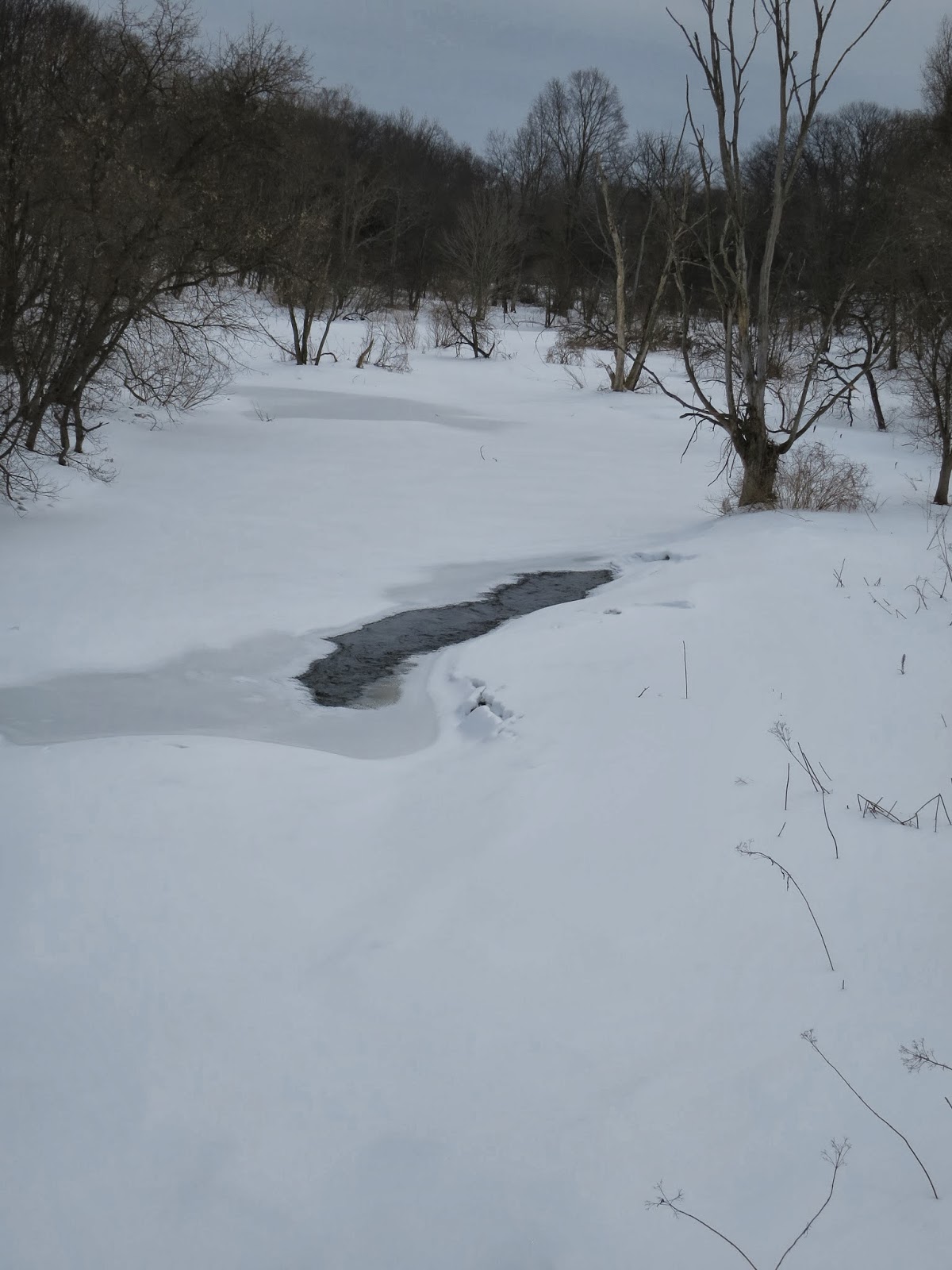
 Grindstone Creek from the NYS Rte. 3 bridge, March 5; gotta wait until ice-out to dip.

Back in the early 1960s, environmental pollution was rampant. Lake Erie was so dirty, authorities began drafting a death certificate. Lake Ontario was much deeper so it could swallow more stuff, but it was limping along on its last leg, too; fish populations were down to a fraction of what they used to be.

But there was hope.

By the middle of the decade, strict environmental laws were passed and enforced. Nature responded quickly, improving the water in the Lower Great Lakes to such a degree that fish numbers took off. Since it takes a while for game fish to grow to legal size, they were slow in coming around; but bait fish populations exploded.

That was good…and bad.

First the good: smelt reached such incredible numbers, guys dipping for them in the mouth of the Salmon River could fill 5-gallon buckets with their eyes closed. On skinny creeks like Deer and Little Sandy, conscientious anglers dipped gently, carefully to avoid crushing the smelt below the net’s rim or hurting those off to the sides.

The bad: alewives thrived, too. Boney and tasting like swamp mud, they were avoided by man. Unsightly winter kill lined beaches around the lake and the authorities decided to bring the lake back into balance by stocking voracious lake trout, king and coho salmon.

It worked. The salmonids swam around with mouths wide open, growing huge. Smelt numbers dropped incredibly. Dave Wood, owner of Woody’s Tackle on NYS Rte. 3, says dipping for them got so bad by the late 70s, he stopped going.

Fran Daher, over at North Syracuse’s Mickey’s Live Bait and Tackle concurs. “We used to sell dozens of dipping nets annually in the 70s, now we’re lucky if we sell a couple- three a year. Smelting has become a dead art,” he adds.

But it shouldn’t be. Word coming out of the western part of the lake has it that smelt numbers are rebounding. Fran Daher’s admission that he’s only selling a few nets a year suggests someone’s getting smelt around here. After all, argues cousin Staash, “these guys ain’t buying dip nets to catch butterflies; they’re getting smelt but they ain’t talking about it.”

Brian Weidel, of the USGS, Great Lakes Science Center, says” “From what I hear, spring 2011 was a good year for smelting, at least in the western NY tributaries. This MAY have been associated with slightly higher smelt abundance in the lake in 2010. Since then the population has dropped, which is usual for the species. Their abundance tends to naturally cycle.”

However, Weidel isn’t so quick to blame the drop in smelt populations on predators: “One thing that is important for anglers and the public to recognize is the overall productivity of the lake has decreased (which is a good thing) because of the Clean Water Act and other important legislation that reduced pollutants in the lake,” he claims.

Since smelt numbers are cyclical, there’s a good chance this year’s run will be a good one. The only way to find out if they’re running up Oswego County’s Lake Ontario tributaries again is to go for ‘em.

The mouth of any tributary will do. Here’s some with good public access:

- Little Salmon River, County Route 40 or Mexico Point Drive, Texas, NY.
- Grindstone Creek, Selkirk Shores State Park, NYS Rte. 3, a couple miles south of Port Ontario.
- Deer Creek, Deer Creek Marsh Wildlife Management Area, NYS Rte. 3, a couple miles north of Port Ontario     

Going for these guys isn’t rocket science; all you gotta do is stand on the bank, dip and scoop. Dip nets come with long handles so you don’t have to stretch too much.

Woody claims [global warming notwithstanding]“This winter is like the ones we used to have, so the smelt won’t be running until April.”

And that’s reassuring, suggesting the weather is like smelt…cyclical.

Dave Wood, owner of Woody's Tackle Shop in Port Ontario, holding a smelt dipping net.


Friday, February 21, 2014

Salmon River International Sport Fishing Museum


By
Spider Rybaak

Fred Betts with the cream of his collection.

Fishing museums are rare. Of the handful in existence, NY boasts two of the finest, both located on world famous trout streams. Oswego County has the most complete: The Salmon River International Sport Fishing Museum.

Truth be told, the Catskill Fly Fishing Center and Museum in Livingston Manor, on the banks of Willowemoc Creek, a tributary of the Beaverkill,  which flows into the East Branch of the Delaware River, is more famous. That’s mostly because it’s been around for about 20 years longer, is located in the Catskills, the cradle of American fly-fishing, and is only about 50 miles from New York City.

But the Salmon River is rapidly becoming the top salmonid stream in the world— it’s already the most famous in the Lower 48 states. Another, equally important factor that’ll propel the SRISFM into the front of the pack is its inclusiveness; it covers all aspects of fishing, everything from casting and spinning  reels, to trolling rods, eel spears, lures and trout creels.  

In fact, Fred Betts, a Central New Yorker who boasts one of the finest creel collections around, gave a lecture on their history last Sunday, February 16. He brought the cream of his collection to show the evolution of fishing baskets, and how each change benefited anglers.

Betts’ talk was part of the facility’s newest program, “Afternoon at the Museum.” An open house held every third Sunday of the month, the series will feature speakers on a litany of fishy subjects.
The next talk, given by Mike Riordan, is scheduled for 3:30 p.m. on March 15, and will cover the history of fishing line, from the braided horse hair lines of Ancient Rome to today’s super braids.

Riordan, president of the museum, says it’ll by open at 2 p.m., giving folks a little time to wander through the exciting displays before the speaker’s presentation, which will be given at 3:30 p.m.

But there’s more to the place than fishing equipment. The walls are plastered in fine art. Everything from fanciful Romantic era fishing scenes to realistic oils by greats like Maynard Reece is represented.

Run by volunteers, the hours of operation aren’t set in stone. However, the lobby contains loads of literature and is always open.

The museum is located at 3044 State Route 13, a few miles east of Pulaski. For more information, call 315-298-2213, visit www.salmonriverinternationalfishingmuseum.org. or www.facebook.com/pages/Salmon-River-International-Sport-Fishing-Museum/152643681444857

Old time fly wallet.

Fine art graces the museum's walls.

Ice fishing and eel spears.

Wednesday, January 15, 2014

Hit the North Shore’s Bars for a Grand Slam


By
Spider Rybaak

Dennis, Pittston, Pa, a guest of Anglers' Bay,
holding an  "eye" he took between Cleveland and Vienna Bars

Early last week, I was trolling along NY 49 for some juicy quotes and photos for my next book, “Fishing Oneida Lake” (Burford Books, Ithaca, NY, scheduled for release in autumn, 2014). A group of guys standing around in the parking lot of David C. Webb Memorial Park at Taft Bay caught my eye. They looked too burly, hairy and ugly to be trying out for the Olympic figure skating team. So I figured they must be ice fishermen.

I approached them slowly. When you look like me, you walk gently so’s not to scare anyone.

“How were they hittin’, fellas,” I asked.

All but the hairiest remained silent. 

“I got my limit of walleyes,” he answered “but came up a little short of a Grand Slam.”

“Say what?” 

“I was trying to hit an Oneida Lake Grand Slam,” he answered, looking at me askance, like I was really dumb. “You know, a limit of walleyes and a limit of perch,” he continued, with great patience and understanding.

“Of course I know what you mean,” I protested.

I mentioned what I was doing and Craig Storms immediately volunteered to take me ice-fishing, to show me “How to pick up walleyes and perch on the North Shore’s bars.”

Surprisingly, all the other guys started opening up, too. True to the tradition of camaraderie Oneida Lake ice-fishermen are known for, they all pitched in with stories of their day. Everyone agreed to having a ball, even though the day was the coldest so far this winter.

An aspiring guide, Craig volunteered to take me fishing to show me how it’s done. We agreed to meet 6:30 a.m., on January 8, at Apps Bait, tucked into the northeastern corner of the New York State Department of Environmental Conservation’s Cleveland Docks Public Fishing Access Site. 

We ended up heading out at Anglers Bay, just west of Vienna Bar, because we were “walkers” (the term mechanized icers use to describe their pedestrian counterparts), and that’s where the steep drop-off into the lake’s deepest area comes closest to shore. About a quarter-mile out, Craig pulls out his smart phone, goes to the Navionics App and starts looking for the 20-foot depth on the drop-off, more specifically, “a bend in the structure.”

Craig likes to fish the bends because they attract more fish. When he finds one, he digs a hole and lowers his MarCum LX5 sonar into it. 

“The bottom’s carpeted in fish,” he announces with the excitement of a man who just had the world’s most beautiful woman invite him over for a chat. 

He digs a couple more holes. Setting up his Otter Double--a two-man shelter--he pulls out a jigging rod loaded with a Slender Spoon, hooks on the top half of a pinched buckeye (he actually lets his left thumbnail grow all winter so he can pinch bait--and irritate his wife). Dropping it to bottom, he lifts it a couple inches and starts jigging pretty forcefully, in 4- to 6- inch sweeps, punctuated every 6th time or so by lifting it to arms-length.

I tie-on a Northland Buck-Shot Rattle Spoon, bait it, and follow his lead.

After about 30 minutes, our arms are twitching … Nothing.

We move about 10 yards north, into 28 feet of water. Craig drops his bait. A line separates from bottom and rises toward it (the lake floor, fish and the lure all appear as short horizontal lines on the graph).

“Seeing a separation head for your bait is very exciting. When it merges with the bait, the temptation to set the hook can be overwhelming. But don’t do it!” he says, with a look as serious as cancer. “Wait until you feel the hit before setting the hook,” he advises.

The fish hits. Barely legal, we agree it’s still a nice one. Breaking out in a smile, the master says “I can’t remember ever seeing a bad one, come to think of it.”

Dropping his lure back down, Craig gets another hit almost immediately, but loses it.

Things are starting to smoke, I think.

I get a hit without seeing a separation. The fish sped in out of the sonar’s range. It’s a shorty, too.

A couple minutes later, I watch a separation rise to my lure. Then it goes down again. Then it comes up. 

“Steady…steady,” Craig instructs.

After playing a mind game for a couple minutes, the fish hits. The fight is a good one. We’re using 4 lb. test line so it takes a couple minutes. But it appears, dodging maddeningly in and out of view. Finally, it goes vertical and Craig pulls it out of the hole.

After high-fiving, and taking hero shots, I decide to lay the thing down near the graph to get a photo of our set up.

Craig warns me not to…But no, I don’t listen. Somehow, that big, fat walleye managed to stick her head back into the hole. Craig grabbed her, but she slipped through his fingers like an exciting dream when you wake up. 

The Cleveland, Phillips and Vienna Bars boast drop-offs where walleyes and perch gather in winter, and slowly move west. Find the magic depth and you’ll stand a good chance of pulling fish dinners out of the hole until your arms hurt.

Still, Craig reminds everyone: “Grand slams don’t happen very often; only about 1 in 25 times out. But that’s what makes ‘em so worth it.”

You can access the best walleye spots from the Cleveland Docks Fishing Access site at the sharp bend on the hamlet’s east side, and at the little park at the end of Mill Street in the village of Constantia. 
Craig landing a good one.

One of our shorties

Craig on Ice

Wednesday, January 8, 2014

Icing Hawg Perch

By Spider Rybaak
Burt with Billington Bay ice hawg.
Oneida Lake is one of the most productive lakes in the country. No matter what warm-water species you have swimming in and out of your imagination all day long, the place is full of ‘em.

Still, yellow perch ranks as top dog, year-round. And lately, they’re bigger than ever and more plentiful than at any time in recent memory. In fact, 2014’s first weekend saw colorful shanty cities sprout all over the lake, and the perch spread on the ice outnumbered all other species by about 10 to 1.

So when Burt Menninger called, saying: “Sorry to call you on such short notice Spider, but there’s a good perch bite on right now.  My contacts caught their limits yesterday and they’re well on their way to matching that today. I’m leaving within the hour. Wanna come?”

His words launched me into a flurry of activity that had the whole house (four cats and my sweetheart) running for cover.  What can I say?  My stuff is stashed all over the house and I had the opportunity to go ice-fishing with one of the lake’s living legends; nothing was gonna stand in my way.

You see, Burt has lived on the lake for almost 60 years. In that time, he’s fished every inch of the place. In fact, his reputation for catching walleye and perch was so widespread in the last century, a popular refrain around the lake was “If Burt ain’t catching fish, no one is.” And while 75 years of life have slowed him down a bit lately, he still knows his stuff.

Before long, we were standing on the ice in the fish-rich southeastern corner of Oswego County’s territorial waters. Cazenovia’s Michael Sattler (an old friend of Burt’s) and son Hunter did their reconnaissance well and a batch of perch was sprawled out in front of their ice shanty like a Persian rug.

We stood on ice 11 inches thick, over 18 to 20 feet of water. Burt started catching perch, including monstrous 13-inch hawgs, on hardware tipped with a perch eye. Mike and Hunter were doing equally well on buckeyes. I started nailing them on flatheads. Jim Evans, another buddy of Burt’s who was already out there when we arrived, was running around tending tip-ups loaded with buckeyes.

At one point, Jim’s action was so fast and furious, he called Hunter over: “There’s a load of them down here. Fish one of these holes before they move.

They moved, eventually, over to my hole, then over to Burt’s, followed by Jim’s tip-ups, one after the other…round and round.

So dig a couple holes in a 50-foot radius and when they stop hitting in one, do “the ice fisherman’s troll:” move to the next.

Rick Sorensen, over at App’s Landing, a bait and tackle shop at the Cleveland Docks, says the perch are scattered all over the lake, and any spot can produce right now.

The New York State Department of Environmental Conservation’s Web site offers an informative feature on ice fishing, covering everything from clothing to tackle and techniques. Check it out at www.dec.ny.gov/outdoor/7733.html. If you’re new to ice fishing and don’t have time to read the above article, the most important thing you should know is the power of ice. While many veterans won’t go out unless the lake is paved in at least 3 inches, the DEC considers 2/3 of that safe.

Below is a short list of DEC’s recommendations drawn from the article:
Ice Thickness               Permissible Load
2 inches                       one person on foot
3 inches                       group in single file
7.5 inches                    one car
10 inches                     light truck (2.5 tons)
In addition, stay away from open water and tributary mouths.


Hunter's bucket running over.

Michael next to his rug of perch.

Jim with three in five minutes.

Monday, December 23, 2013

Ice Fishing before Christmas

By Spider Rybaak
A couple happy ice fishermen.

The seriously cold weather we’ve had over the past couple of weeks put a hurtin’ on a lot of folk’s faith in global warming. Indeed, cousin Staash was about to use the pages of his autographed copy of Al Gore’s “Earth in the Balance” to fire up his pot-bellied stove. Saturday’s unseasonably high temperatures stopped him in his tracks and he returned it to its place of honor on his book shelf (that’s not so honorable considering he’s only got one book).

The extreme cold followed by the warm spell created a situation you don’t find around these parts very often: “Ice fishing before Christmas,” in the words of Jim Denson. He spent the better part of Sunday morning on Oneida Lake’s Big Bay with sons Kyle and Ryan.

Their efforts were rewarded with a mess of bluegill and pumpkinseeds, punctuated with several hawg crappies. All were caught on tiny ice jigs tipped with spikes (a gentleman’s word for maggots).

Ryan claimed the ice was 3 inches thick, safe enough, according to the DEC’s Web site (http://www.dec.ny.gov/outdoor/7733.html), to support groups of ice fishermen lined up in single file.

They weren’t the only ones courageous enough to brave the early ice. Indeed, a larger number was out there on Saturday. But the following day’s warmer weather discouraged a lot from returning. By Sunday afternoon, the number of anglers was down to about a dozen, but for everyone leaving, new guys were coming out.

Getting out on the bay from DEC’s Toad Harbor Fishing access site on Shaw Drive (at the end of Toad Harbor Road, off NY 49, West Monroe), was too dangerous over the weekend because of soft spots. Most guys paid to park in the private lots of commercial operations like Big Bay Marina, on Camic Road (off CR 37), and other  businesses in the neighborhood, and skirted the ice looking for high spots before heading out.

If the warm spell continues, the ice will probably be too dangerous by Tuesday.  Be careful.


Jim Denson (center) and sons Kyle (left) and Ryan
with Sunday's catch.

Sunday afternoon on Big Bay.

Tuesday, December 10, 2013

Holiday Browns and Chromers


By Spider Rybaak


Centerpinning at the West River Walk's last stairs, upstream of the powerhouse.

December is the best month for taking trout from the bank in the city of Oswego.

Draining 5,100 square miles, including the Finger Lakes and Oneida Lake, the river running through town carries a lot of water, an average of 6,700 cubic feet per second, according to the United States Geological Survey. Late autumn storms can raise the stream’s temperature and double its flow. Driven deep into Lake Ontario, the plume’s relatively warm current draws fish to the friendly rapids in downtown Oswego.

Last Friday water levels in the city reached 16,000 cfs, a level way too high to fish effectively from the high wall downstream of the power house. And Motel Row? Forget it, too much water to cover from shore.

By Sunday, the flow dropped to 13,000 cfs, just right for taking it to the bank.

A couple guys wading along the wall between the dam and the hydro plant scored browns and rainbows averaging 7 pounds each. Both were float-fishing with centerpin equipment. One used a bead, the other an egg sac.

Fishing from a drift boat was even better. Three guys running the rapids off Motel Row landed over a dozen steelies and browns. They were float-fishing beads with centerpin equipment.

“Center-pinning is the best way to catch steelhead,” boasted one.

Conditions were exactly what they should be in December. Surprisingly, there were very few anglers out. And it wasn’t even that cold.

Don’t be intimidated by the snow and ice. Oh, sure, you can see your breath, and getting your hands wet guarantees cold fingers. But dressing in layers and carrying a towel will keep you toasty.

Indeed, the hits alone are enough to beat the cold.

The rest of December promises more dynamite, run-off-triggered action.

January will turn the rain into ice and snow, cooling any thaw streaming over it. Oh, the fish will still bite, but not as eagerly on most days; sunny days can spur hot and furious action, however.

Anglers must wear personal flotation devices to fish the river upstream of the power house. Since the utility owns the property, it has the right to make the rules and anyone not complying with the dress code can be evicted.
View from the West River Walk upstream of the power dam.

Drift boat at Varick Dam.

A float fisherman working the tailrace at the foot of the West River Walk's high wall
while a drift boat works the Dug Out on the other side.

Jon, Fair Haven, NY, holding a decent steelie taken on a bead off Motel Row.

J.J.Elmer with a big brown he took on a bead off Motel Row.


Thursday, November 14, 2013

Steelheading without the Leaves


By Spider Rybaak

Nice hen steelie taken on a wooly bugger.

One of the most frustrating things about early steelhead fishing is putting up with fallen leaves; they’re floating on the surface, suspended in the water, carpeting the floor. Come November, they can be so thick, it’s like fishing in a kaleidoscope.

To the uninitiated, that doesn’t sound so bad. After all, kaleidoscopes are entertaining, giving idle hands something to turn, bored eyes symmetrical patterns to feast on.

But fishing is serious business, and the Salmon River ain’t a romper room. If you have to spend half your time clearing leaves off the hook, the other half dodging leaves while trying to present a bait naturally, especially when you’re watching fish shooting the rapids, it can amount to an exercise in frustration, and that can make you grumpy.

So I went up to the Salmon River on Veterans Day to swing some streamers through the rapids with my Spey-casting equipment, conditions permitting.

Much to my delight, the conditions are super. Oh, a few leaves are still blowing into the water. But they’re so few, I only hooked a couple in the hour I fished.

Best of all, I hooked a steelhead weighing about 5 pounds, too, on a chartreuse wooly bugger I swung through the rapids behind a 10-foot Rio Spey VersiLeader, with a sink rate of 2.6 inches per second.

And I wasn’t the only lucky one on the river. A couple guys hooked steelies on beads they were float-fishing with centerpins in the Long Bridge Hole. Another took one in the rapids on an estaz egg he was chuck-n-ducking in the bottleneck, at the curve, about 100 yards upstream.

I was Spey-casting in the pool between the Long Bridge pool and Village pool, a relatively shallow spot with heavy rapids; two features that discourage normal anglers--which normally means there’s fish and room.

You see, most guys fishing the Salmon River think like humans, and concentrate on deep, slow moving pools.

I like to think like a fish. Right now, the water temperature is in the high 40s, and trout are still very active. Since they’re as lazy as I am, they hang out in fast water (they’re streamlined, the current goes effortlessly around them) where eggs float down to them and all they gotta do is open their mouths and suck ‘em in. And if a streamer swims by…well, that’s icing on the cake.

Steelhead are running the river right now in search of easy pickings; which means they can be anywhere…and they’re hungry.